

Which Toyota Model Gets the Best MPG for Long Daily Commutes?
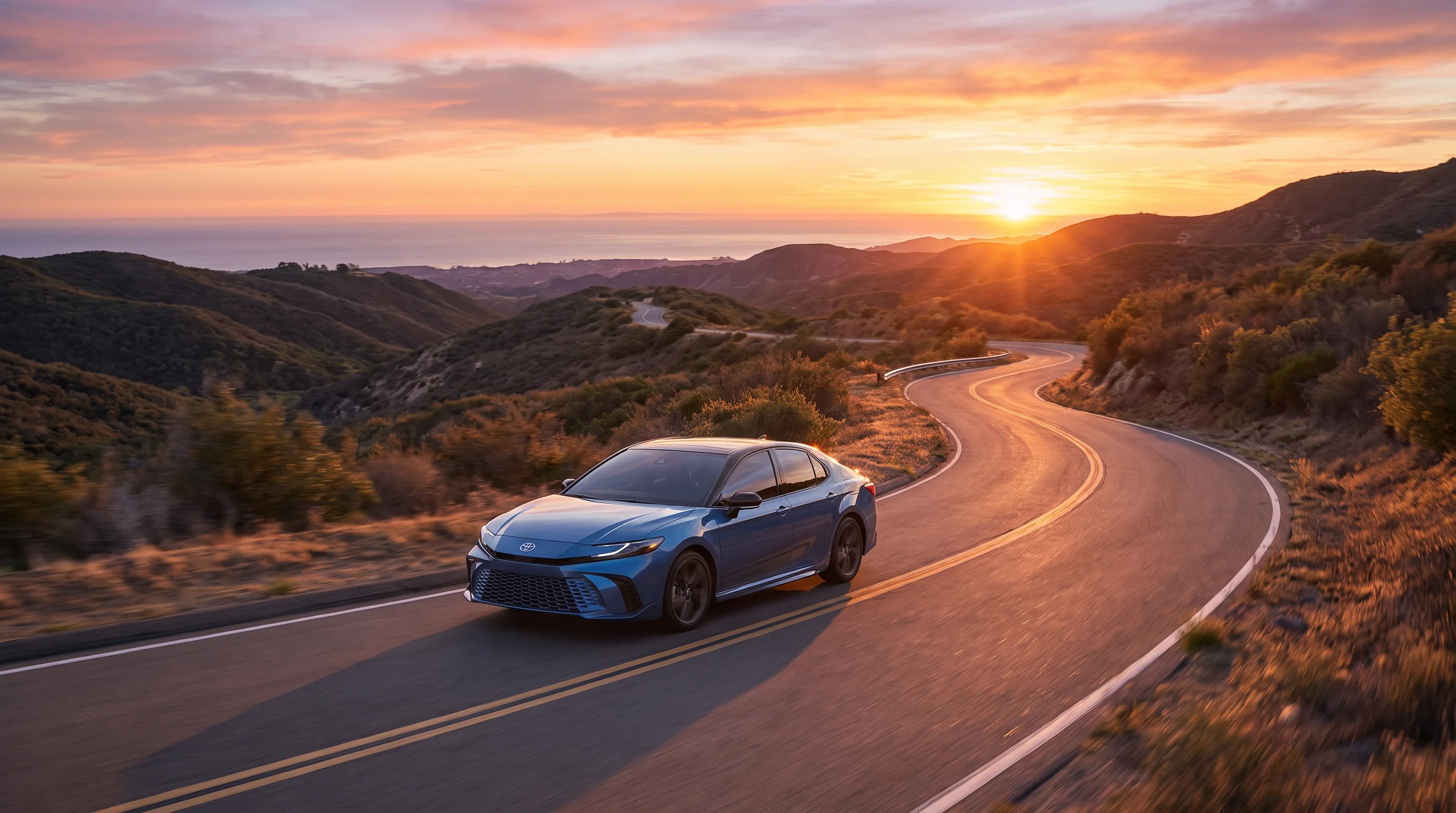
The 2026 Toyota Prius LE front-wheel-drive model gets the best fuel economy in Toyota’s lineup. It delivers an EPA-estimated 57 mpg city / 56 mpg highway / 57 mpg combined. For commuters who need midsize cabin dimensions, the 2026 Toyota Camry Hybrid LE delivers an EPA-estimated 53 mpg city / 50 mpg highway / 51 mpg combined. The compact 2026 Toyota Corolla Hybrid LE achieves an EPA-estimated 53 mpg city / 46 mpg highway / 50 mpg combined.
EPA-estimated fuel economy figures are for comparison purposes only. Your actual mileage will vary depending on driving conditions, how you drive and maintain your vehicle, battery age/condition, and other factors.
Choosing the right hybrid for a long daily drive means balancing maximum efficiency against interior space. The 2026 Toyota Prius LE is the efficiency leader. It pairs a 2.0-liter four-cylinder engine with an electronically controlled continuously variable transmission (eCVT). Its aerodynamic profile reduces wind resistance at highway speeds. The result is a combined driving range of over 640 miles on a single 11.3-gallon tank of regular gasoline.
Drivers who want more passenger space on extended freeway trips can step up to the 2026 Toyota Camry Hybrid LE. It offers midsize comfort while keeping compact-car running costs. Every 2026 Camry uses Toyota’s fifth-generation hybrid system. That system generates 225 net combined horsepower in front-wheel drive and 232 horsepower with available Electronic On-Demand All-Wheel Drive.
Commuters looking for the most accessible entry point to hybrid efficiency can opt for the 2026 Toyota Corolla Hybrid LE. Per Toyota’s model specifications, it pairs a 1.8-liter four-cylinder engine with an eCVT for 138 net combined horsepower. Toyota Safety Sense 3.0 driver-assist technology is standard.
Toyota Prius Fuel Economy: Trim Differences and Range
Official EPA ratings place the entry-level Prius LE FWD at an EPA-estimated 57 mpg combined. Figures vary by trim and drivetrain. The LE rides on 17-inch wheels and holds the lineup’s peak ratings. The XLE, Nightshade Edition and Limited ride on 19-inch alloy wheels and add convenience features. Those trims are rated at an EPA-estimated 52 mpg combined in front-wheel drive. With Electronic On-Demand All-Wheel Drive, they are rated at 49 mpg combined.
On Edmunds’ real-world test route, a Prius Limited FWD returned 52.3 mpg. That effectively matches its EPA-estimated 52 mpg combined rating.
Commuters weighing the LE against higher trims usually ask about that efficiency trade-off before they look at interior tech. The step up buys cabin upgrades. Those include heated front seats and synthetic leather upholstery. A 12.3-inch Toyota Audio Multimedia touchscreen is available on XLE and Nightshade Edition, and standard on Limited.
Prius Fuel Economy by Trim and Drivetrain
| Prius Trim & Drivetrain | EPA-Estimated City | EPA-Estimated Highway | EPA-Estimated Combined |
|---|---|---|---|
| LE FWD | 57 mpg | 56 mpg | 57 mpg |
| LE AWD | 53 mpg | 54 mpg | 54 mpg |
| XLE / Nightshade Edition / Limited FWD | 52 mpg | 52 mpg | 52 mpg |
| XLE / Nightshade Edition / Limited AWD | 49 mpg | 50 mpg | 49 mpg |
EPA-estimated fuel economy figures are for comparison purposes only. Your actual mileage will vary depending on driving conditions, how you drive and maintain your vehicle, battery age/condition, and other factors.
Are Hybrid Toyotas Reliable Enough for Very High Annual Mileage?
Toyota hybrids have a strong track record over high annual mileage. Toyota’s eCVT coordinates power continuously between the gasoline engine and the electric motor-generators rather than stepping through fixed gears. The hybrid system’s regenerative braking also handles much of the initial deceleration, which extends the service life of brake pads and rotors.
Hybrid Warranty Coverage
| Coverage | What It Covers | Term |
|---|---|---|
| Hybrid battery | High-voltage battery, model year 2020 and newer | 10 years from date of first use or 150,000 miles, whichever comes first |
| Hybrid-related components | Battery control module, hybrid control module, inverter with converter | 8 years or 100,000 miles, whichever comes first |
Coverage terms above are published by Toyota Owners.
This information is provided for general educational purposes only and does not constitute legal advice. Warranty coverage depends on the specific terms of your vehicle’s warranty agreement. Consult your owner’s manual or a qualified legal professional for guidance on your individual situation.
Maintenance Intervals for High-Mileage Drivers
High-mileage commuters benefit from predictable maintenance intervals. Toyota’s schedule calls for a service visit every 5,000 miles or six months. That visit covers tire rotation and inspections. Under normal driving conditions, the full synthetic oil and filter change falls on a 10,000-mile or 12-month interval.
How Much Fuel Does a Toyota Hybrid Actually Save?
Driving 15,000 miles a year, a 2026 Toyota Camry Hybrid LE uses about 206 fewer gallons of fuel than a 30-mpg gas sedan. On a daily 30-mile commute along the I-15 corridor, that gap compounds over a five-year ownership cycle. Across 75,000 miles, a 30-mpg sedan burns 2,500 gallons. The Camry Hybrid LE needs roughly 1,470 gallons for the same distance. That is a reduction of about 1,030 gallons.
For a fuller picture of what hybrid ownership actually costs in Southern California, including maintenance and battery considerations, see our hybrid ownership guide.
Fuel Used per Year and over Five Years
| Vehicle | EPA-Estimated Combined MPG | Cabin | Gallons Used per Year (15,000 mi) | Gallons Used over 5 Years (75,000 mi) |
|---|---|---|---|---|
| Standard 30-mpg gas sedan | 30 mpg | Midsize sedan | 500 gal | 2,500 gal |
| 2026 Toyota Corolla Hybrid LE | 50 mpg | Compact sedan | 300 gal | 1,500 gal |
| 2026 Toyota Camry Hybrid LE | 51 mpg | Midsize sedan | 294 gal | 1,470 gal |
| 2026 Toyota Prius LE FWD | 57 mpg | Compact hatchback | 263 gal | 1,315 gal |
EPA-estimated fuel economy figures are for comparison purposes only. Your actual mileage will vary depending on driving conditions, how you drive and maintain your vehicle, battery age/condition, and other factors.
Regenerative braking also captures energy during deceleration to recharge the lithium-ion battery. That reduces heat and friction on the brake components.
Which Toyota Hybrids Offer the Best Comfort and Low Running Costs for Murrieta Commuters?
For suburban commuters, two models balance comfort, cabin technology and running costs best. Those are the 2026 Toyota Camry Hybrid LE and the 2026 Toyota Corolla Hybrid LE.
Commuters covering the rolling hills and suburban arterial roads around Murrieta get midsize room in the Camry Hybrid LE. It includes dual-zone automatic climate control with rear-seat vents, wireless Apple CarPlay and Android Auto, and an 8-inch touchscreen. Its 2.5-liter four-cylinder hybrid powertrain delivers confident passing power on highway ramps without giving up its EPA-estimated 51 mpg combined rating.
Drivers who want maximum efficiency in a compact footprint should look at the Corolla Hybrid LE. It delivers an EPA-estimated 50 mpg combined with 13.1 cubic feet of trunk space and standard Toyota Safety Sense 3.0.
EPA-estimated fuel economy figures are for comparison purposes only. Your actual mileage will vary depending on driving conditions, how you drive and maintain your vehicle, battery age/condition, and other factors.
Toyota Corolla Hybrid LE
Nimble handling for tight parking, with 13.1 cubic feet of trunk space.
Toyota Camry Hybrid LE
Midsize interior dimensions and 225 net combined horsepower.
Toyota Prius LE
Hatchback utility with 23.8 cubic feet of cargo space behind the second row.
How Toyota Safety Sense Helps Reduce Commute Fatigue
Standard Toyota Safety Sense 3.0 helps reduce commuter fatigue. Its driver-assist features adjust speed, support lane centering and monitor surrounding traffic during heavy freeway driving.
Toyota equips these hybrid commuter sedans with Full-Speed Range Dynamic Radar Cruise Control. It uses front-mounted radar and camera sensors to hold a pre-set distance from the vehicle ahead. When traffic slows, the system decelerates on its own and can come to a complete stop. It resumes the set speed once traffic clears. Lane Tracing Assist works alongside it, using lane markings and the preceding vehicle to help keep the car centered.
Feature descriptions below follow Toyota’s Safety Sense documentation.
Pre-Collision System with Pedestrian Detection
Scans for vehicles, pedestrians, bicyclists and motorcyclists. Provides forward-collision alerts and automatic emergency braking.
Lane Departure Alert with Steering Assist
Alerts drivers to inadvertent lane drift above 32 mph and applies gentle corrective steering.
Proactive Driving Assist
Provides subtle braking into curves and gentle distance control behind preceding traffic.
Road Sign Assist
Displays speed limit, stop and yield signs on the Multi-Information Display.
Automatic High Beams
Toggles between high and low beams based on oncoming and preceding traffic.
Driver-assistance and advanced safety systems are supplemental aids and are not substitutes for safe and attentive driving. Availability, operation, and effectiveness vary by trim and equipment and depend on factors including road, weather, traffic, and vehicle condition. Always keep your hands on the wheel and your eyes on the road. See your owner’s manual for system limitations and details.
Common Questions About Buying a Toyota Hybrid for Daily Commutes
Does a standard Toyota hybrid require a 240-volt home charging station?
No. Standard hybrid models like the Toyota Prius, Camry Hybrid and Corolla Hybrid do not require plug-in charging. The hybrid battery recharges automatically through engine generation and regenerative braking while driving. You simply fill the fuel tank with regular gasoline.
Are maintenance costs higher on a Toyota hybrid than a traditional gas sedan?
Routine maintenance costs are comparable to conventional gas sedans. Hybrid models share basic maintenance items like engine oil, air filters and coolant. Regenerative braking also reduces wear on brake pads and rotors.
What warranty coverage protects the hybrid battery on a new Toyota?
Every new 2026 Toyota hybrid is backed by a hybrid battery warranty covering 10 years from the date of first use or 150,000 miles, whichever comes first. Hybrid-related components, including the hybrid control module and inverter with converter, are covered for 8 years or 100,000 miles.
This information is provided for general educational purposes only and does not constitute legal advice. Warranty coverage depends on the specific terms of your vehicle’s warranty agreement. Consult your owner’s manual or a qualified legal professional for guidance on your individual situation.
Is electronic all-wheel drive available on Toyota hybrid commuter sedans?
Yes, with some limits by model. Electronic On-Demand All-Wheel Drive is available across the 2026 Prius lineup and on every 2026 Camry trim. On the 2026 Corolla Hybrid, it is available on the LE and SE grades. The system uses an independent electric motor on the rear axle to send power to the rear wheels when front-wheel slip is detected, without a mechanical driveshaft.
Start Your Hybrid Commuter Strategy at Temecula Valley Toyota
Choosing the right hybrid commuter sedan comes down to your daily mileage, space requirements and operating budget. You may prioritize the efficiency of the Toyota Prius, the midsize comfort of the Toyota Camry Hybrid, or the value of the Toyota Corolla Hybrid. All three are backed by the same hybrid warranty coverage.
Our team at Temecula Valley Toyota can walk you through vehicle specifications and demonstrate Toyota Safety Sense 3.0 features on a test drive. Visit our showroom at 26631 Ynez Road or call our sales team at (951) 319-7911.
Disclaimers
EPA-estimated fuel economy figures are for comparison purposes only. Your actual mileage will vary depending on driving conditions, how you drive and maintain your vehicle, battery age/condition, and other factors.
This information is provided for general educational purposes only and does not constitute legal advice. Warranty coverage depends on the specific terms of your vehicle’s warranty agreement. Consult your owner’s manual or a qualified legal professional for guidance on your individual situation.
Driver-assistance and advanced safety systems are supplemental aids and are not substitutes for safe and attentive driving. Availability, operation, and effectiveness vary by trim and equipment and depend on factors including road, weather, traffic, and vehicle condition. Always keep your hands on the wheel and your eyes on the road. See your owner’s manual for system limitations and details.
0 comment(s) so far on Which Toyota Model Gets the Best MPG for Long Daily Commutes?