

2027 Toyota Prius Plug-in Hybrid Electric Range and Charging Guide
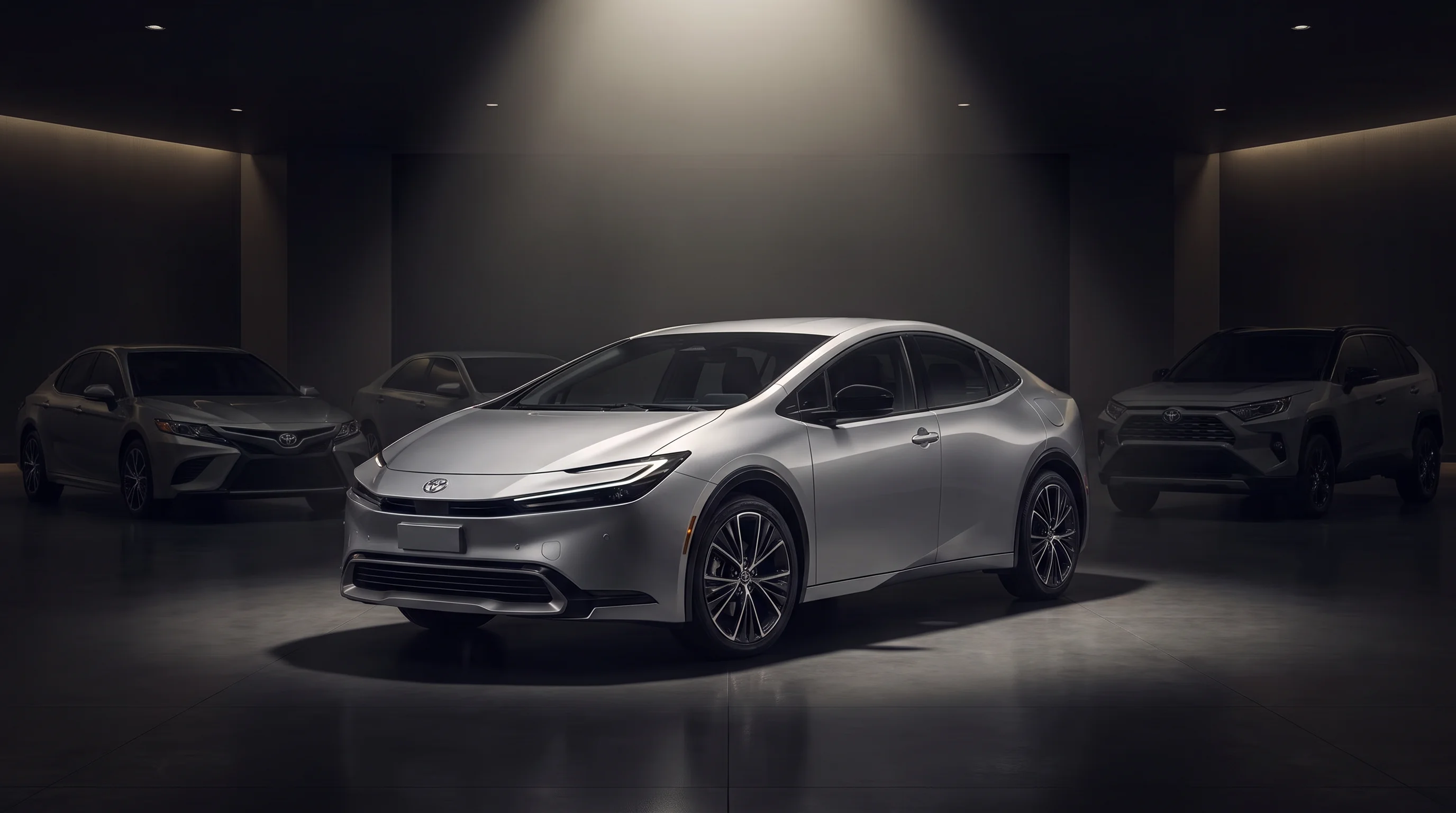
The 2027 Toyota Prius Plug-in Hybrid delivers an EPA-estimated all-electric driving range of up to 44 miles on the SE grade. The XSE, Nightshade, and XSE Premium grades are rated at up to 39 miles. A 13.6-kWh lithium-ion battery lets drivers cover most daily errands without using gasoline. Once the charge runs down, the 2.0-liter Atkinson-cycle four-cylinder engine takes over seamlessly.
Toyota’s fifth-generation Hybrid System pairs that engine with electric motor-generators. Together they produce 220 net-combined horsepower. Toyota lists an EPA-estimated 0-60 mph time of 6.6 seconds in its published 2027 Prius Plug-in Hybrid specifications. That makes this the quickest Prius the brand has built.
In pure EV mode, the vehicle runs on electric power alone at speeds up to 84 mph. When the battery reaches its minimum threshold, the system switches to hybrid operation on its own. A top-mounted Multi-Information Display with a 7-inch LCD screen tracks energy flow, battery charge percentage, and electric efficiency.
Powertrain and electric range at a glance
| Specification | 2027 Prius Plug-in Hybrid |
|---|---|
| Hybrid system | Toyota fifth-generation Hybrid System |
| Engine | 2.0-liter Atkinson-cycle four-cylinder |
| Net combined horsepower | 220 hp |
| 0-60 mph | 6.6 seconds, EPA-estimated |
| Battery | 13.6-kWh lithium-ion |
| EPA-estimated electric range | Up to 44 miles (SE); up to 39 miles (XSE, Nightshade, XSE Premium) |
| Maximum speed in EV Mode | 84 mph |
| Drivetrain | Front-wheel drive, all grades |
| Onboard charger | 3.5 kW |
| Fuel tank capacity | 10.6 gallons |
What is the electric range and starting price for each 2027 Prius Plug-in Hybrid grade?
Toyota offers the 2027 Prius Plug-in Hybrid in four grades. Total Suggested Retail Prices run from $35,275 TSRP for the SE to $41,970 TSRP for the XSE Premium. Electric range varies by grade, driven largely by wheel and tire sizing. The plug-in lineup sits above the conventional Prius hybrid. Each tier adds battery capability and updated cabin technology.
Total Suggested Retail Price (TSRP) for new vehicles includes manufacturer and distributor options and delivery, processing, and handling fees, which are subject to change at any time. TSRP excludes taxes, title, license, dealer-installed options, accessories, fees and charges. TSRP is not the dealer advertised price. Dealer prices will vary. The dealer sets the final price.
For 2027, Toyota made Dual-Zone HVAC standard across all four grades. The driver and front passenger can now set their own cabin temperatures. The color palette also gains Inked, a new black exterior finish offered at no extra cost.
| Grade | TSRP | EPA-Estimated EV Range | EPA-Estimated Combined MPG | Notable Standard Equipment |
|---|---|---|---|---|
| SE | $35,275 TSRP | Up to 44 miles | 51 MPG | 17-in. alloy wheels, fabric-trimmed seats, 8.0-in. Toyota Audio Multimedia display, six USB-C ports, Toyota Safety Sense 3.0 |
| XSE | $38,525 TSRP | Up to 39 miles | 47 MPG | 19-in. alloy wheels, SofTex-trimmed seats, 8-way power driver’s seat, heated front seats, Qi wireless charging, Parking Assist with Automatic Braking |
| Nightshade | $39,295 TSRP | Up to 39 miles | 47 MPG | 19-in. black alloy wheels, black bumper trim and badging, black SofTex seats with gray stitching, carbon-fiber dashboard trim |
| XSE Premium | $41,970 TSRP | Up to 39 miles | 47 MPG | 12.3-in. touchscreen, 8-speaker JBL Premium Audio, ventilated front seats, fixed glass roof, power liftback |
Total Suggested Retail Price (TSRP) for new vehicles includes manufacturer and distributor options and delivery, processing, and handling fees, which are subject to change at any time. TSRP excludes taxes, title, license, dealer-installed options, accessories, fees and charges. TSRP is not the dealer advertised price. Dealer prices will vary. The dealer sets the final price.
EPA-estimated fuel economy figures are for comparison purposes only. Your actual mileage will vary depending on driving conditions, how you drive and maintain your vehicle, battery age/condition, and other factors.
Driver-assistance and advanced safety systems are supplemental aids and are not substitutes for safe and attentive driving. Availability, operation, and effectiveness vary by trim and equipment and depend on factors including road, weather, traffic, and vehicle condition. Always keep your hands on the wheel and your eyes on the road. See your owner’s manual for system limitations and details.
Why the SE earns the highest electric range
The SE is the efficiency leader of the lineup. Its 17-inch wheels wear taller tire sidewalls than the 19-inch wheels used on the upper grades. That smaller rolling diameter is why the SE earns the highest electric range and fuel economy ratings in the family.
At the top of the range, the XSE Premium adds an available 185-watt solar roof. It charges the drive battery while the vehicle is parked. Availability is limited.
Still weighing electrified options? Read how a hybrid compares with a plug-in hybrid before you narrow the list.
How does onboard charging capacity affect Level 1 and Level 2 charge times?
The 2027 Prius Plug-in Hybrid uses a 3.5-kW onboard charger. A depleted battery reaches full charge in approximately 4 hours on a 240-volt Level 2 station. On a standard 120-volt household outlet, the same charge takes approximately 11 hours.
Level 1 Charging
Power source: Standard 120-volt household outlet
Equipment needed: Included dual-voltage cable, no installation
Full charge time: Approximately 11 hours
Best suited to: Overnight charging on a regular schedule
Level 2 Charging
Power source: 240-volt charging station
Equipment needed: 240-volt circuit and station installation
Full charge time: Approximately 4 hours
Best suited to: Faster turnaround between daytime trips
Toyota includes a dual-voltage charging cable with every Prius Plug-in Hybrid. No special equipment is needed to start charging at home. If you park overnight, an 11-hour window restores full electric range before the morning commute. A 240-volt station shortens that turnaround. It suits households that need to recharge between trips on the same day.
Does the Prius Plug-in Hybrid support DC fast charging?
No. The Prius Plug-in Hybrid charges on AC only and does not accept DC fast charging. Home and workplace charging are the intended use case, and the battery is sized accordingly.
If a Level 2 setup is on your list, our guide to preparing your home for EV charging walks through what the installation involves.
What factors can reduce real-world electric range on commutes?
Several things cut into real-world electric range on the 2027 Prius Plug-in Hybrid. The EPA rates the SE at up to 44 miles under test conditions. Daily driving variables move actual consumption from the 13.6-kWh battery in either direction.
| Factor | Effect on electric range |
|---|---|
| Sustained speeds above 65 mph | Aerodynamic drag increases, drawing more current than stop-and-go city driving |
| Steep elevation gain | Requires more torque output than flat suburban routes |
| Heavy climate control use | Air conditioning on hot afternoons or cabin heat on cold mornings pulls power directly from the battery |
| Aggressive acceleration | Draws more energy from the battery than smooth, gradual acceleration |
| Added cargo weight | Shortens daily zero-emission distance; removing unnecessary weight helps extend it |
EPA-estimated fuel economy figures are for comparison purposes only. Your actual mileage will vary depending on driving conditions, how you drive and maintain your vehicle, battery age/condition, and other factors.
Temperature extremes affect both battery efficiency and auxiliary load. Using the seat heaters instead of full cabin heating helps preserve electric miles.
Choosing the right drive mode
EV Mode
Uses the battery only when sufficient charge is available, operating like a battery-electric vehicle without support from the gasoline engine.
Auto EV/HV Mode
Primarily uses battery power, switching to hybrid operation when more power is needed, such as on steep grades or at higher speeds.
Hybrid Mode
Automatically switches between the gasoline engine and electric motors, combining engine drive force with electric power from the hybrid battery.
Regenerative braking recovers energy during deceleration and routes it back into the battery. Proper tire inflation and smooth acceleration habits also help extend daily zero-emission distance.
What fuel economy and fuel tank capacity does the 2027 Prius Plug-in Hybrid deliver?
The 2027 Prius Plug-in Hybrid carries a 10.6-gallon fuel tank. Once the EV battery depletes, the vehicle shifts to hybrid operation. The SE then returns an EPA-estimated 51 MPG combined. The XSE, Nightshade, and XSE Premium grades return an EPA-estimated 47 MPG combined and 114 MPGe combined.
EPA-estimated fuel economy figures are for comparison purposes only. Your actual mileage will vary depending on driving conditions, how you drive and maintain your vehicle, battery age/condition, and other factors.
What that means for a Temecula-area commute
That gas-and-electric pairing makes the liftback versatile across trip lengths. Commuters running I-15 between Murrieta and Temecula can cover a typical work week largely on battery power. The gas engine is still there for longer weekend drives, so fuel stops need no planning.
The 2.0-liter Atkinson-cycle engine works alongside the electric motors. Together they balance power demand against fuel consumption. The system monitors vehicle speed, throttle position, and battery state of charge. On long freeway stretches, the engine runs in its efficiency band while driving the front wheels.
Cargo space
The hatchback body adds practical flexibility. Cargo space measures 20.3 cubic feet behind the rear row, and expands to 26.7 cubic feet with the 60/40 split rear seats folded.
What warranty coverage protects the plug-in hybrid system?
Toyota backs the plug-in hybrid drive system with layered coverage that extends well beyond the basic new-vehicle warranty. Full terms are published in Toyota’s warranty and owner’s manual resources.
| Coverage | Term | What it covers |
|---|---|---|
| Hybrid (HV) battery | 10 years / 150,000 miles | High-voltage lithium-ion battery pack, from date of first use, on model year 2020 and newer vehicles |
| Hybrid-related components | 8 years / 100,000 miles | Battery control module, hybrid control module, and inverter with converter |
| Powertrain | 5 years / 60,000 miles | Engine and transaxle components |
| Basic new-vehicle | 3 years / 36,000 miles | All components other than normal wear and maintenance items |
| Corrosion perforation | 5 years / unlimited miles | Perforation from corrosion, with no mileage limitation |
| ToyotaCare | 1 year / 10,000 miles | Normal factory-scheduled maintenance, plus 24-hour roadside assistance for 2 years with unlimited mileage |
This information is provided for general educational purposes only and does not constitute legal advice. Warranty coverage depends on the specific terms of your vehicle’s warranty agreement. Consult your owner’s manual or a qualified legal professional for guidance on your individual situation.
A thermal management system regulates battery cell temperatures during charging and hard driving. That helps the high-voltage pack last.
What about California incentives and federal tax credits?
Incentive programs for electrified vehicles change frequently. Eligibility varies by ZIP code, utility territory, income, and vehicle type. Federal clean vehicle tax credits under IRC Section 30D ended for vehicles acquired after September 30, 2025. Many state and local programs exclude plug-in hybrids or require pre-approval, so California shoppers should confirm current eligibility through the state’s DriveClean incentive search before finalizing a purchase.
Common questions about 2027 Prius Plug-in Hybrid range, charging, and performance
Can the 2027 Prius Plug-in Hybrid run at highway speeds in pure electric mode?
Yes. The electric motor system can propel the vehicle in EV Mode at speeds up to 84 mph without starting the gasoline engine. Two conditions apply: the traction battery must hold sufficient charge, and the driver must not press the accelerator past the kick-down threshold.
Does the 2027 Prius Plug-in Hybrid offer all-wheel drive?
No. The standard Prius hybrid offers Electronic On-Demand All-Wheel Drive, but the plug-in hybrid is offered exclusively in front-wheel drive across all four grades.
What happens when the electric battery runs completely out of charge?
The powertrain transitions automatically to hybrid operation. The gasoline engine starts smoothly and the vehicle runs as a conventional hybrid, maintaining high fuel economy with no risk of being stranded.
How does the available solar roof on the XSE Premium grade work?
The 185-watt solar roof collects solar energy while the vehicle is parked and feeds electricity into the high-voltage battery. While driving, the system powers auxiliary functions, reducing electrical load on the primary battery. Availability is limited.
Is a Level 2 home charger required to own a Prius Plug-in Hybrid?
No. Every Prius Plug-in Hybrid includes a dual-voltage charging cable that works with a standard 120-volt household outlet. A full charge takes approximately 11 hours at that level, which suits overnight charging for most daily driving routines.
Taking the next step toward your 2027 Prius Plug-in Hybrid
The 2027 Toyota Prius Plug-in Hybrid, formerly sold as the Prius Prime, pairs up to 44 miles of EPA-estimated electric driving with 220 horsepower. The hybrid powertrain handles longer trips. Many drivers across Temecula, Murrieta, Menifee, Wildomar, and Lake Elsinore have a daily round trip shorter than that electric range. For them, most routine driving can happen without using gasoline at all.
Maybe you are weighing trim packages. Maybe you are comparing electrified options or planning a home charging setup. Our product specialists can walk you through the differences in person. Considering a plug-in SUV instead? Our RAV4 Plug-in Hybrid range and charging guide covers the same ground. Our Prius Plug-in Hybrid vs. Corolla Hybrid comparison weighs plug-in capability against a conventional hybrid.
Disclaimers
Total Suggested Retail Price (TSRP) for new vehicles includes manufacturer and distributor options and delivery, processing, and handling fees, which are subject to change at any time. TSRP excludes taxes, title, license, dealer-installed options, accessories, fees and charges. TSRP is not the dealer advertised price. Dealer prices will vary. The dealer sets the final price.
EPA-estimated fuel economy figures are for comparison purposes only. Your actual mileage will vary depending on driving conditions, how you drive and maintain your vehicle, battery age/condition, and other factors.
Driver-assistance and advanced safety systems are supplemental aids and are not substitutes for safe and attentive driving. Availability, operation, and effectiveness vary by trim and equipment and depend on factors including road, weather, traffic, and vehicle condition. Always keep your hands on the wheel and your eyes on the road. See your owner’s manual for system limitations and details.
This information is provided for general educational purposes only and does not constitute legal advice. Warranty coverage depends on the specific terms of your vehicle’s warranty agreement. Consult your owner’s manual or a qualified legal professional for guidance on your individual situation.