

2026 Toyota Corolla Hybrid vs Prius Prime (Plug-in Hybrid): Do You Need to Plug In?
Both of these Toyotas will save you money at the pump. Only one asks you to plug it in. That single difference — not price, not size, not styling — is what actually separates the 2026 Toyota Corolla Hybrid from the 2026 Toyota Prius Plug-in Hybrid, and it is the question worth settling before you shop either one.
A naming note before we go further: Toyota officially renamed the Prius Prime to the Prius Plug-in Hybrid (PHEV) beginning with the 2025 model year. The badging now reads PHEV. Most shoppers still search for it as the Prius Prime, so both names appear throughout this comparison and across Toyota’s marketing. They refer to the same vehicle.
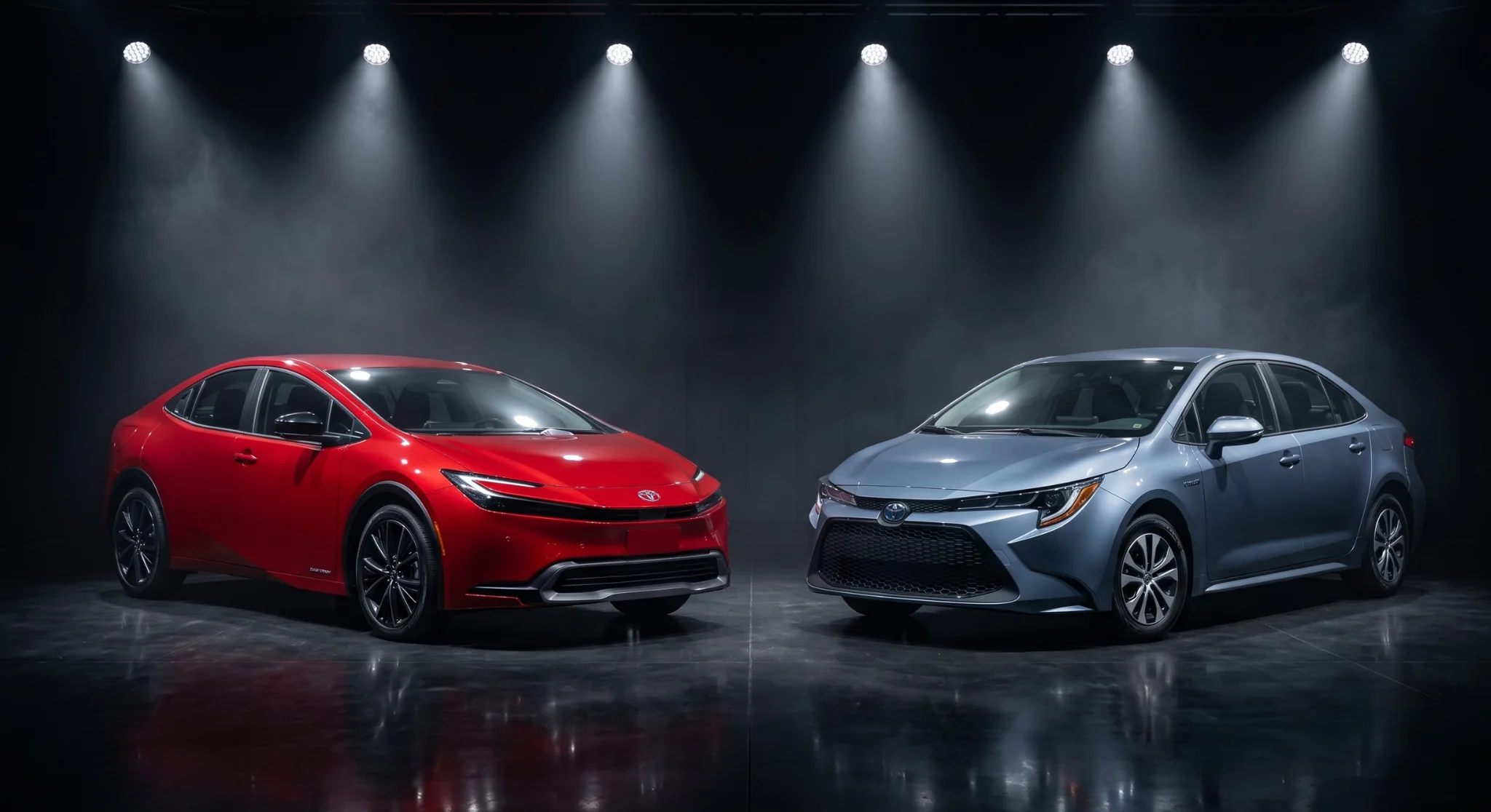
How the Two Powertrains Actually Differ
The Corolla Hybrid is a self-charging hybrid. It pairs a 1.8-liter four-cylinder engine with an electric motor and lithium-ion battery for 138 combined horsepower, routed through an electronically controlled continuously variable transmission. It generates its own charge from the engine and regenerative braking. You never plug it in, and you never think about it.
The Prius Prime is a plug-in hybrid. It uses a 2.0-liter Dynamic Force four-cylinder paired with a second electric motor and a 13.6-kWh lithium-ion battery for 220 combined horsepower. Fully charged, it drives up to 44 miles on electricity alone before the gasoline engine engages. Past that point it behaves like a conventional hybrid.
The practical translation is simple. If your daily driving fits inside the Prius Prime’s electric window, and you can charge at home, you may go weeks without buying gas. If you can’t charge at home, that capability sits unused. The Corolla Hybrid then delivers most of the fuel savings with none of the logistics.
Efficiency by Trim
The Corolla Hybrid comes in three grades — LE, SE, and XLE. All-wheel drive is available on the LE and SE. The Prius Prime comes in four — SE, XSE, Nightshade, and XSE Premium — and is front-wheel drive only, which matters if all-weather traction is on your list.
| Trim | EPA-Est. Combined MPG | EV-Only Range | EPA-Est. MPGe | Drivetrain |
|---|---|---|---|---|
| Corolla Hybrid LE | 50 | None — cannot be plugged in | N/A — no plug-in charging | FWD (AWD available) |
| Corolla Hybrid SE | 47 | None — cannot be plugged in | N/A — no plug-in charging | FWD (AWD available) |
| Corolla Hybrid XLE | 50 | None — cannot be plugged in | N/A — no plug-in charging | FWD |
| Prius Prime SE | 52 | Up to 44 miles | 127 | FWD only |
| Prius Prime XSE | 48 | Up to 39 miles | 114 | FWD only |
| Prius Prime Nightshade | 48 | Up to 39 miles | 114 | FWD only |
| Prius Prime XSE Premium | 48 | Up to 39 miles | 114 | FWD only |
| Prius Prime SE — 2027 model year | 51 | Up to 44 miles | Not yet published for 2027 | FWD only |
Two things stand out. First, the Corolla Hybrid LE and XLE post a higher combined MPG in pure hybrid operation than every Prius Prime trim except the SE. Second, the Prius Prime SE leads both lineups on combined MPG even before you plug it in — and its 127 MPGe and 44 miles of electric range are what you are paying the premium for. Choosing a higher Prius Prime trim costs you range: the XSE, Nightshade, and XSE Premium drop to 39 miles.
A note on model years: Toyota introduced the 2027 Prius Plug-in Hybrid in July 2026. The 2027 SE carries the same 220 combined horsepower, the same 13.6-kWh battery, and the same up-to-44-mile all-electric range, but its EPA-estimated combined rating in Hybrid Mode is 51 MPG. The 2027 also adds Dual-Zone HVAC and a new Inked exterior color. Ask us which model year is on the ground when you visit.
EPA-estimated fuel economy figures are for comparison purposes only. Your actual mileage will vary depending on driving conditions, how you drive and maintain your vehicle, battery age/condition, and other factors.
Space, Shape, and Everyday Practicality
These two cars solve the cargo problem differently. The Corolla Hybrid is a sedan with a 13.1 cubic-foot trunk and a 60/40 split-folding rear seat. It seats five, and the low lift-over height makes loading groceries and luggage straightforward.
The Prius Prime is a liftback. It offers 20.3 cubic feet behind the rear seats, expanding to 26.7 cubic feet with them folded, and the wide hatch opening swallows bulky items a sedan trunk simply cannot. It also seats five.
On raw numbers the Prius Prime carries more. On shape, the sedan trunk is more secure and better suited to daily errands, while the liftback is the better tool for bikes, boxes, and gear.
Technology and Cabin
Both cars run Toyota’s current multimedia platform. The Corolla Hybrid comes standard with an 8-inch touchscreen, wireless Apple CarPlay and Android Auto, Bluetooth hands-free calling, four USB-C ports, and cloth-trimmed seats with a six-way manually adjustable driver’s seat.
Stepping up unlocks more screen. The SE Premium Package adds a 10.5-inch touchscreen, a 12.3-inch digital gauge cluster, and a wireless charging pad. On the LE, the LE Premium Package bundles 16-inch alloy wheels, the Smart Key System with Push Button Start, and a wireless charging pad.
The Prius Prime starts with an 8.0-inch touchscreen as well, with a 12.3-inch display available on upper grades. The cabins are close enough that technology alone should not decide this.
Safety: Standard, Not Optional, on Both
Toyota Safety Sense 3.0 is standard equipment across both lineups — no trim walk required to get it.
Pre-Collision System with Pedestrian Detection
Scans the road ahead to warn of potential frontal impacts and can automatically apply the brakes if necessary.
Full-Speed Range Dynamic Radar Cruise Control
Maintains a preset distance from the vehicle ahead, adjusting speed automatically down to a complete stop.
Lane Departure Alert with Steering Assist
Detects lane markings and provides gentle steering corrections if the vehicle begins to drift.
Lane Tracing Assist
Works in tandem with cruise control to keep the vehicle centered in its lane.
Road Sign Assist
Uses an intelligent camera to detect speed limit signs, stop signs, and yield signs, displaying them on the gauge cluster.
Proactive Driving Assist
Provides gentle braking or steering support in everyday driving conditions to help maintain distance or navigate curves.
New for 2026, Blind Spot Monitor with Rear Cross-Traffic Alert is standard on every Corolla trim, and it is standard across the Prius Prime lineup as well. The Corolla Hybrid also carries ten standard airbags.
Toyota Safety Sense is an active safety system designed to support the driver. It is not a substitute for safe and attentive driving. System effectiveness depends on many factors, such as speed, size and position of detected objects, and weather, light and road conditions. See the Owner’s Manual for additional limitations and details.
Head to Head
2026 Toyota Corolla Hybrid
- Powertrain: Self-charging hybrid
- Engine: 1.8L four-cylinder hybrid
- Combined Horsepower: 138
- Plug-In Charging: Not required — and not possible
- EV-Only Range: None — cannot be plugged in
- Best Combined MPG: EPA-estimated 50 (LE and XLE)
- Drivetrain: FWD standard; AWD available on LE and SE
- Body Style: Sedan
- Cargo: 13.1 cu ft trunk
- Seating: 5
- Trims: LE, SE, XLE
- Toyota Safety Sense 3.0: Standard
2026 Toyota Prius Prime (Plug-in Hybrid)
- Powertrain: Plug-in hybrid (PHEV)
- Engine: 2.0L Dynamic Force four-cylinder
- Combined Horsepower: 220
- Plug-In Charging: Required to use EV range
- EV-Only Range: Up to 44 miles (SE); 39 miles other trims
- Best Combined MPG: EPA-estimated 52 in hybrid mode (SE)
- Drivetrain: FWD only
- Body Style: Liftback
- Cargo: 20.3 cu ft; 26.7 cu ft seats folded
- Seating: 5
- Trims: SE, XSE, Nightshade, XSE Premium
- Toyota Safety Sense 3.0: Standard
Warranty
Both models carry the same Toyota coverage. The basic warranty runs 3 years or 36,000 miles. The powertrain warranty runs 5 years or 60,000 miles. Hybrid components are covered for 8 years or 100,000 miles.
This information is provided for general educational purposes only and does not constitute legal advice. Warranty coverage depends on the specific terms of your vehicle’s warranty agreement. Consult your owner’s manual or a qualified legal professional for guidance on your individual situation.
Which One Should You Buy?
Choose the 2026 Corolla Hybrid if you cannot charge at home. It also posts a higher pure-hybrid combined MPG than every Prius Prime trim except the SE. All-wheel drive is available. And ownership is as simple as it gets: nothing to plug in, nothing to plan around.
Choose the 2026 Prius Prime if you can plug in where you park, using either a 120V or 240V outlet. It also fits if your daily driving stays inside 44 miles. You get the stronger 220-horsepower powertrain.
The honest test is a single question: can you plug in where you park? If yes, the Prius Prime’s electric range is worth serious consideration. If no, the Corolla Hybrid gives you nearly all of the efficiency and none of the homework.
Shoppers across Temecula, Murrieta, Menifee, Fallbrook, Lake Elsinore, Canyon Lake, Wildomar, Winchester, and Sun City can compare both at Temecula Valley Toyota. If you would rather compare the Prius Prime against the standard Prius hybrid instead, our 2026 Prius Prime vs Prius comparison covers that decision in detail. Prefer to skip hybrids altogether? The gas-powered Corolla lineup starts with the LE at an EPA-estimated 32 city / 41 highway / 35 combined MPG. Our full electrified and hybrid inventory collects every Toyota hybrid, plug-in hybrid, and EV in one place.
Frequently Asked Questions
Is the Prius Prime the same as the Prius Plug-in Hybrid?
Yes. Toyota renamed the Prius Prime to the Prius Plug-in Hybrid (PHEV) starting with the 2025 model year. The vehicle is the same; only the badging changed. Many shoppers still search for it by the Prime name.
How far can the 2026 Prius Prime drive on electricity alone?
Up to 44 miles on the SE trim and 39 miles on the XSE, Nightshade, and XSE Premium trims, once fully charged. After that, it operates as a conventional hybrid.
Does the Corolla Hybrid need to be plugged in?
No. The Corolla Hybrid is a self-charging hybrid. It generates its own battery charge from the gasoline engine and regenerative braking and cannot be plugged in.
Which gets better gas mileage, the Corolla Hybrid or the Prius Prime?
In pure hybrid operation the Prius Prime SE leads at an EPA-estimated 52 MPG combined, ahead of the Corolla Hybrid LE and XLE at 50 MPG combined and the other Prius Prime trims at 48 MPG. Once you factor in charging, the Prius Prime pulls well ahead at up to 127 MPGe.
Is all-wheel drive available on either model?
All-wheel drive is available on the Corolla Hybrid LE and SE. The Prius Prime is front-wheel drive only.
Which one has more cargo space?
The Prius Prime liftback offers 20.3 cubic feet behind the rear seats and 26.7 cubic feet with them folded. The Corolla Hybrid sedan offers a 13.1 cubic-foot trunk with a 60/40 split-folding rear seat.