

2026 Toyota 4Runner Hybrid vs. 4Runner: Off-Road Capability Compared
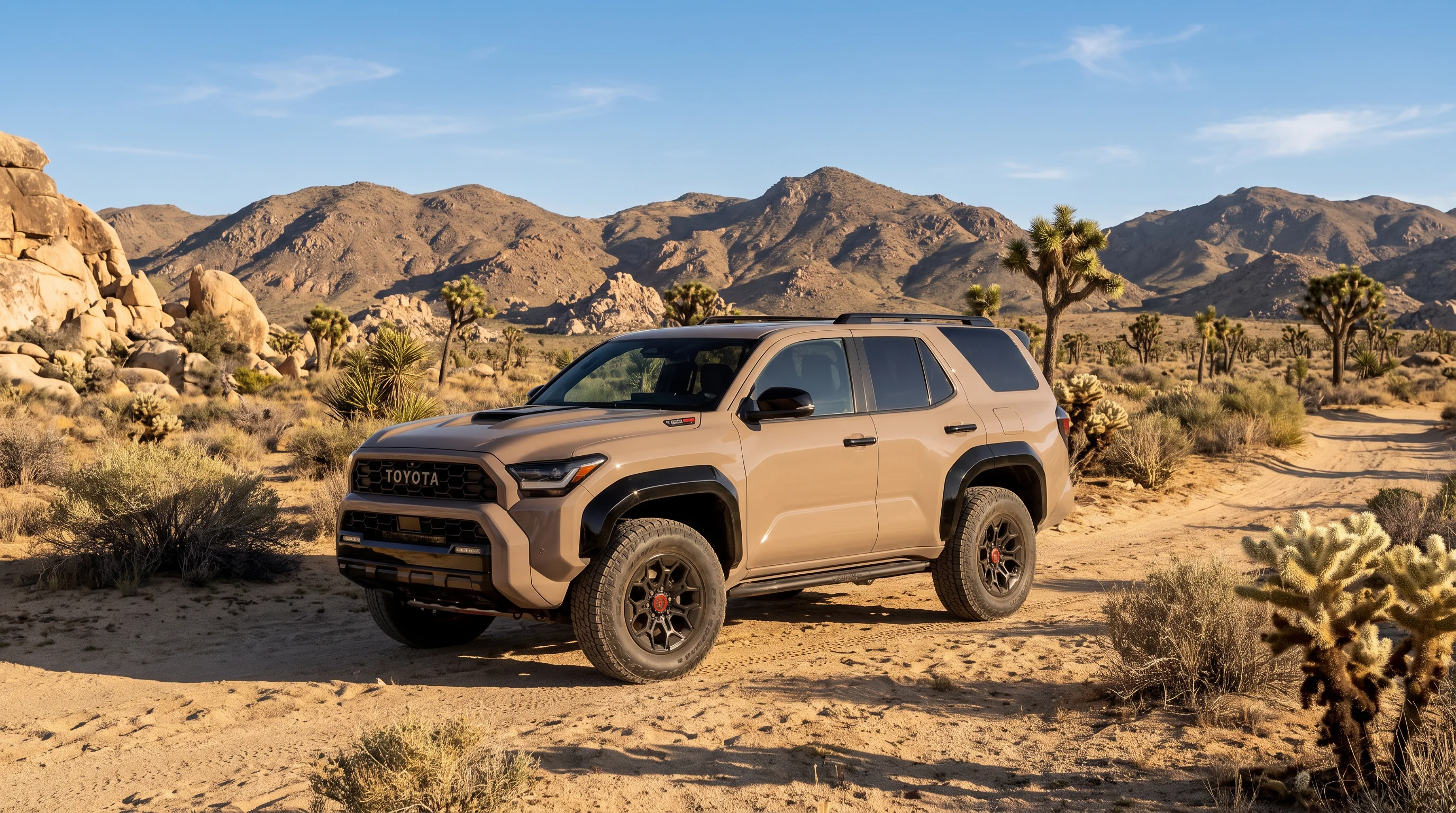
Shoppers comparing the 2026 Toyota 4Runner TRD Off-Road Premium against the TRD Off-Road Premium i-FORCE MAX usually expect the hybrid to be the more capable off-roader. It is not. Both trims run the same off-road hardware and the same part-time four-wheel-drive system.
What actually separates them is everything that happens between trailheads. The i-FORCE MAX adds power, torque and fuel economy. The gas model stays lighter, costs less and carries more gear.
Here is how the two compare, category by category.
Which 2026 Toyota 4Runner Powertrain Fits Murrieta Families Best?
Both trims start from the same TRD Off-Road foundation. So the decision comes down to what you value once the trail ends.
Pricing on both trims comes from Toyota’s published 2026 4Runner grade pricing.
| Trim | TSRP |
|---|---|
| 2026 Toyota 4Runner TRD Off-Road Premium | $57,365 TSRP |
| 2026 Toyota 4Runner TRD Off-Road Premium i-FORCE MAX | $60,165 TSRP |
| Difference | $2,800 TSRP |
Total Suggested Retail Price (TSRP) for new vehicles includes manufacturer and distributor options and delivery, processing, and handling fees, which are subject to change at any time. TSRP excludes taxes, title, license, dealer-installed options, accessories, fees and charges. TSRP is not the dealer advertised price. Dealer prices will vary. The dealer sets the final price.
For active households in Murrieta loading up backpacks and gear for weekend outings, that difference leaves room in the budget for factory accessories. For drivers who commute during the week and tow on weekends, the hybrid earns it back in fuel economy and low-end torque.
Neither choice costs you off-road capability. That is the part that surprises most shoppers cross-shopping these two.
Off-Road Hardware: What the Gas and Hybrid 4Runner Share
Every piece of mechanical off-road equipment on the TRD Off-Road Premium carries over to the i-FORCE MAX version. Per Toyota’s 2026 4Runner press materials, the TRD Off-Road Premium builds directly off the TRD Off-Road grade, and the hybrid system is an available powertrain on that same grade rather than a separate vehicle.
Shared Off-Road Equipment
The hardware list below is identical on both trims, including the maximum they can tow. For configuration details, see our 2026 4Runner towing capacity breakdown.
| Off-Road Equipment | TRD Off-Road Premium | TRD Off-Road Premium i-FORCE MAX |
|---|---|---|
| Electronic locking rear differential | Standard | Standard |
| Multi-Terrain Select | Standard | Standard |
| CRAWL Control | Standard | Standard |
| Active Traction Control (A-TRAC) | Standard | Standard |
| Downhill Assist Control | Standard | Standard |
| Multi-Terrain Monitor | Standard | Standard |
| Drivetrain | Part-time 4WD | Part-time 4WD |
| Maximum towing capacity | 6,000 lbs | 6,000 lbs |
Maximum towing and payload capacity figures are based on properly equipped vehicles and vary by configuration. Do not exceed any weight rating. See your owner’s manual and the vehicle’s door-jamb label for specific capacities.
Where the Two Diverge Off-Road: Weight
The real mechanical difference is mass. The gas TRD Off-Road Premium weighs 4,850 lbs. The i-FORCE MAX weighs 5,225 lbs. That is a 375-lb difference created by the hybrid system.
Drivers who prioritize a lighter vehicle for technical trail work will prefer the gas model. Drivers who want instant low-speed torque for crawling and climbing will prefer the hybrid.
Power and Efficiency: i-FORCE vs. i-FORCE MAX
The 2026 Toyota 4Runner TRD Off-Road Premium uses a 2.4L turbocharged i-FORCE four-cylinder producing 278 hp and 317 lb-ft of torque. The TRD Off-Road Premium i-FORCE MAX pairs that engine with a hybrid system for 326 hp and 465 lb-ft. If the badge is new to you, our explainer on what i-FORCE MAX means covers how the system works.
Both engines deliver peak torque at just 1,700 rpm. That is why both feel strong on steep grade climbs and under load. The i-FORCE MAX simply delivers more of it.
That 148 lb-ft advantage is the single largest performance gap between the two trims. It shows up most in stop-and-go driving, and when pulling a trailer away from a stop.
| Specification | TRD Off-Road Premium | TRD Off-Road Premium i-FORCE MAX |
|---|---|---|
| Engine | 2.4L turbocharged i-FORCE 4-cylinder | 2.4L turbocharged i-FORCE MAX hybrid 4-cylinder |
| Horsepower | 278 hp | 326 hp |
| Torque | 317 lb-ft @ 1,700 rpm | 465 lb-ft @ 1,700 rpm |
| Transmission | 8-speed automatic | 8-speed automatic |
| Drivetrain | Part-time 4WD | Part-time 4WD |
EPA-Estimated Fuel Economy and Range
Fuel economy favors the hybrid almost everywhere. Per Toyota’s published EPA-estimated ratings, the gas TRD Off-Road Premium is EPA-estimated at 19 city / 25 hwy / 21 combined MPG. The i-FORCE MAX is EPA-estimated at 23 city / 24 hwy / 23 combined MPG.
The gas model holds a 1 MPG highway advantage. The hybrid takes city driving by 4 MPG and combined by 2 MPG. Both carry a 19.0-gallon fuel tank, which works out to an estimated 399 miles of range for the gas model and roughly 437 miles for the hybrid.
| Specification | TRD Off-Road Premium | TRD Off-Road Premium i-FORCE MAX |
|---|---|---|
| EPA-Estimated MPG | 19 city / 25 hwy / 21 combined | 23 city / 24 hwy / 23 combined |
| Fuel tank | 19.0 gal | 19.0 gal |
| Estimated range | 399 mi | 437 mi |
EPA-estimated fuel economy figures are for comparison purposes only. Your actual mileage will vary depending on driving conditions, how you drive and maintain your vehicle, battery age/condition, and other factors.
If most of your miles are freeway miles between Temecula and work, the gap narrows considerably. If you drive in traffic, the hybrid pulls ahead. For the broader trade-offs, read up on how hybrid and gas powertrains differ.
Cargo and Comfort for Weekend Adventures
Cargo volume is where the gas model wins outright. The TRD Off-Road Premium offers 48.4 cu ft behind the second row and 90.2 cu ft with the rear seats folded. The i-FORCE MAX offers 42.6 cu ft and 82.6 cu ft respectively, because the hybrid battery sits beneath the rear cargo floor.
That is a 5.8 cu ft difference behind the second row. It is enough to matter when you are packing camping gear or a full set of recovery equipment.
Everything else in the cabin is shared. Both trims seat five in SofTex-trimmed seating with heated, power-adjustable front seats and a heated steering wheel. Front occupants get 39.7 in of headroom, 41.8 in of legroom and 55.2 in of hip room. Second-row passengers get 37.8 in of headroom and 34.8 in of legroom.
| Specification | TRD Off-Road Premium | TRD Off-Road Premium i-FORCE MAX |
|---|---|---|
| Seating | 5 | 5 |
| Cargo behind 2nd row | 48.4 cu ft | 42.6 cu ft |
| Max cargo (seats folded) | 90.2 cu ft | 82.6 cu ft |
| Curb weight | 4,850 lbs | 5,225 lbs |
| Maximum towing capacity | 6,000 lbs | 6,000 lbs |
Maximum towing and payload capacity figures are based on properly equipped vehicles and vary by configuration. Do not exceed any weight rating. See your owner’s manual and the vehicle’s door-jamb label for specific capacities.
Technology and Connectivity
Both trims come with a 14-inch Toyota Audio Multimedia touchscreen. A 14-speaker JBL Premium Audio system is offered on either one.
The JBL system includes the JBL FLEX. That is a removable portable Bluetooth speaker which docks in the vehicle as a center-channel speaker and runs on its own battery when you take it out.
The Hybrid’s 2400W AC Power Supply
One technology feature is hybrid-exclusive and worth knowing about. Toyota lists a standard 2400W AC power supply in both the cabin and cargo area on i-FORCE MAX models.
For campsite power, jobsite tools or running equipment at a trailhead, that is a capability the gas model does not offer at any price. If you power gear away from the pavement, this single feature may decide the comparison for you.
Safety Systems and Crash-Test Results
Toyota Safety Sense 3.0
Toyota Safety Sense 3.0 is standard on every 2026 4Runner, including both trims here. The suite includes:
- Pre-Collision System with Pedestrian Detection
- Lane Departure Alert with Steering Assist
- Full-Speed Range Dynamic Radar Cruise Control
- Lane Tracing Assist
- Road Sign Assist
- Automatic High Beams
- Proactive Driving Assist
Driver-assistance and advanced safety systems are supplemental aids and are not substitutes for safe and attentive driving. Availability, operation, and effectiveness vary by trim and equipment and depend on factors including road, weather, traffic, and vehicle condition. Always keep your hands on the wheel and your eyes on the road. See your owner’s manual for system limitations and details.
IIHS Crash-Test Ratings
Crash-test results apply to the 4Runner as a model, not to a specific powertrain. Ratings below are from IIHS testing of the 2026 4Runner.
| IIHS Test | Rating |
|---|---|
| Small overlap front, driver-side | Good |
| Side (updated test) | Good |
| Front crash prevention, vehicle-to-vehicle | Good |
| Front crash prevention, pedestrian | Good |
| LATCH child-seat anchor ease of use | Good+ |
| Seat belt reminders | Good |
| Moderate overlap front (updated test) | Marginal |
| Headlights | Varies by trim and build date |
IIHS headlight ratings on this trim group vary by build date, so confirm the rating on the specific vehicle you are considering.
NHTSA Crash-Test Ratings
NHTSA has not yet rated the 2026 4Runner. The ratings below are for the 2025 4Runner 4WD and are shown for reference only.
| NHTSA Test (2025 4Runner 4WD) | Rating |
|---|---|
| Overall | 4 stars |
| Side crash | 5 stars |
| Frontal crash | 4 stars |
| Rollover | 3 stars |
Warranty and ToyotaCare Coverage
Factory warranty coverage is identical on both trims, with additional protection for the hybrid system. ToyotaCare covers normal factory-scheduled maintenance for 1 year or 10,000 miles, whichever comes first, and includes 2 years of unlimited-mileage Roadside Assistance.
| Coverage | TRD Off-Road Premium | TRD Off-Road Premium i-FORCE MAX |
|---|---|---|
| Basic | 36 months / 36,000 miles | 36 months / 36,000 miles |
| Powertrain | 60 months / 60,000 miles | 60 months / 60,000 miles |
| Corrosion perforation | 60 months, no mileage limit | 60 months, no mileage limit |
| Hybrid-related components | Not applicable | 8 years / 100,000 miles |
| Hybrid battery | Not applicable | 10 years / 150,000 miles, transferable |
| ToyotaCare maintenance | 1 year / 10,000 miles | 1 year / 10,000 miles |
| Roadside Assistance | 2 years, unlimited mileage | 2 years, unlimited mileage |
This information is provided for general educational purposes only and does not constitute legal advice. Warranty coverage depends on the specific terms of your vehicle’s warranty agreement. Consult your owner’s manual or a qualified legal professional for guidance on your individual situation.
Shopping further up the lineup? Our 4Runner vs. Land Cruiser comparison covers the next step up in Toyota’s body-on-frame SUV range.
2026 Toyota 4Runner Hybrid vs. Gas: Buyer FAQs
Does the 2026 4Runner i-FORCE MAX tow more than the gas model?
No. Both the 2026 Toyota 4Runner TRD Off-Road Premium and the TRD Off-Road Premium i-FORCE MAX are rated at the same 6,000-lb maximum towing capacity. The hybrid does deliver considerably more torque, 465 lb-ft versus 317 lb-ft, which changes how the vehicle feels pulling away from a stop with a trailer attached. The maximum rating itself is identical.
Maximum towing and payload capacity figures are based on properly equipped vehicles and vary by configuration. Do not exceed any weight rating. See your owner’s manual and the vehicle’s door-jamb label for specific capacities.
Is the gas 4Runner better for cargo than the hybrid?
Yes. The gas-powered TRD Off-Road Premium offers 48.4 cu ft of cargo space behind the second row and 90.2 cu ft with the rear seats folded. The TRD Off-Road Premium i-FORCE MAX offers 42.6 cu ft and 82.6 cu ft. The 5.8 cu ft difference behind the second row comes from the hybrid battery mounted beneath the cargo floor.
What is the price difference between the 4Runner TRD Off-Road Premium and the i-FORCE MAX?
The 2026 Toyota 4Runner TRD Off-Road Premium carries a Total Suggested Retail Price (TSRP) of $57,365. The TRD Off-Road Premium i-FORCE MAX carries a TSRP of $60,165. That is a $2,800 TSRP difference.
Total Suggested Retail Price (TSRP) for new vehicles includes manufacturer and distributor options and delivery, processing, and handling fees, which are subject to change at any time. TSRP excludes taxes, title, license, dealer-installed options, accessories, fees and charges. TSRP is not the dealer advertised price. Dealer prices will vary. The dealer sets the final price.
Does the hybrid 4Runner give up any off-road capability?
No. The electronic locking rear differential, Multi-Terrain Select, CRAWL Control, Active Traction Control, Downhill Assist Control and Multi-Terrain Monitor are all standard on both trims, and both use the same part-time 4WD system. The i-FORCE MAX carries 375 lbs more curb weight, and it adds 148 lb-ft of torque for low-speed crawling and climbing.
Which 2026 4Runner should I buy, the hybrid or the gas model?
Choose the gas TRD Off-Road Premium if you want maximum cargo room, the lowest entry price and the lightest curb weight, and if most of your driving is highway miles. Choose the TRD Off-Road Premium i-FORCE MAX if you want substantially more power and torque, better city and combined fuel economy, longer range between fill-ups and the 2400W AC power supply. Off-road hardware and towing capacity are identical, so neither choice sacrifices capability.
Where can I test drive the 2026 Toyota 4Runner near Temecula?
You can test drive both the 2026 Toyota 4Runner and the 4Runner i-FORCE MAX at Temecula Valley Toyota, 26631 Ynez Road, Temecula, CA 92591. Call our team at (951) 319-7911 to schedule your test drive, or browse our new vehicle inventory online before visiting.
Disclaimers
Total Suggested Retail Price (TSRP) for new vehicles includes manufacturer and distributor options and delivery, processing, and handling fees, which are subject to change at any time. TSRP excludes taxes, title, license, dealer-installed options, accessories, fees and charges. TSRP is not the dealer advertised price. Dealer prices will vary. The dealer sets the final price.
EPA-estimated fuel economy figures are for comparison purposes only. Your actual mileage will vary depending on driving conditions, how you drive and maintain your vehicle, battery age/condition, and other factors.
Maximum towing and payload capacity figures are based on properly equipped vehicles and vary by configuration. Do not exceed any weight rating. See your owner’s manual and the vehicle’s door-jamb label for specific capacities.
Driver-assistance and advanced safety systems are supplemental aids and are not substitutes for safe and attentive driving. Availability, operation, and effectiveness vary by trim and equipment and depend on factors including road, weather, traffic, and vehicle condition. Always keep your hands on the wheel and your eyes on the road. See your owner’s manual for system limitations and details.
This information is provided for general educational purposes only and does not constitute legal advice. Warranty coverage depends on the specific terms of your vehicle’s warranty agreement. Consult your owner’s manual or a qualified legal professional for guidance on your individual situation.