

2026 Toyota 4Runner vs. 2026 Toyota Land Cruiser: A Complete Comparison for Temecula Drivers
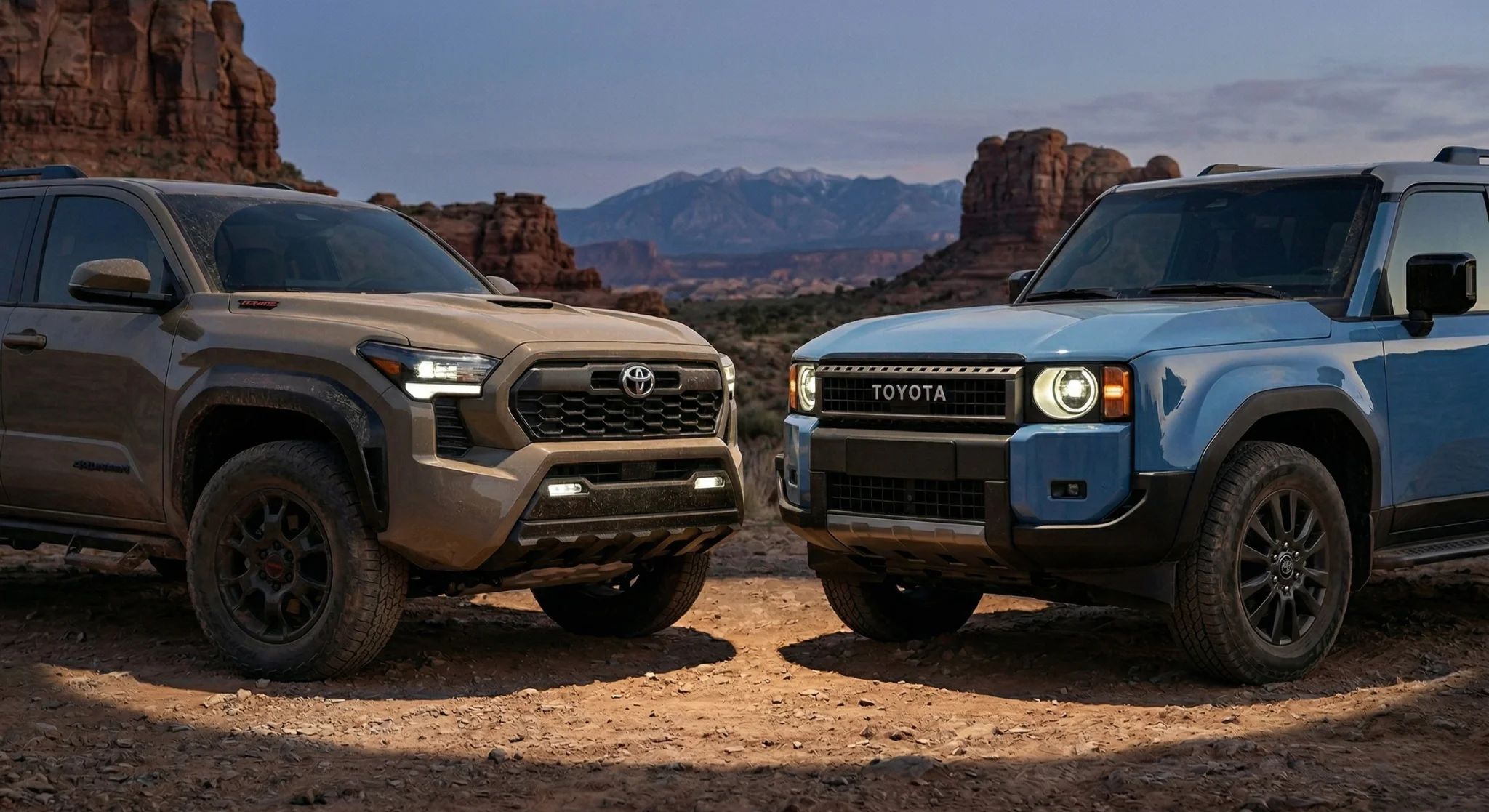
Toyota offers two legendary body-on-frame SUVs for 2026 — the versatile 4Runner and the trail-ready Land Cruiser. Both share Toyota’s TNGA-F platform, but they take distinctly different approaches to capability, comfort, and value. For drivers in Temecula, Murrieta, and the surrounding Inland Empire communities, understanding how these two models compare can help you choose the right fit for your lifestyle.
At Temecula Valley Toyota, we carry both the 4Runner and Land Cruiser lineups and can help you experience each one firsthand.
Powertrain and Performance
The 4Runner offers two powertrain options. The standard i-FORCE 2.4L turbocharged four-cylinder produces 278 horsepower and 317 lb-ft of torque, paired with an 8-speed automatic transmission. For drivers seeking more capability, the available i-FORCE MAX hybrid adds an electric motor to deliver 326 horsepower and 465 lb-ft of torque — the most powerful 4Runner ever.
The Land Cruiser takes a simpler approach: the i-FORCE MAX hybrid powertrain is standard on both trims, delivering the same 326 horsepower and 465 lb-ft of torque through an 8-speed automatic and full-time four-wheel drive.
Both SUVs are rated to tow up to 6,000 pounds when properly equipped.
Where they differ is drivetrain configuration. The 4Runner offers rear-wheel drive, part-time 4WD, and full-time 4WD depending on trim, giving buyers flexibility to match their needs and budget. The Land Cruiser standardizes full-time 4WD with an electronically controlled two-speed transfer case and locking center and rear differentials across both trims — no configuration choices, but maximum capability out of the box.
Off-Road Capability
Both SUVs feature Multi-Terrain Select, Crawl Control, and the available Stabilizer Disconnect Mechanism for enhanced wheel articulation on technical terrain. However, the Land Cruiser includes locking center and rear differentials standard on every model, while the 4Runner offers an electronically locking rear differential on its TRD Off-Road and TRD Pro trims.
The 4Runner’s deeper trim lineup allows more specialized off-road configurations. The TRD Off-Road rides on Bilstein remote-reservoir shocks, the TRD Pro features FOX QS3 adjustable shocks, and the Trailhunter comes equipped with Old Man Emu shocks, an ARB roof rack, and an onboard air compressor — factory-built for overlanding.
| Off-Road Spec | 2026 4Runner | 2026 Land Cruiser |
|---|---|---|
| Ground Clearance | Up to 10.1 in. (TRD Pro / Trailhunter) | 8.3–8.7 in. |
| Approach Angle | Up to 33° (TRD Off-Road+) | 31° |
| Departure Angle | Up to 24° (TRD Off-Road+) | 22° |
| Locking Differentials | Rear (TRD Off-Road+); Center (Limited/Platinum) | Center + Rear (standard all trims) |
| Stabilizer Disconnect | Std on TRD Pro, Trailhunter; Avail on TRD Off-Road Premium | Available |
The Land Cruiser’s standard full-time 4WD with dual locking differentials means every Land Cruiser is trail-ready without requiring a specific trim or package selection.
Interior Space and Comfort
The 4Runner offers available third-row seating on the SR5 and Limited trims, accommodating up to seven passengers. The Land Cruiser seats five exclusively across both trims. For families in Murrieta and Menifee needing extra passenger capacity, the 4Runner holds a clear advantage.
Cargo space also favors the 4Runner. In two-row configuration, the 4Runner provides 48.4 cubic feet behind the second row, expanding to 90.2 cubic feet with rear seats folded. The Land Cruiser offers approximately 37.5 cubic feet behind the second row, expanding to roughly 82 cubic feet with seats down. Note that hybrid 4Runner models sacrifice some cargo volume due to battery placement, bringing the maximum closer to 82.6 cubic feet.
The 4Runner’s power rear window — a signature feature carried across every generation — provides convenient cargo access without opening the full liftgate.
Both vehicles offer heated and ventilated front seats, SofTex or leather-trimmed interiors, and dual-zone or tri-zone climate control on upper trims. The Land Cruiser’s cabin leans toward a more premium, refined feel with physical controls designed for gloved operation, while the 4Runner’s interior prioritizes versatility and durability.
Technology and Infotainment
The 4Runner starts with an 8-inch Toyota Audio Multimedia touchscreen on the SR5 and moves up to a 14-inch display on TRD Sport Premium, TRD Off-Road Premium, Limited, Platinum, TRD Pro, and Trailhunter trims. A 14-speaker JBL premium audio system with a removable FLEX Bluetooth speaker is available on mid-tier and upper trims.
The Land Cruiser’s 1958 trim features an 8-inch touchscreen with a 6-speaker audio system, while the Land Cruiser trim upgrades to a 12.3-inch display with a 10-speaker system. A 14-speaker JBL system is available via the $4,600 Premium Package on the Land Cruiser trim, which also adds a Head-Up Display and Toyota Digital Key.
Both models offer wireless Apple CarPlay and Android Auto, Qi wireless charging on select trims, and Toyota’s latest Audio Multimedia platform across all trims.
Safety
Toyota Safety Sense 3.0 comes standard on every 4Runner and Land Cruiser, including Pre-Collision System with Pedestrian Detection, Full-Speed Dynamic Radar Cruise Control, Lane Departure Alert with Steering Assist, Lane Tracing Assist, and Road Sign Assist.
Both models also include standard Blind Spot Monitor with Rear Cross-Traffic Alert, Front and Rear Parking Assist with Automatic Braking, and Proactive Driving Assist on select trims. The 4Runner offers an available Panoramic View Monitor (360-degree camera) starting at the TRD Sport Premium level, while the Land Cruiser offers a Multi-Terrain Monitor with underbody camera view for precise off-road obstacle detection.
Fuel Economy and Operating Costs
| Fuel Economy | 2026 4Runner (i-FORCE) | 2026 4Runner (i-FORCE MAX Hybrid) | 2026 Land Cruiser (i-FORCE MAX Hybrid) |
|---|---|---|---|
| City | 20 MPG | 23 MPG | 22 MPG |
| Highway | 26 MPG | 24 MPG | 25 MPG |
| Combined | 22 MPG | 23 MPG | 23 MPG |
| Fuel Type | Regular Gasoline | Regular Gasoline | Premium Recommended (91 oct.) |
When comparing like-for-like hybrid powertrains, the two SUVs are virtually identical in fuel efficiency. The 4Runner gains an additional advantage by offering a non-hybrid option for buyers who prefer a lower purchase price and regular gasoline — while the Land Cruiser recommends premium fuel (91 octane) for optimal performance.
Pricing and Value
The 4Runner’s nine-trim lineup starts at $41,570 MSRP for the SR5, making it one of the most accessible body-on-frame SUVs on the market. The range extends through TRD Sport, TRD Off-Road, premium and limited trims, up to the Platinum, TRD Pro, and Trailhunter models — offering configurations for nearly every budget and lifestyle.
The Land Cruiser starts at $57,200 MSRP for the 1958 trim and is available in two trims. Its higher price reflects the standard hybrid powertrain, full-time 4WD, and locking differentials included on every model.
For Temecula-area families weighing these two options, the decision often comes down to priorities. The 4Runner delivers more variety, a lower entry price, available third-row seating, and more cargo space. The Land Cruiser delivers maximum standard capability, a premium driving experience, and the simplicity of every model coming fully equipped for serious off-road use.
Both are built on Toyota’s proven TNGA-F architecture, both carry identical warranty coverage (3-year/36,000-mile basic, 5-year/60,000-mile powertrain, 5-year unlimited-mileage corrosion), and both are available now at Temecula Valley Toyota.