Open Today Sales: 9 AM-7 PM
Open Today Service: 6 AM-5 PMOpen Today Express Service Center: 6 AM-5 PM
What’s the difference between a Toyota Prius and a Toyota Prius Prime? The Prius is a self-charging hybrid that runs on gasoline. The Prius Prime — officially renamed the Toyota Prius Plug-in Hybrid (PHEV) starting with the 2025 model year — is a plug-in hybrid that drives up to 44 miles on electricity alone before switching to hybrid mode, but it needs to be plugged in to take advantage of that EV range. Both share the same striking exterior design, the same fifth-generation Toyota Hybrid System, and the same legendary efficiency reputation. The real choice comes down to whether you want to plug in.
This guide breaks down every meaningful difference between the two 2026 Prius models — pricing, EV range, fuel economy, power, safety, technology, and warranty — so shoppers near Temecula, Murrieta, Menifee, and the surrounding Inland Empire and Riverside County communities can pick the right one with confidence.
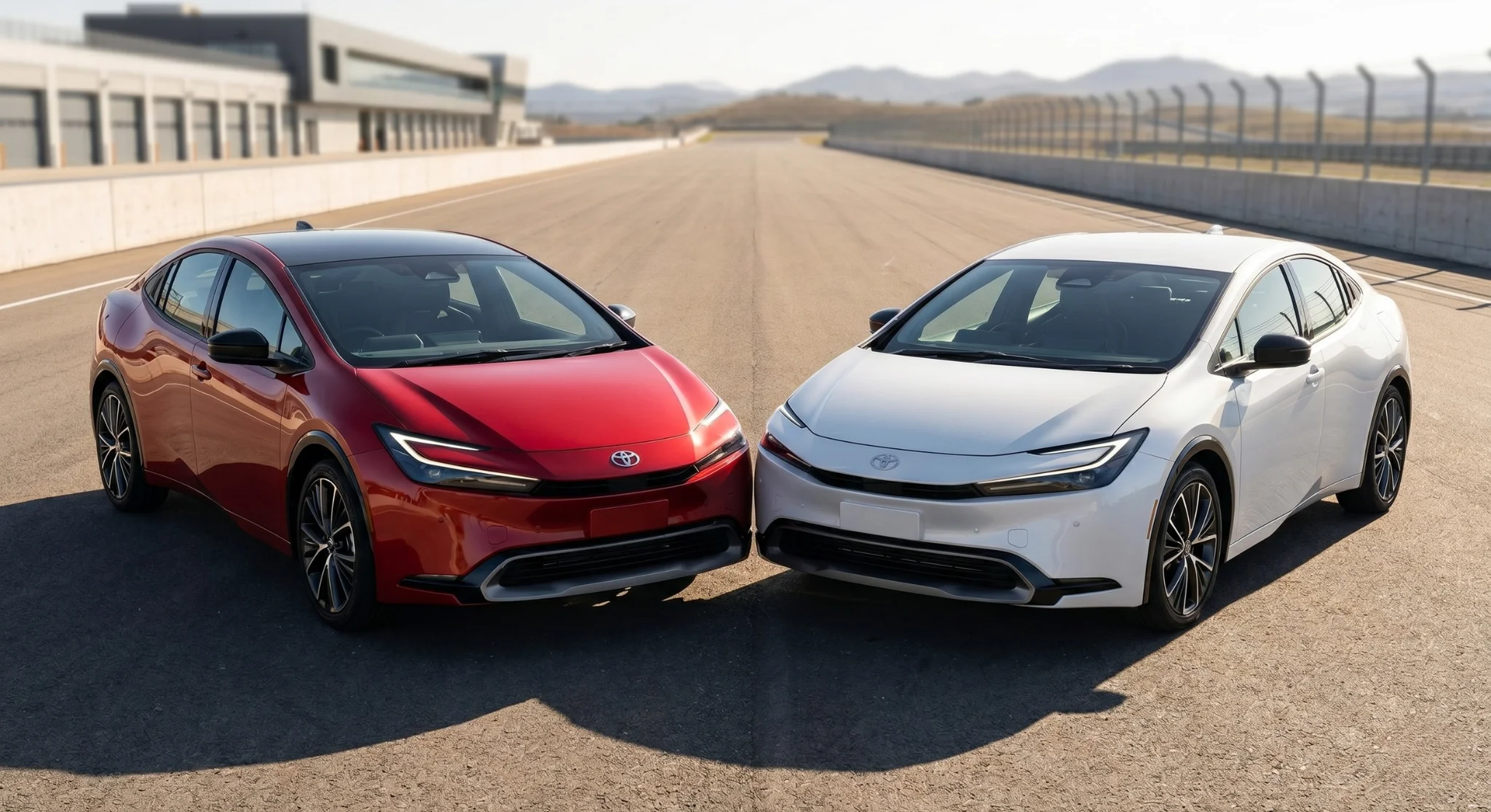
| Feature | 2026 Toyota Prius (Hybrid) | 2026 Toyota Prius Prime (Plug-in Hybrid) |
|---|---|---|
| Powertrain Type | Self-charging hybrid | Plug-in hybrid (PHEV) |
| Combined Output | 194 hp (FWD) / 196 hp (AWD) | 220 hp (FWD only) |
| Drivetrain | FWD standard, AWD available on every trim | FWD only |
| Trims | LE, XLE, Nightshade, Limited | SE, XSE, Nightshade, XSE Premium |
| Starting TSRP | $28,550 (Prius LE) | $33,775 (Prius Prime SE) |
| EV-Only Range | Not applicable (does not plug in) | Up to 44 miles (SE trim); 39 miles on other trims |
| Best Fuel Economy | EPA-Estimated 57 MPG combined (Prius LE FWD) | EPA-Estimated 127 MPGe combined / 52 MPG combined in hybrid mode (Prius Prime SE) |
| 0–60 mph | 7.2 sec (FWD) / 7.0 sec (AWD) | ~6.6 seconds |
| IIHS 2026 Rating | Top Safety Pick+ | Strong individual scores; not yet on the 2026 TSP list |
| NHTSA Rating | 5-Star Overall | 5-Star Overall |
TSRP excludes destination charge and any fees, taxes, or dealer-installed accessories. Dealer sets final price.
The Toyota Prius Prime is the plug-in hybrid version of the Prius. It pairs the same 2.0-liter four-cylinder engine and fifth-generation hybrid system with a larger 13.6-kWh lithium-ion battery and a second electric motor, allowing you to drive up to 44 miles purely on electricity before the gasoline engine kicks in. If your daily commute fits inside that EV window — and you can charge at home — you may go weeks at a time without buying gas.
Important naming update for 2026: Toyota officially renamed the Prius Prime to the Prius Plug-in Hybrid beginning with the 2025 model year. The badging now reads “PHEV.” Most shoppers still search for it as the Prius Prime, so you’ll see both names used interchangeably throughout this comparison and across Toyota’s marketing — they refer to the same vehicle.
The standard Prius, in contrast, is a traditional hybrid. It generates its own battery charge from the gasoline engine and regenerative braking, so it never needs to be plugged in — but it can’t drive on electricity alone for any meaningful distance.
The 2026 Toyota Prius lineup starts at a TSRP of $28,550 for the LE trim and climbs through the XLE, Nightshade, and Limited grades. All-wheel drive adds roughly $1,400 to any Prius trim.
The 2026 Toyota Prius Prime (Plug-in Hybrid) lineup starts at a TSRP of $33,775 for the SE trim and tops out with the XSE Premium. The Prius Prime is front-wheel drive only — Toyota does not offer AWD on the PHEV.
| Lineup | Starting TSRP | Trim Levels | Drivetrain |
|---|---|---|---|
| 2026 Toyota Prius (Hybrid) | $28,550 (LE) | LE, XLE, Nightshade, Limited | FWD standard; AWD available on every trim |
| 2026 Toyota Prius Prime / Plug-in Hybrid | $33,775 (SE) | SE, XSE, Nightshade, XSE Premium | FWD only |
That puts the Prius Prime roughly $5,000 above the comparable standard Prius trim. For shoppers focused purely on sticker price, the Prius wins. For shoppers who can charge at home and want to dramatically reduce gas spending, the Prius Prime may pay back that premium over time, especially with current federal and California state PHEV incentives that may apply.
TSRP excludes destination charge and any fees, taxes, or dealer-installed accessories. Pricing is subject to change. Dealer sets final price. Visit Temecula Valley Toyota or browse the Prius inventory and Prius Plug-in Hybrid inventory for current pricing.
This is where the two models genuinely diverge.
| Efficiency Metric | 2026 Toyota Prius (Hybrid) | 2026 Toyota Prius Prime (PHEV) |
|---|---|---|
| EPA-Estimated Combined MPG (FWD) | Up to 57 MPG (LE) | Up to EPA-Estimated 52 MPG in hybrid mode (SE) / 48 MPG (other trims) |
| EPA-Estimated Combined MPG (AWD) | Up to 54 MPG | AWD not available |
| EPA-Estimated MPGe Combined | Not applicable | Up to 127 MPGe (SE); 114 MPGe (other trims) |
| EV-Only Driving Range | Not applicable | Up to 44 mi (SE); 39 mi (XSE / Nightshade / XSE Premium) |
| External Charging Required? | No | To use EV range, yes |
| Charge Time (120V outlet) | Not applicable | ~11 hours |
| Charge Time (240V outlet) | Not applicable | ~4 hours |
Practical translation: A typical Riverside County round-trip commute under 40 miles can be completed in the Prius Prime entirely on electricity — and recharged overnight on a standard 120V household outlet or a 240V Level 2 outlet. Weekend trips to San Diego or the desert run on hybrid mode just like a standard Prius. The standard Prius can’t do EV-only commuting, but it also doesn’t ask you to plug in anything.
Both models use the same 2.0-liter four-cylinder Dynamic Force engine paired with Toyota’s fifth-generation hybrid system, but they differ in total system output and drivetrain availability.
| Spec | 2026 Toyota Prius (Hybrid) | 2026 Toyota Prius Prime (PHEV) |
|---|---|---|
| Engine | 2.0L 4-cyl DOHC | 2.0L 4-cyl DOHC |
| Total Combined Horsepower | 194 hp (FWD) / 196 hp (AWD) | 220 hp |
| Drivetrain Options | FWD standard; AWD available on every trim | FWD only |
| Transmission | CVT (electronically controlled) | CVT (electronically controlled) |
| Battery Type | Hybrid (self-charging) | 13.6-kWh lithium-ion (plug-in) |
| 0–60 mph | 7.2 sec (FWD) / 7.0 sec (AWD) | ~6.6 sec |
The Prius Prime is the quicker of the two thanks to its second electric motor and larger battery. The standard Prius offers Electronic On-Demand AWD as an option on every trim — a meaningful advantage if you regularly drive in rain, mountain runs to Big Bear, or want extra confidence on winding routes out of Temecula Valley. The Prius Prime does not offer AWD.
Both models come standard with Toyota Safety Sense 3.0 (TSS 3.0) — the full active-safety suite that includes forward collision warning with automatic emergency braking, adaptive cruise control, lane departure prevention with lane-centering assist, automatic high beams, and road-sign recognition. Both also include Blind Spot Monitor with Rear Cross-Traffic Alert as standard equipment across the lineup.
| Safety / Driver Assistance | 2026 Prius | 2026 Prius Prime |
|---|---|---|
| Toyota Safety Sense 3.0 | Standard | Standard |
| Blind Spot Monitor with Rear Cross-Traffic Alert | Standard | Standard |
| Forward Collision Warning & Auto Emergency Braking | Standard | Standard |
| Lane Departure Alert with Lane-Centering | Standard | Standard |
| Adaptive Cruise Control | Standard | Standard |
| 2026 IIHS Rating | Top Safety Pick+ | Good ratings in tested categories; not on 2026 TSP list |
| NHTSA Overall Rating | 5-Star | 5-Star |
Where the Prius pulls ahead: In May 2026, the IIHS upgraded the 2026 Toyota Prius to Top Safety Pick+ — its highest crashworthiness award. The Prius earned “Good” ratings across the moderate overlap front, small overlap front, side, and updated vehicle-to-vehicle front crash prevention tests, with “Acceptable” headlights across all trims.
The 2026 Prius Prime / Plug-in Hybrid earned “Good” scores in IIHS small overlap, side, and pedestrian crash-prevention tests, plus a 5-Star Overall rating from NHTSA. It’s not currently on the IIHS 2026 Top Safety Pick list, but its individual category scores are strong. The crash structure is essentially identical to the standard Prius.
The two models share Toyota’s latest infotainment platform with virtually identical cabin layouts.
| Feature | 2026 Toyota Prius | 2026 Toyota Prius Prime |
|---|---|---|
| Standard Touchscreen | 8.0-inch (LE, XLE) | 8.0-inch (SE, XSE) |
| Available Touchscreen | 12.3-inch (Limited standard; XLE optional) | 12.3-inch (XSE Premium standard; XSE optional) |
| Digital Cluster | 7-inch top-mount Multi-Information Display | 7-inch top-mount Multi-Information Display |
| Wireless Apple CarPlay / Android Auto | Standard | Standard |
| USB-C Ports | 6 | 6 |
| JBL Premium Audio | Standard on Limited | Standard on XSE Premium |
| Wi-Fi Hotspot | Standard (trial subscription) | Standard (trial subscription) |
| Wireless Phone Charging | Standard on XLE+ | Standard on XSE and XSE Premium |
| Seating Capacity | 5 passengers | 5 passengers |
| Cargo (rear seats up) | 23.8 cu ft | 20.3 cu ft |
| Cargo (rear seats folded) | 50.4 cu ft | 26.7 cu ft |
The standard Prius has a notable practical edge in cargo space — particularly with the rear seats folded — because the Prius Prime sacrifices some space to accommodate the larger lithium-ion battery pack.
Both the 2026 Prius and 2026 Prius Prime / Plug-in Hybrid are covered by Toyota’s full warranty program.
| Coverage | Term |
|---|---|
| Basic (bumper-to-bumper) | 3 years / 36,000 miles |
| Powertrain | 5 years / 60,000 miles |
| Corrosion-Perforation | 5 years / unlimited miles |
| Hybrid Battery | 10 years / 150,000 miles |
| Hybrid Components | 8 years / 100,000 miles |
| ToyotaCare Maintenance | 2 years / 25,000 miles, no cost |
| ToyotaCare 24-Hour Roadside Assistance | 2 years / unlimited miles |
Warranty coverage details are subject to terms and limitations; see your Toyota dealer or the Owner’s Warranty Information booklet for complete details.
Both are excellent choices — and both build on more than 25 years of Toyota’s hybrid leadership. The right answer depends almost entirely on whether you can plug in.
Yes. The Prius Prime is a plug-in hybrid electric vehicle (PHEV) with a 13.6-kWh battery that delivers up to 44 miles of all-electric driving before transitioning to hybrid mode. Toyota officially renamed it the “Prius Plug-in Hybrid” starting with the 2025 model year.
Yes. Every Toyota Prius is a hybrid. The standard Prius is a self-charging hybrid that never needs to be plugged in; the Prius Prime is a plug-in hybrid that can also be charged from an external outlet.
The Prius is a traditional hybrid that runs on gasoline and self-charges its battery. The Prius Prime is a plug-in hybrid that can drive up to 44 miles on electricity alone before operating like a regular hybrid. The Prime is more efficient if you charge regularly; the standard Prius costs less and is simpler to own.
Yes. The 2026 Prius Prime starts at $33,775 TSRP — roughly $5,000 more than the standard Prius LE at $28,550. The premium reflects the larger battery, plug-in capability, and extra electric motor.
No. The 2026 Prius Prime / Plug-in Hybrid is front-wheel drive only. If you want AWD in a Prius, you’ll need to choose the standard Prius hybrid, which offers Electronic On-Demand AWD on every trim.
Yes. There has never been a non-hybrid Prius. The lineup consists of the standard Prius (hybrid) and the Prius Prime / Plug-in Hybrid (PHEV).
Approximately 11 hours on a standard 120V household outlet, or about 4 hours on a 240V Level 2 outlet.
Both the 2026 Toyota Prius and the 2026 Toyota Prius Prime (Plug-in Hybrid) are available at Temecula Valley Toyota, serving drivers across Temecula, Murrieta, Menifee, Fallbrook, Lake Elsinore, Canyon Lake, Wildomar, Winchester, and Sun City. Stop by 26631 Ynez Road or call (951) 319-7911 to schedule a test drive in both and decide which Prius fits your driving life.