

Towing a Boat to Canyon Lake: Tow Ratings, Launch Rules, and the Right Toyota for the Job
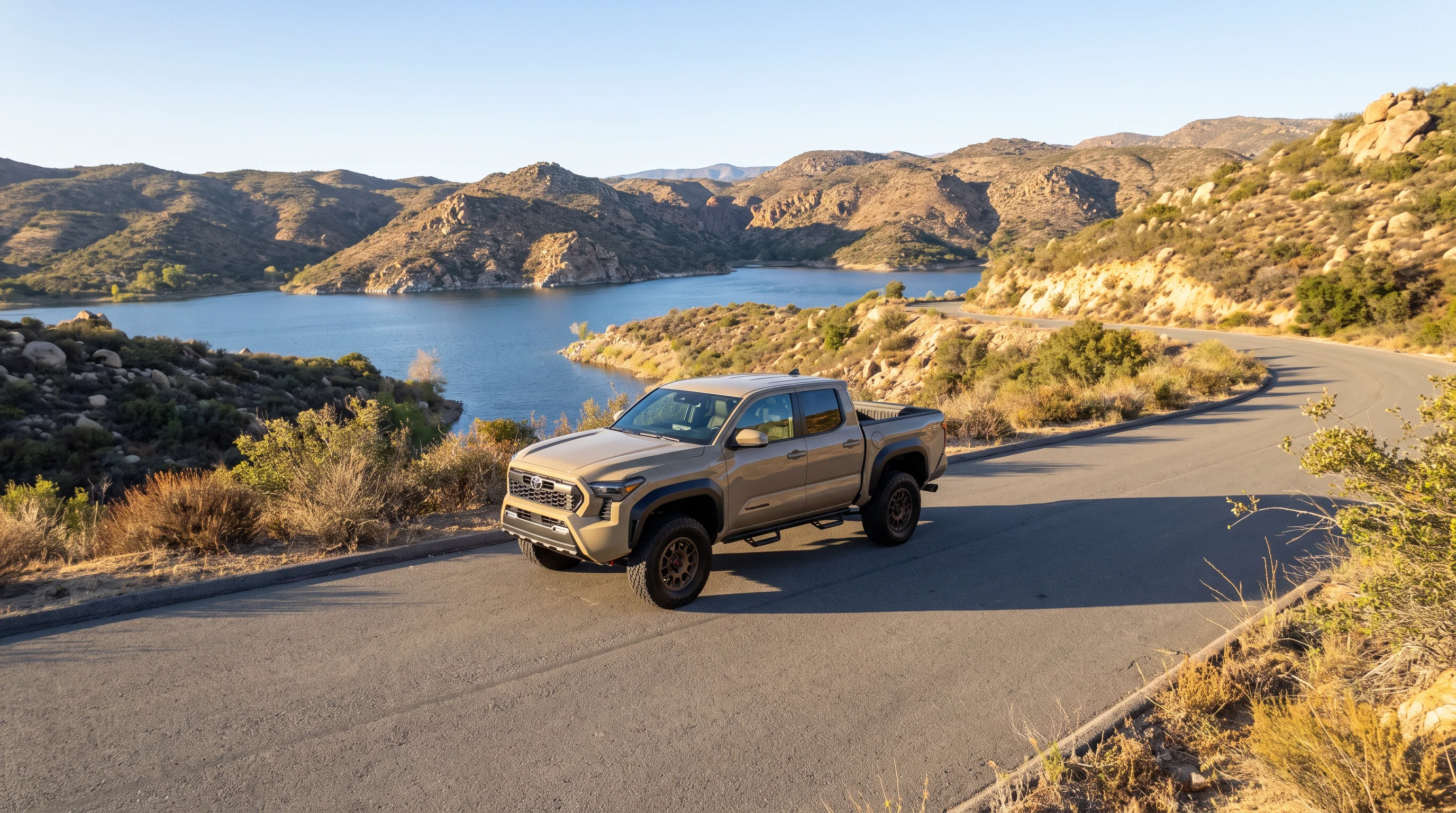
Canyon Lake is not a public reservoir. It is an exclusive 400-acre private lake inside a gated Southern California community. The Canyon Lake Property Owners Association leases the surface rights from the Elsinore Valley Municipal Water District, specifically to keep the lake an exclusive benefit for its members. Boats launch from the POA’s own ramps at Holiday Harbor and Eastport Park, and lake status is communicated through a red, yellow, and green flag system posted at both locations.
That private-lake structure shapes every towing decision a Canyon Lake household makes. The POA also caps how large a motorized vessel can be. Knowing that cap before you shop saves a lot of trouble at registration. The lake sits roughly 22 road miles from our Temecula showroom. That is close enough for an easy drive, and far enough that a properly equipped rig still matters.
What Canyon Lake’s Boat Size Limits Mean Before You Shop
The 21’6″ and 6,000-Pound Cap
Under POA rule LM.7.2, motorized vessels at Canyon Lake may not exceed 21 feet 6 inches in length or 6,000 pounds in dry weight. Boats registered with the POA as of February 7, 2023 are grandfathered if they exceed those limits. That protection lasts until the boat is sold, removed, or transferred. There is no separate pontoon exemption. A 28-foot pontoon, or a 22-foot one for that matter, cannot be registered at this lake.
Related Limits Worth Knowing
A few related rules shape the same decision. A maximum of two boats may be registered per property. Only one of them may exceed 70 horsepower. Jet skis, motorized boards, and personal motorized watercraft are prohibited on Canyon Lake entirely. All vessels, motorized and non-motorized alike, must carry current POA registration stickers on both sides of the bow. Motorized boats and sailboats over 8 feet also need California state registration.
For tow vehicle shopping, that 6,000-pound dry-weight ceiling is the number that matters. It sets a hard upper bound on the boat you will ever legally pull to this lake. That makes the towing question much easier to answer than it is at an open public reservoir.
How Much Towing Capacity Do You Actually Need?
Start With the Loaded Weight of Your Rig
Start with the boat, not the brochure. A 22-foot-class pontoon averages roughly 2,200 pounds dry, including the motor. A typical pontoon trailer adds about 1,200 pounds. That puts a common dry package in the 3,400 to 3,700 pound range before anything goes aboard.
| Component | Typical Weight |
|---|---|
| 22-foot-class pontoon, dry, including motor | About 2,200 lbs |
| Pontoon trailer | About 1,200 lbs |
| Full 30-gallon fuel tank | About 180 lbs |
| Typical dry package (boat plus trailer) | About 3,400 to 3,700 lbs |
Then load it. Batteries, anchors, safety gear, a bimini top, and coolers push the number higher still. That is why towing guides commonly recommend a vehicle rated for at least 5,500 to 6,000 pounds for a pontoon package. A tow rating with real headroom keeps your transmission, cooling system, and frame inside their design limits rather than at the edge of them.
Maximum towing and payload capacity figures are based on properly equipped vehicles and vary by configuration. Do not exceed any weight rating. See your owner’s manual and the vehicle’s door-jamb label for specific capacities.
Get Tongue Weight Right
Balance matters as much as capacity. The governing specification is tongue weight. On a conventional bumper-pull trailer it should land between 10 and 15 percent of the loaded gross trailer weight. Fall below roughly 9 percent and the trailer turns rear-heavy and sway-prone at highway speed. Go much above 15 percent and you overload the rear axle and lighten the steering. Loading about 60 percent of your cargo forward of the trailer axle is the practical way to land in that window. Always measure loaded rather than dry, and check the result against your vehicle’s tongue weight rating.
Which Toyota Matches a Canyon Lake-Legal Boat?
Because the lake caps dry vessel weight at 6,000 pounds, the right Toyota is not automatically the biggest one. Several models in the lineup clear a Canyon Lake-legal boat comfortably.
| Model | Max Towing (Properly Equipped) | Powertrain Notes | Clears a Canyon Lake-Legal Boat? |
|---|---|---|---|
| 2026 Toyota Tundra | Up to 12,000 lbs with the gas i-FORCE V6; up to 11,450 lbs with i-FORCE MAX | 3.4-liter twin-turbo V6; the i-FORCE MAX hybrid adds an electric motor for 437 hp and 583 lb-ft | Yes, with substantial margin |
| 2026 Toyota Sequoia | Up to 9,520 lbs on SR5 2WD; roughly 8,980 to 9,300 lbs on other trims and 4WD | i-FORCE MAX 3.4-liter twin-turbo V6 hybrid, standard on every trim | Yes, with substantial margin |
| 2026 Toyota Tacoma | Up to 6,500 lbs on SR5 and TRD PreRunner; from 3,500 lbs on base grades | 2.4-liter turbocharged gas four for the highest rating; i-FORCE MAX hybrid also offered | Yes, when configured for maximum towing |
| 2026 Toyota Grand Highlander | Up to 5,000 lbs with Hybrid MAX; 3,500 lbs with the standard Hybrid | Hybrid MAX pairs a 2.4-liter turbo with standard all-wheel drive; the standard Hybrid uses a 2.5-liter | Yes for lighter packages; check against your loaded weight |
Maximum towing and payload capacity figures are based on properly equipped vehicles and vary by configuration. Do not exceed any weight rating. See your owner’s manual and the vehicle’s door-jamb label for specific capacities.
How the Four Models Compare in Practice
The 2026 Tundra leads the lineup. It tows up to 12,000 pounds when properly equipped with the gas i-FORCE twin-turbo V6, and up to 11,450 pounds as an i-FORCE MAX hybrid. The Sequoia runs the i-FORCE MAX twin-turbo 3.4-liter V6 hybrid on every trim and tows up to 9,520 pounds in SR5 two-wheel drive. Four-wheel drive and the upper trims land closer to 8,980 to 9,300 pounds, so the configuration you pick matters. It seats eight across three rows, or seven with second-row captain’s chairs. The Tacoma reaches up to 6,500 pounds with the 2.4-liter turbocharged gas engine on SR5 and TRD PreRunner grades. Base grades start at 3,500 pounds, so configuration matters. The Grand Highlander splits by powertrain. The 2.5-liter Hybrid is rated at 3,500 pounds. The Hybrid MAX 2.4-liter turbo reaches 5,000 pounds.
Maximum towing and payload capacity figures are based on properly equipped vehicles and vary by configuration. Do not exceed any weight rating. See your owner’s manual and the vehicle’s door-jamb label for specific capacities.
Grand Highlander Hybrid Fuel Economy by Configuration
The trade-off between the two Grand Highlander hybrid powertrains shows up clearly at the pump.
| Configuration | EPA-Estimated City | EPA-Estimated Highway | EPA-Estimated Combined | Max Towing |
|---|---|---|---|---|
| Grand Highlander Hybrid XLE, front-wheel drive | 37 mpg | 34 mpg | 36 mpg | 3,500 lbs |
| Grand Highlander Hybrid, all-wheel drive | 36 mpg | 32 mpg | 34 mpg | 3,500 lbs |
| Grand Highlander Hybrid MAX, all-wheel drive | 26 mpg | 27 mpg | 27 mpg | 5,000 lbs |
EPA-estimated fuel economy figures are for comparison purposes only. Your actual mileage will vary depending on driving conditions, how you drive and maintain your vehicle, battery age/condition, and other factors.
Factory Towing Features That Matter at a Launch Ramp
Launching a heavy vessel puts specific demands on a vehicle, and Toyota’s towing hardware addresses most of them directly.
Braking and Stability
An Integrated Trailer Brake Controller lets you fine-tune trailer braking from the driver’s seat. That is what keeps a trailer from pushing the tow vehicle’s rear tires toward the water on a wet, algae-slick ramp. For 2026, Toyota makes a tow hitch receiver and 7/4-pin trailer connector standard on every US Tundra. The brake controller, tow mirrors, and camera systems depend on grade, package, and build configuration.
Visibility and Hitch Alignment
Trailer-Sway Control is standard towing technology on the 2026 Tundra, delivered through the vehicle stability system. Trailer Backup Guide with Straight Path Assist uses cameras and sensors to help hold a straight line while reversing. On Sequoia it arrives in the available Tow Technology Package alongside a digital rearview mirror. The Panoramic View Monitor is a separate system. It stitches multiple cameras into a 360-degree exterior view for judging clearances and lining up a hitch. Sequoia also offers a wireless trailer camera that mounts to the back of the trailer and displays on the digital rearview mirror or the center screen.
Holding Position on the Ramp
Hill Start Assist Control addresses the ramp incline itself. On the 2026 Tundra it is designed to help minimize backward rolling on steep ascents as you move from the brake to the accelerator. Toyota is explicit that it is not a substitute for safe driving judgment, and that speed, grade, surface conditions, and driver input all affect whether it is effective.
Driver-assistance and advanced safety systems are supplemental aids and are not substitutes for safe and attentive driving. Availability, operation, and effectiveness vary by trim and equipment and depend on factors including road, weather, traffic, and vehicle condition. Always keep your hands on the wheel and your eyes on the road. See your owner’s manual for system limitations and details.
Canyon Lake Boating Rules Every Tow-Vehicle Owner Should Know
Compliance at Canyon Lake is enforced by the POA’s Marine Patrol, which also conducts biannual safety inspections and inspects all new boats. Full rules are published on the Canyon Lake POA lake rules page.
| Requirement | What Canyon Lake Requires |
|---|---|
| Vessel registration | Annual POA registration for every vessel, with current stickers on both sides of the bow. Motorized boats and sailboats over 8 feet also need California state registration. |
| Insurance and inspection | Certificate of Liability Insurance with minimum $300,000 coverage naming the POA as additional insured, plus a Marine Patrol Safety Certificate renewed every two years or on change of ownership. |
| Operator credential | A California Boater Card, required of all boaters regardless of age. |
| Speed limits | 35 mph inside the Main Lake Ski Area buoys. Everywhere else is no-wake: up to 5 mph, and only as fast as you can travel without creating a wake. That includes the entire Main Lake perimeter, all coves, and the whole of East Bay. |
| Warning flags | Red closes the Main Lake to boat traffic, yellow restricts it to no-wake, green means no restrictions. Check the flag before you launch. |
| Water quality closures | Chelated copper algaecide treatments can restrict swimming, boating, and all water contact for up to 72 hours during and after each application. Routine alum applications typically leave the lake open with little disruption. |
The California Boater Card
This one catches people out, because it is a state requirement rather than a lake rule. Effective January 1, 2025, every operator of a motorized vessel on California waterways must complete an approved boating safety course and carry a California Boater Card issued by the California State Parks Division of Boating and Waterways. The requirement applies to all ages, the earlier age-based phase-in is finished, and the card is valid for life once issued. A few narrow exemptions remain in the statute. Canyon Lake’s own rules restate the requirement for anyone operating on its waterways.
Required Equipment on Motorized Boats
Marine Patrol checks for all of the following:
- One Coast Guard approved life jacket per person aboard
- One whistle or horn
- Approved navigation lights, displayed between almanac sunset and sunrise and during restricted visibility
- One Type B-1 Coast Guard approved fire extinguisher
- One paddle or oar
- One red or international orange flag
- One Coast Guard approved throwable Type IV flotation device
- Fenders adequate to protect other boats and POA property
- A backfire flame control device on carbureted engines
Frequently Asked Questions About Towing and Boating
What is the maximum vessel length permitted on Canyon Lake?
Motorized vessels may not exceed 21 feet 6 inches in length or 6,000 pounds in dry weight under POA rule LM.7.2. Boats registered with the POA as of February 7, 2023 that exceed those limits are grandfathered until sold, removed, or transferred. No pontoon exemption exists.
What safety equipment is required on a vessel on Canyon Lake?
Motorized boats must carry one Coast Guard approved life jacket per person aboard, one whistle or horn, approved navigation lights for use between almanac sunset and sunrise and during restricted visibility, one Type B-1 fire extinguisher, one paddle or oar, one red or international orange flag, one Coast Guard approved throwable Type IV flotation device, adequate fenders, and a backfire flame control device on carbureted engines.
Why does a dual-axle trailer require a higher tow rating safety margin?
Dual-axle trailers weigh more than single-axle designs and add rolling resistance and tongue weight. A higher vehicle tow rating gives your engine, transmission cooling, frame, and braking systems room to manage that extra load on highway drives and steep ramps rather than working at their limit.
How do seasonal lake maintenance treatments affect launch access?
Chelated copper algaecide applications can restrict swimming, boating, and water contact for up to 72 hours during and after each treatment. Alum applications typically leave the lake open with little disruption. Check current POA lake condition notices before traveling to the ramp.
Start Your Lake-Ready Towing Plan at Temecula Valley Toyota
Once you know Canyon Lake caps your boat at 21 feet 6 inches and 6,000 pounds dry, choosing a tow vehicle gets much more concrete. That might point you toward a Tundra, a Sequoia, a Tacoma, or a Grand Highlander Hybrid MAX. Our team can walk you through tow ratings, factory towing equipment, and which configurations actually carry the capability you need. Call our sales team at (951) 319-7911 or stop by 26631 Ynez Road in Temecula.
Disclaimers
Maximum towing and payload capacity figures are based on properly equipped vehicles and vary by configuration. Do not exceed any weight rating. See your owner’s manual and the vehicle’s door-jamb label for specific capacities.
EPA-estimated fuel economy figures are for comparison purposes only. Your actual mileage will vary depending on driving conditions, how you drive and maintain your vehicle, battery age/condition, and other factors.
Driver-assistance and advanced safety systems are supplemental aids and are not substitutes for safe and attentive driving. Availability, operation, and effectiveness vary by trim and equipment and depend on factors including road, weather, traffic, and vehicle condition. Always keep your hands on the wheel and your eyes on the road. See your owner’s manual for system limitations and details.
0 comment(s) so far on Towing a Boat to Canyon Lake: Tow Ratings, Launch Rules, and the Right Toyota for the Job