

2026 Toyota RAV4 Hybrid vs. Older Gas RAV4 Models: What Actually Changed
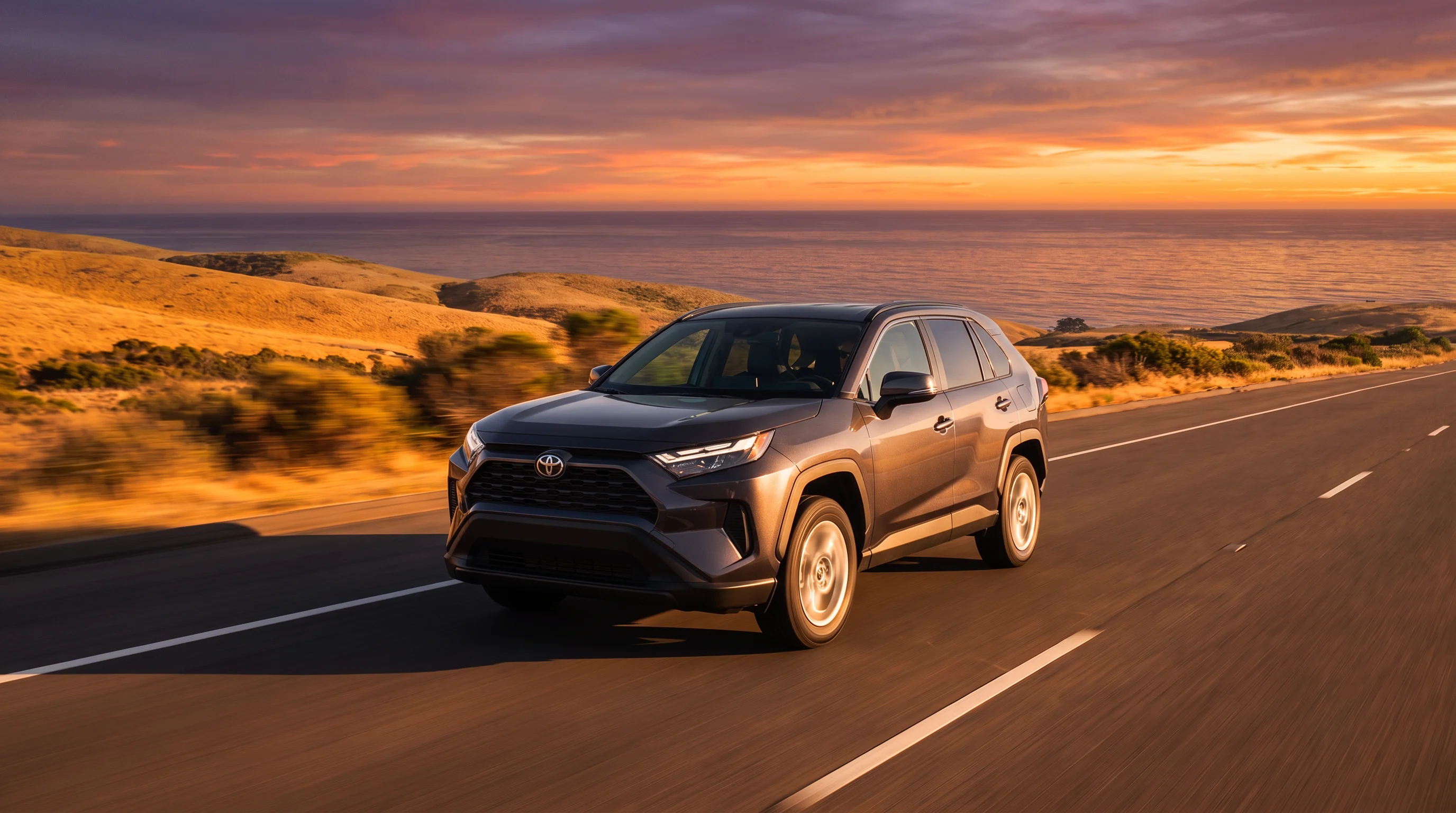
The 2026 Toyota RAV4 is hybrid-only. Toyota discontinued the gas-only model for the sixth generation. Every new RAV4 now pairs a 2.5-liter four-cylinder with electric motors.
The difference at the pump is large. A front-wheel-drive 2026 RAV4 Hybrid is rated at an EPA-estimated 47 mpg city, 40 mpg highway and 43 mpg combined. A front-wheel-drive gas RAV4 from the 2019 through 2025 generation was rated at an EPA-estimated 27 mpg city, 35 mpg highway and 30 mpg combined.
That is 20 mpg more in the city and 13 mpg more combined. The gain is biggest exactly where drivers around Temecula and Murrieta spend most of their time.
EPA-estimated fuel economy figures are for comparison purposes only. Your actual mileage will vary depending on driving conditions, how you drive and maintain your vehicle, battery age/condition, and other factors.
What Happened to the Gas-Only RAV4?
For its sixth generation, Toyota moved the RAV4 to an all-electrified lineup. There is no gasoline-only RAV4 for 2026. Every model is either a hybrid or a plug-in hybrid. The 2026 hybrid lineup spans six grades: LE, SE, XLE Premium, Woodland, XSE and Limited.
The shift had been building for a while. Toyota dropped the gas-powered Adventure and TRD Off-Road grades after the 2024 model year. That left the 2025 gas lineup to LE, XLE, XLE Premium and Limited. Then the gas engine left the RAV4 entirely.
If you drive a RAV4 built between 2019 and 2025, what follows covers what a trade-up actually changes. For a grade-by-grade look at where each 2026 model lands, our 2026 RAV4 MPG guide breaks the lineup down in detail.
Generation vs. Generation: The Numbers
| Specification | 2019–2025 RAV4 (Gas) | 2026 RAV4 Hybrid |
|---|---|---|
| Powertrain | 2.5L 4-cylinder, Direct Shift 8-speed automatic | 2.5L 4-cylinder hybrid, eCVT |
| Horsepower | 203 hp | 226 hp FWD / 236 hp AWD |
| EPA-Estimated MPG (FWD) | 27 city / 35 hwy / 30 combined | 47 city / 40 hwy / 43 combined |
| EPA-Estimated MPG (AWD) | 25–27 city / 32–34 hwy / 28–30 combined | 46 city / 39 hwy / 42 combined (LE, SE) |
| Drivetrain choice | FWD or AWD on gas grades; hybrid grades were AWD only | FWD or AWD, depending on grade |
| All-wheel-drive type | Mechanical — driveshaft to rear differential | Electronic On-Demand — rear electric motor |
| Driver assistance | Toyota Safety Sense 2.0 (2019–22) / 2.5 (2023–25) | Toyota Safety Sense 4.0 |
| Grades | LE, XLE, XLE Premium, Limited; Adventure and TRD Off-Road through 2024 | LE, SE, XLE Premium, Woodland, XSE, Limited |
EPA-estimated fuel economy figures are for comparison purposes only. Your actual mileage will vary depending on driving conditions, how you drive and maintain your vehicle, battery age/condition, and other factors.
Fuel Economy: Where the Gain Shows Up
Why city driving punishes a gas engine
Repeated stops, idling at signals and pulling away from a standstill all burn fuel without covering much ground. The older gas RAV4 paired its 2.5-liter four-cylinder with a Direct Shift 8-speed automatic. Every launch asked that engine to work hard through first and second gear.
How the hybrid handles the same traffic
The 2026 hybrid shuts the gasoline engine off during coasting and at full stops. Its electric motor moves the vehicle at low speeds instead. Energy a gas RAV4 threw away as brake heat is recovered through regenerative braking and stored in the battery.
That is why the 2026 RAV4 Hybrid posts a higher city rating than highway rating. Most SUVs work the other way around. The pattern favors stop-and-go commuting through Temecula, Murrieta and Menifee over steady highway cruising.
What lowers real-world mileage
Running air conditioning through a Southern California summer draws on the system. The engine cycles on more often, and real-world efficiency lands below the EPA figures. That holds true for both powertrains.
Power and All-Wheel Drive
The 2026 RAV4 Hybrid produces 226 combined horsepower with front-wheel drive and 236 horsepower with all-wheel drive. The 2019 through 2025 gas engine made 203 horsepower.
The delivery feels different too. The older gas RAV4 built power by climbing through the ratios of its 8-speed automatic. That produced familiar, linear acceleration on a freeway on-ramp. The hybrid uses electric torque from a standstill. The vehicle is already moving before the gasoline engine reaches its power band, which shows up most when merging onto I-15 or changing lanes.
Older Gas RAV4: Mechanical AWD
A driveshaft ran back to a rear differential. On the Adventure and TRD Off-Road grades, a dynamic torque-vectoring system could send up to 50 percent of torque to the rear wheels.
2026 RAV4 Hybrid: Electronic On-Demand AWD
A dedicated electric motor sits on the rear axle. There is no mechanical connection between the axles, so torque reaches the rear wheels the moment front-wheel slip is detected.
A new choice for hybrid buyers
Through 2025, choosing the RAV4 Hybrid meant choosing all-wheel drive. Toyota did not offer it any other way. For 2026, front-wheel drive comes to the RAV4 Hybrid for the first time. It is standard on the LE, SE and XLE Premium, with all-wheel drive available. The Woodland, XSE and Limited come with all-wheel drive standard.
Safety and Driver Assistance
Which Toyota Safety Sense version your RAV4 has
Every RAV4 has carried Toyota Safety Sense as standard equipment since 2019. The version matters when you compare an older model to a new one.
| RAV4 Model Years | Toyota Safety Sense Version |
|---|---|
| 2019–2022 | Toyota Safety Sense 2.0 |
| 2023–2025 (gas and hybrid) | Toyota Safety Sense 2.5 |
| 2026 | Toyota Safety Sense 4.0 |
The RAV4 is the first Toyota to launch with Toyota Safety Sense 4.0, which comes standard on every 2026 grade. TSS 4.0 runs on Toyota’s new Arene software platform. It updates detection for systems including Pre-Collision Detection and Lane Tracing Assist, and it adds Proactive Driving Assist. Our Toyota Safety Sense page covers how each system works.
Crash-test ratings
RAV4 models from 2022 through 2025 earned a 5-Star Overall Vehicle Score from the National Highway Traffic Safety Administration. That rating does not carry over to a redesigned vehicle. The 2026 RAV4 has not yet received a published NHTSA overall rating. It also does not hold an IIHS Top Safety Pick award, though no Toyota SUV earned one for the 2026 model year under the institute’s tightened criteria. Full test-by-test results for earlier model years are published on the IIHS RAV4 ratings page.
Driver-assistance and advanced safety systems are supplemental aids and are not substitutes for safe and attentive driving. Availability, operation, and effectiveness vary by trim and equipment and depend on factors including road, weather, traffic, and vehicle condition. Always keep your hands on the wheel and your eyes on the road. See your owner’s manual for system limitations and details.
Common Questions About the 2026 RAV4 Hybrid
Does the 2026 Toyota RAV4 Hybrid need to be plugged in?
No. The standard 2026 RAV4 Hybrid is self-charging and does not plug into an external electrical outlet. The battery recharges automatically while you drive, using energy generated by the gasoline engine and energy recovered through regenerative braking during deceleration. If plugging in is what you want, that is the separate RAV4 Plug-in Hybrid, which adds a charging port and electric-only driving range.
How does warranty coverage compare between a gas RAV4 and the 2026 hybrid?
Both carry Toyota’s 3-year/36,000-mile basic warranty and 5-year/60,000-mile powertrain warranty. The hybrid adds coverage the gas model never had: 8 years or 100,000 miles on hybrid-related components, and 10 years or 150,000 miles on the hybrid battery.
| Coverage | Gas RAV4 (2019–2025) | 2026 RAV4 Hybrid |
|---|---|---|
| Basic | 3 years / 36,000 miles | 3 years / 36,000 miles |
| Powertrain | 5 years / 60,000 miles | 5 years / 60,000 miles |
| Hybrid components | Not applicable | 8 years / 100,000 miles |
| Hybrid battery | Not applicable | 10 years / 150,000 miles |
This information is provided for general educational purposes only and does not constitute legal advice. Warranty coverage depends on the specific terms of your vehicle’s warranty agreement. Consult your owner’s manual or a qualified legal professional for guidance on your individual situation.
See the 2026 RAV4 Hybrid in Temecula
Whether trading up makes sense depends on how you drive. Drivers covering heavy stop-and-go miles see the largest return. That is where the hybrid system does the most work. Drivers who spend most of their time at highway speed still gain, though the margin narrows.
Our team at Temecula Valley Toyota can walk you through the 2026 lineup and how it compares to the RAV4 you drive now. Call (951) 319-7911 or visit us at 26631 Ynez Road in Temecula. We serve drivers throughout Murrieta, Menifee, Fallbrook, Lake Elsinore, Canyon Lake, Wildomar, Winchester and Sun City.
Disclaimers
EPA-estimated fuel economy figures are for comparison purposes only. Your actual mileage will vary depending on driving conditions, how you drive and maintain your vehicle, battery age/condition, and other factors.
Driver-assistance and advanced safety systems are supplemental aids and are not substitutes for safe and attentive driving. Availability, operation, and effectiveness vary by trim and equipment and depend on factors including road, weather, traffic, and vehicle condition. Always keep your hands on the wheel and your eyes on the road. See your owner’s manual for system limitations and details.
This information is provided for general educational purposes only and does not constitute legal advice. Warranty coverage depends on the specific terms of your vehicle’s warranty agreement. Consult your owner’s manual or a qualified legal professional for guidance on your individual situation.
0 comment(s) so far on 2026 Toyota RAV4 Hybrid vs. Older Gas RAV4 Models: What Actually Changed