Open Today Sales: 9 AM-7 PM
Open Today Service: 6 AM-5 PMOpen Today Express Service Center: 6 AM-5 PM
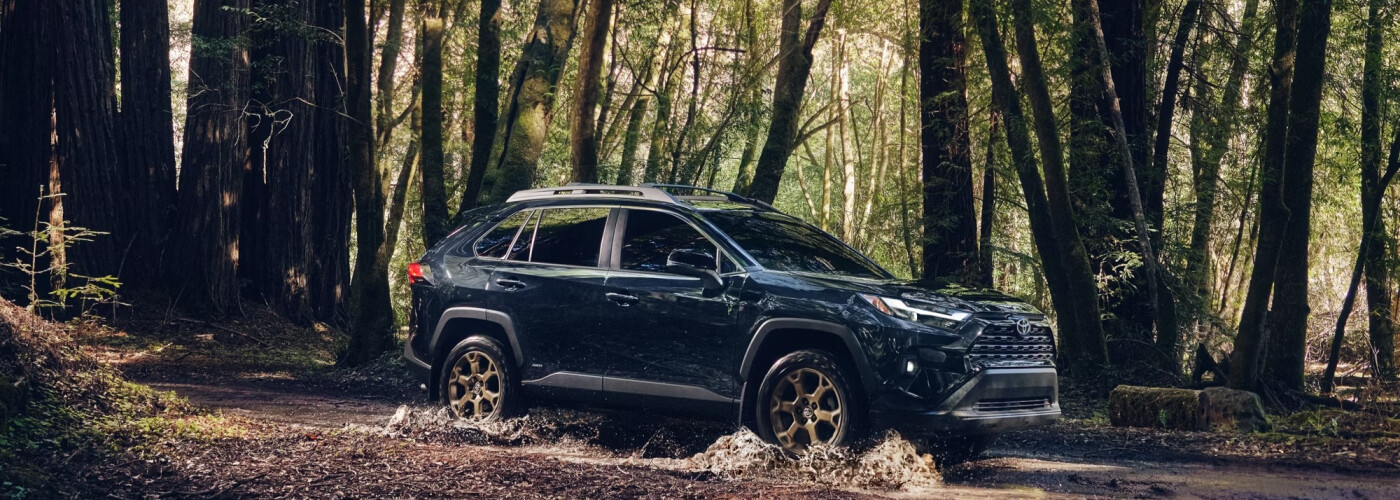
vs.
Seating Capacity
Base-Level FWD Fuel Economy
Maximum Available Towing Capacity
All-Wheel Drive
Touchscreen Size
Toyota Safety Sense™
Few compact SUV matchups generate as much conversation as the Toyota RAV4 vs. Honda CR-V. Drivers in Murrieta and beyond have trusted both nameplates for years, and the 2026 models continue to deliver comfort, efficiency, and versatility. That said, the two are far from identical. Let Temecula Valley Toyota walk you through the key differences and help you choose the best crossover SUV for your daily drives in Winchester.
Powertrain choices set these two apart right away. The entire 2026 RAV4 lineup runs on a 2.5L four-cylinder hybrid system that delivers 236 combined hp and 170 lb-ft of torque. Honda takes a different approach with the CR-V, offering a turbocharged 1.5L gas engine rated at 190 hp on the base trim. The fuel economy gap is hard to overlook—compare the base FWD figures for yourself:
Towing is another area where the RAV4 pulls ahead, literally. Canyon Lake adventurers who need to bring along a small trailer or watercraft will appreciate a maximum available capacity of 3,500 pounds versus 1,500 pounds for the CR-V. A plug-in hybrid option is also exclusive to the RAV4 lineup, giving efficiency-minded drivers even more flexibility.
Shoppers comparing the RAV4 vs. CR-V size will find more similarities than differences. Five-passenger seating is standard on both models, and exterior dimensions line up closely across all trims. Neither model forces you to sacrifice cabin or cargo room in this segment.
Touchscreen infotainment, smartphone integration, and robust driver-assist systems come standard on both models. Where the RAV4 separates itself is in the details—a larger available display and a collection of technologies that the Honda lineup does not match. Here are some of the standard and available features you can enjoy during your Wildomar drives:
Long-term dependability is a major factor for any SUV purchase, and the 2026 J.D. Power U.S. Vehicle Dependability Study sheds light on how Toyota and Honda stack up. The study surveys original owners of three-year-old vehicles and measures reliability using a metric called problems per 100 vehicles (PP100)—the lower the score, the fewer issues reported. In the 2026 rankings, Toyota placed 8th overall, well above the industry average of 204 PP100.
Honda, on the other hand, landed at 17th, falling below the industry average. For drivers who plan to keep their compact SUV for years to come, that gap in long-term dependability is worth considering.
The numbers tell a compelling story, but nothing replaces time behind the wheel. Reach out to our team or swing by Temecula Valley Toyota to experience the 2026 RAV4 firsthand. If you want to save time on your visit, we encourage you to apply for financing before you arrive.

When you need to take home an SUV that offers plenty of space, and performance, then it’s no secret you’re going to turn your attention to the latest from Toyota and Honda. You’ve probably narrowed your selections down to the Honda CR-V vs. Toyota RAV4, but why should you take home either the RAV4 or CR-V? When comparing both vehicles’ side-by-side performance, towing, and interior features, you can get a better idea about which one is best for your driving needs in Murrieta or Canyon Lake. Continue reading about the RAV4 vs. CR-V with this guide from Temecula Valley Toyota, then contact us to schedule a test drive of the RAV4 for yourself.
Let’s start with the 2023 Toyota RAV4 vs. Honda CR-V price. The CR-V comes with a higher-priced base trim level than the Toyota RAV4:
When looking over the 2023 Toyota RAV4 vs. Honda CR-V in terms of performance, the difference is striking. The 2023 Toyota RAV4 provides more engine power for easier handling, and you’ll need the higher power for traversing Wildomar hills. The extra power also lends well to better towing for utility trailers, 5th-wheel campers, and small boats. Take a look at the engine specs and capabilities so you can easily decide whether to take home the RAV4 or CR-V:
Driver assist safety features are the norm for SUVs everywhere, including on many Canyon Lake roads. These technologically advanced safety systems alert you to immediate dangers, such as other vehicles, pedestrians, or objects in your path.
Toyota has made its Toyota Safety Sense™ system standard on all new vehicles, including the 2023 Toyota RAV4. Honda offers Honda Sensing® in most of their inventory. However, you’ll notice that the Toyota RAV4 offers more standard safety features compared to the Honda CR-V. Check out the safety systems of the Toyota RAV4 vs. Honda CR-V:
So between the Toyota RAV4 and Honda CR-V, which one should you take home? Obviously the Toyota RAV4! A new 2023 Toyota RAV4 offers more standard features, higher standard power, and better safety than the Honda CR-V. You can even apply for financing online so that you can easily take home the Toyota model that works for you. Our team of finance experts are here to help as well.
Ever since compact SUVs have been in the market, there’s always been a fierce competition between the Toyota RAV4 and the Honda CR-V. Both of these do their job well, helping with commutes and saving you space around Murrieta, but many ask us which to choose in the RAV4 vs. CR-V matchup. It can be a difficult decision, so Temecula Valley Toyota covers the 2021 Toyota RAV4 vs. Honda CR-V comparison below!
Let’s start with the engine options that Lake Elsinore drivers have with both vehicles. The Honda CR-V has an engine that’ll help it get around easily, but the RAV4 specs outdo it by many measures. With more horsepower and more torque, you’ll be able to tow and control your drives on the RAV4. Here are more details about the 2021 Toyota RAV4 vs. Honda CR-V engines:
2021 Toyota RAV4 LE with Front-Wheel Drive
2021 Honda CR-V LX with Front-Wheel Drive
The RAV4 also comes as a hybrid!
One of the best reasons to invest in a Toyota vehicle in 2021 is the implementation of their Toyota Safety Sense™ suite of safety features across their entire vehicle lineup. Safety features that used to require expensive upgrades now come standard on Toyota vehicles like the RAV4. Honda has their own safety suite called Honda Sensing®, but it doesn’t have everything that the RAV4 does:
Toyota Safety Sense™ 2.0 (TSS 2.0) Standard Features Not on Honda Safety Sense®: is
Honda Sensing® comes with Forward Collision Warning (FCW), Lane Departure Warning (LDW), Collision Mitigation Braking System (CMBS), and Road Departure Mitigation System (RDMS) on its base trim, but it doesn’t include some of the most valuable features on the RAV4.
The 2021 Toyota RAV4 vs. Honda CR-V matchup is a tight race, but the advantages of the RAV4 this year are undeniable. If you’re still on the fence, Temecula and Menifee drivers should come down to Temecula Valley Toyota and try out the RAV4 for themselves! Go ahead and contact us to set up a test drive!
*MSRP excludes the Delivery, Processing, and Handling Fee of $955 for Cars (Yaris HB, Yaris, Yaris iA, 86, Corolla, Corolla HB, Camry, Camry HV, Prius LB, Prius c, Prius Prime, Mirai, Avalon, Avalon HV, Supra), $1,120 for Small/Medium Trucks, SUVs and Van (C-HR, RAV4, RAV4 HV, Highlander, Highlander HV, 4Runner, Sienna, Tacoma), $1,325 for Large SUVs (Sequoia, Land Cruiser), and $1,595 for Large Truck (Tundra). (Historically, vehicle manufacturers and distributors have charged a separate fee for processing, handling and delivering vehicles to dealerships. Toyota’s charge for these services is called the “Delivery, Processing and Handling Fee” and is based on the value of the processing, handling and delivery services Toyota provides as well as Toyota’s overall pricing structure. Toyota may make a profit on the Delivery, Processing and Handling Fee.) Excludes taxes, license, title and available or regionally required equipment. The Delivery, Processing and Handling Fee in AL, AR, FL, GA, LA, MS, NC, OK, SC and TX will be higher. The published prices do not apply to Puerto Rico and the U.S. Virgin Islands. Actual dealer price will vary.