

2027 Toyota Camry vs. 2027 Toyota Prius: Which Hybrid Is Better for Your Temecula Commute?
Temecula Valley drivers have two strong Toyota hybrids to choose from. They solve the commute differently. The 2027 Toyota Prius LE is EPA-estimated at 59 MPG city and 55 MPG combined. The 2027 Toyota Camry LE answers with an EPA-estimated 52 MPG city, 51 MPG combined, a midsize cabin and 38 inches of rear legroom for an extra $945 TSRP. Neither is the wrong answer. The right one depends on whether your daily drive rewards efficiency or space.
Total Suggested Retail Price (TSRP) for new vehicles includes manufacturer and distributor options and delivery, processing, and handling fees, which are subject to change at any time. TSRP excludes taxes, title, license, dealer-installed options, accessories, fees and charges. TSRP is not the dealer advertised price. Dealer prices will vary. The dealer sets the final price.
EPA-estimated fuel economy figures are for comparison purposes only. Your actual mileage will vary depending on driving conditions, how you drive and maintain your vehicle, battery age/condition, and other factors.
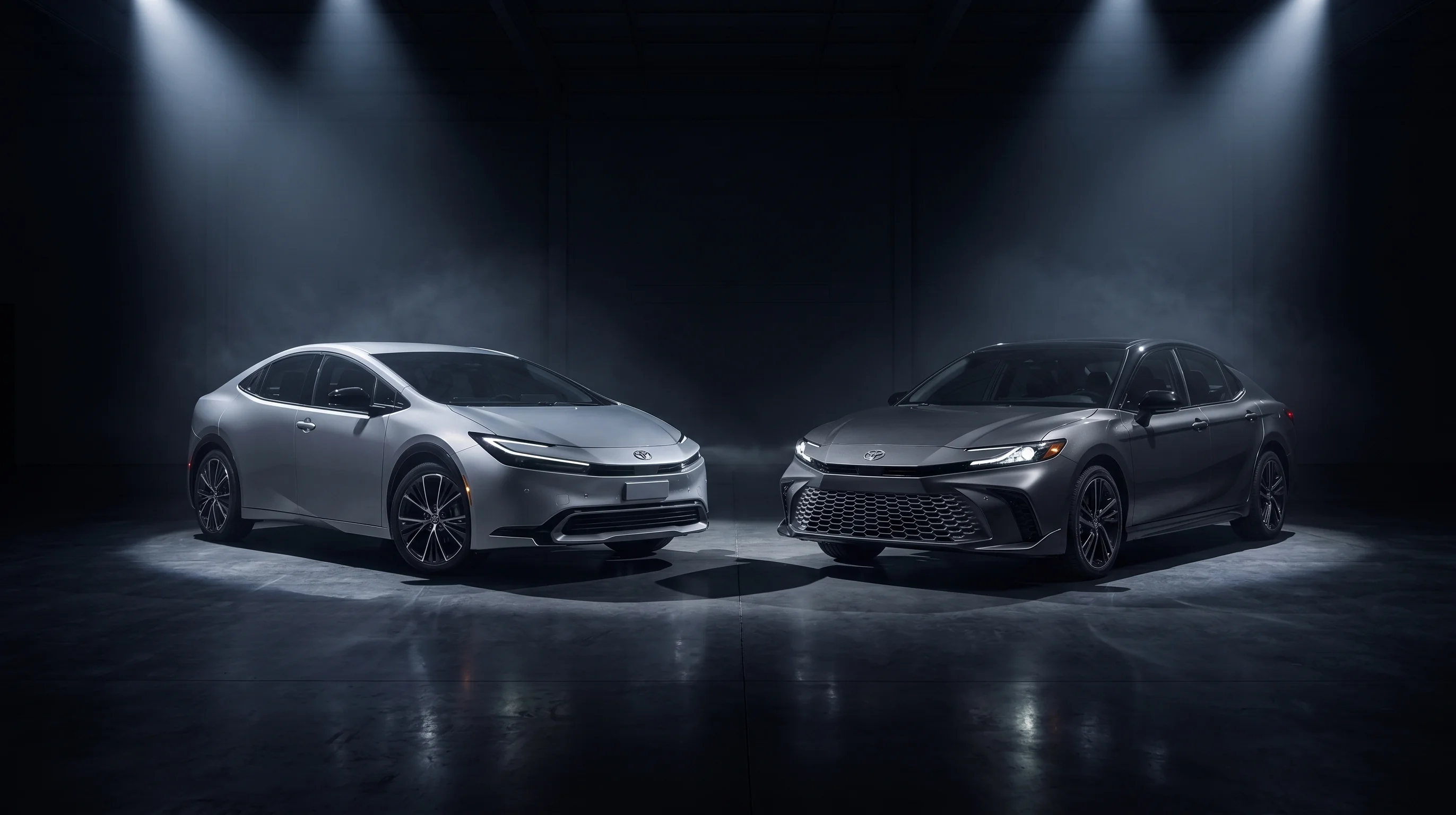
Which Toyota Hybrid Fits a Temecula Valley Commute?
A daily commute is repeated mileage across mixed surface streets and freeway, and the fuel bill compounds over a year. The two cars below handle that routine in different ways.
The Prius Approach: Stretch Every Gallon
The Prius is a compact hatchback measuring 181.1 inches long on a 108.3-inch wheelbase, which makes it the more compact of the two. Full specifications are published on the official Toyota Prius page.
The Camry Approach: Make the Miles Comfortable
At 193.5 inches long on a 111.2-inch wheelbase, the Camry gives up some efficiency to gain midsize proportions. It still returns an EPA-estimated 51 MPG combined on the LE grade, per the official Toyota Camry page.
EPA-estimated fuel economy figures are for comparison purposes only. Your actual mileage will vary depending on driving conditions, how you drive and maintain your vehicle, battery age/condition, and other factors.
2027 Camry LE vs. 2027 Prius LE: Head-to-Head Specifications
Both lineups are hybrid-only, and both entry grades use a continuously variable transmission. The differences show up in size, efficiency and price. Figures below are drawn from the Toyota Camry and Toyota Prius official model pages.
| Specification | 2027 Toyota Camry LE | 2027 Toyota Prius LE |
|---|---|---|
| Starting TSRP | $30,995 TSRP | $30,050 TSRP |
| EPA-Estimated MPG (FWD) | 52 city / 49 hwy / 51 combined | 59 city / 50 hwy / 55 combined |
| Engine | 2.5L 4-cylinder hybrid | 2.0L 4-cylinder hybrid |
| Body style | Midsize sedan | Compact hatchback |
| Overall length | 193.5 in | 181.1 in |
| Wheelbase | 111.2 in | 108.3 in |
| Rear legroom | 38.0 in | 34.8 in |
| Cargo capacity | 15.1 cu ft | 23.8 cu ft |
| Fuel tank | 13.0 gal | 11.3 gal |
| Seating | 5 | 5 |
Total Suggested Retail Price (TSRP) for new vehicles includes manufacturer and distributor options and delivery, processing, and handling fees, which are subject to change at any time. TSRP excludes taxes, title, license, dealer-installed options, accessories, fees and charges. TSRP is not the dealer advertised price. Dealer prices will vary. The dealer sets the final price.
EPA-estimated fuel economy figures are for comparison purposes only. Your actual mileage will vary depending on driving conditions, how you drive and maintain your vehicle, battery age/condition, and other factors.
Pricing and Trim Value
At the entry point the two cars are closer than their reputations suggest. The 2027 Camry LE opens at $30,995 TSRP and the 2027 Prius LE at $30,050 TSRP, a gap of $945 TSRP. For that difference the Camry delivers a full midsize cabin rather than a compact hatchback footprint.
| Configuration | Body style | Starting price |
|---|---|---|
| 2027 Toyota Prius LE FWD | Compact hatchback | $30,050 TSRP |
| 2027 Toyota Camry LE FWD | Midsize sedan | $30,995 TSRP |
| 2027 Toyota Camry LE AWD | Midsize sedan | $32,520 TSRP |
Total Suggested Retail Price (TSRP) for new vehicles includes manufacturer and distributor options and delivery, processing, and handling fees, which are subject to change at any time. TSRP excludes taxes, title, license, dealer-installed options, accessories, fees and charges. TSRP is not the dealer advertised price. Dealer prices will vary. The dealer sets the final price.
How the Trim Ladders Are Structured
The Camry lineup runs five grades: LE, SE, Nightshade, XLE and XSE. The Prius lineup runs four: LE, XLE, Nightshade and Limited. Electronic On-Demand All-Wheel Drive is available across both lineups, and on the Camry it adds $1,525 TSRP to any grade.
The Base Grade Is Also the Efficiency Grade
One detail is worth knowing before you shop up the ladder. On both cars, the entry grade is the most efficient one. The Camry LE rides on 16-inch wheels while the sportier Camry grades use 18s and 19s. The Prius LE rides on 17-inch wheels, against 19-inch wheels on the XLE, Nightshade and Limited. Moving up the ladder buys equipment and styling, but it costs fuel economy on both cars.
Fuel Efficiency and Driving Range for Daily Commutes
This is the category that decides the comparison for most commuters. EPA figures for both models are published at fueleconomy.gov.
| Configuration | EPA-Estimated city | EPA-Estimated highway | EPA-Estimated combined |
|---|---|---|---|
| 2027 Toyota Prius LE FWD | 59 MPG | 50 MPG | 55 MPG |
| 2027 Toyota Prius LE AWD | 56 MPG | 49 MPG | 53 MPG |
| 2027 Toyota Camry LE FWD | 52 MPG | 49 MPG | 51 MPG |
EPA-estimated fuel economy figures are for comparison purposes only. Your actual mileage will vary depending on driving conditions, how you drive and maintain your vehicle, battery age/condition, and other factors.
Where the Efficiency Gap Actually Sits
Note where the difference lands. On the highway the two cars are within one MPG of each other. In the city the Prius leads by seven. If your commute is freeway-dominant, the efficiency argument narrows considerably. If it involves surface streets, signals and stop-and-go traffic, the Prius advantage is real and it compounds.
Tank Size Partly Offsets the Gap
The Camry carries 13.0 gallons and the Prius 11.3. At their combined ratings that works out to roughly 663 miles between fill-ups for the Camry and roughly 622 for the Prius. The Prius uses less fuel; the Camry simply carries more of it.
All-Wheel Drive Costs Less Efficiency Than You Would Expect
All-wheel drive is available on both models. The Camry LE AWD returns up to an EPA-estimated 50 MPG combined, one MPG off the front-wheel-drive LE. The Prius LE AWD is EPA-estimated at 56 MPG city, 49 MPG highway and 53 MPG combined. Neither car asks much of a fuel-economy penalty for the added traction.
EPA-estimated fuel economy figures are for comparison purposes only. Your actual mileage will vary depending on driving conditions, how you drive and maintain your vehicle, battery age/condition, and other factors.
Passenger Comfort and Cargo Space
Camry: Room for People
The Camry offers 38.0 inches of rear legroom, 42.1 inches of front legroom and 37.6 inches of rear headroom, with 57.7 inches of front shoulder room and 55.7 inches in back. Those are the numbers that matter when you regularly carry adults in the second row or install a rear-facing child seat. Trunk capacity is 15.1 cubic feet.
Prius: Room for Gear
The Prius trades rear-seat space for cargo flexibility. Rear legroom measures 34.8 inches and rear headroom 36.4 inches, with 55.3 inches of front shoulder room and 52.8 inches in back. In exchange, the liftgate opens onto 23.8 cubic feet behind the rear seats on the LE grade, well clear of the Camry’s trunk.
The practical read: the Prius carries more stuff, the Camry carries more people. A hatchback opening also swallows tall and awkward items a sedan trunk cannot. The Camry’s wider cabin is the better place to spend an hour in traffic with passengers aboard.
Technology Both Models Share
The two cars are closely matched here, which keeps the decision focused on size and efficiency. Both entry grades come standard with an 8-inch Toyota Audio Multimedia touchscreen, a six-speaker audio system, and wireless Apple CarPlay and Android Auto compatibility, so smartphone integration works without a cable on either car. Both also use a 7-inch digital instrument cluster. Standard equipment is listed on the Toyota Camry and Toyota Prius official pages.
The Camry LE provides five USB ports, three in front and two in the rear. Buyers who want the larger display can add the Multimedia Upgrade Package on the Camry SE, which brings a 12.3-inch touchscreen.
Safety Systems
Toyota Safety Sense 3.0 is standard equipment on both models, and both include Blind Spot Monitor with Rear Cross-Traffic Alert as standard. For a broader look at what the suite covers, Temecula Valley Toyota maintains a dedicated Toyota Safety Sense overview.
Both models also carry top-tier third-party crash credentials, published by the Insurance Institute for Highway Safety. The most recent IIHS Top Safety Pick+ awards, for the 2026 model year, went to both the Camry and the Prius. The Prius award was an upgrade from a prior Top Safety Pick, following improved vehicle-to-vehicle front crash prevention results. The 2026 Camry and 2026 Prius each also hold a five-star overall rating from the National Highway Traffic Safety Administration.
Driver-assistance and advanced safety systems are supplemental aids and are not substitutes for safe and attentive driving. Availability, operation, and effectiveness vary by trim and equipment and depend on factors including road, weather, traffic, and vehicle condition. Always keep your hands on the wheel and your eyes on the road. See your owner’s manual for system limitations and details.
The Verdict for Temecula Valley Drivers
Choose the Prius If Fuel Cost Decides It
An EPA-estimated 59 MPG city rating is a meaningful advantage on stop-and-go driving. The hatchback is more useful than a trunk for bulky loads, and the Prius starts $945 TSRP below the Camry.
Choose the Camry If People Ride With You
Three-plus extra inches of rear legroom and a wider cabin change what a long drive feels like for everyone who is not in the driver’s seat. And an EPA-estimated 51 MPG combined is still strong for a midsize sedan.
EPA-estimated fuel economy figures are for comparison purposes only. Your actual mileage will vary depending on driving conditions, how you drive and maintain your vehicle, battery age/condition, and other factors.
Total Suggested Retail Price (TSRP) for new vehicles includes manufacturer and distributor options and delivery, processing, and handling fees, which are subject to change at any time. TSRP excludes taxes, title, license, dealer-installed options, accessories, fees and charges. TSRP is not the dealer advertised price. Dealer prices will vary. The dealer sets the final price.
The honest summary is that this is not a case of one car beating another. It is a question of which constraint binds harder in your week: fuel cost or cabin space.
Frequently Asked Questions
Is the 2027 Toyota Camry worth the price premium over the 2027 Toyota Prius?
For drivers who regularly carry adult passengers, yes. The Camry LE starts at $30,995 TSRP against $30,050 TSRP for the Prius LE, a difference of $945 TSRP. That $945 TSRP buys a midsize sedan body, 38.0 inches of rear legroom versus 34.8 inches in the Prius, and 225 net combined horsepower. Drivers who prioritize fuel cost over cabin space will find the Prius the stronger value.
Total Suggested Retail Price (TSRP) for new vehicles includes manufacturer and distributor options and delivery, processing, and handling fees, which are subject to change at any time. TSRP excludes taxes, title, license, dealer-installed options, accessories, fees and charges. TSRP is not the dealer advertised price. Dealer prices will vary. The dealer sets the final price.
Which model gets better fuel economy?
The Prius, by a clear margin. The Prius LE with front-wheel drive is EPA-estimated at 59 MPG city, 50 MPG highway and 55 MPG combined. The Camry LE with front-wheel drive is EPA-estimated at 52 MPG city, 49 MPG highway and 51 MPG combined. The gap is widest in city driving, where the Prius leads by seven MPG, and narrows to one MPG on the highway.
EPA-estimated fuel economy figures are for comparison purposes only. Your actual mileage will vary depending on driving conditions, how you drive and maintain your vehicle, battery age/condition, and other factors.
Which model has more cargo space?
The Prius. Its hatchback layout opens onto 23.8 cubic feet of cargo space behind the rear seats on the LE grade. The Camry uses a conventional enclosed trunk with 15.1 cubic feet. The Prius handles tall or bulky loads better, while the Camry offers the wider rear cabin for passengers and child seats.
How can I compare the Camry and Prius in person at Temecula Valley Toyota?
Visit the showroom at 26631 Ynez Road, Temecula, CA 92591, or call the sales team at (951) 319-7911 to arrange a back-to-back test drive. Driving both cars in the same visit is the fastest way to judge whether the Camry’s extra rear-seat room or the Prius’s fuel economy matters more for your daily commute.
Disclaimers
Total Suggested Retail Price (TSRP) for new vehicles includes manufacturer and distributor options and delivery, processing, and handling fees, which are subject to change at any time. TSRP excludes taxes, title, license, dealer-installed options, accessories, fees and charges. TSRP is not the dealer advertised price. Dealer prices will vary. The dealer sets the final price.
EPA-estimated fuel economy figures are for comparison purposes only. Your actual mileage will vary depending on driving conditions, how you drive and maintain your vehicle, battery age/condition, and other factors.
Driver-assistance and advanced safety systems are supplemental aids and are not substitutes for safe and attentive driving. Availability, operation, and effectiveness vary by trim and equipment and depend on factors including road, weather, traffic, and vehicle condition. Always keep your hands on the wheel and your eyes on the road. See your owner’s manual for system limitations and details.