

2026 Toyota Tacoma vs. 2026 Toyota Tundra: Which Truck Fits Your Needs?
Choosing between the midsize 2026 Toyota Tacoma and the full-size 2026 Toyota Tundra comes down to how you actually use a truck — not which one is objectively better. Both ride on Toyota’s TNGA-F body-on-frame truck platform, both are backed by the same factory warranty, and Temecula Valley Toyota stocks both. This comparison lays out verified pricing, powertrain output, capability, fuel economy, cabin equipment, and safety results for each lineup, then points you toward the one that fits your work, your driveway, and your budget.
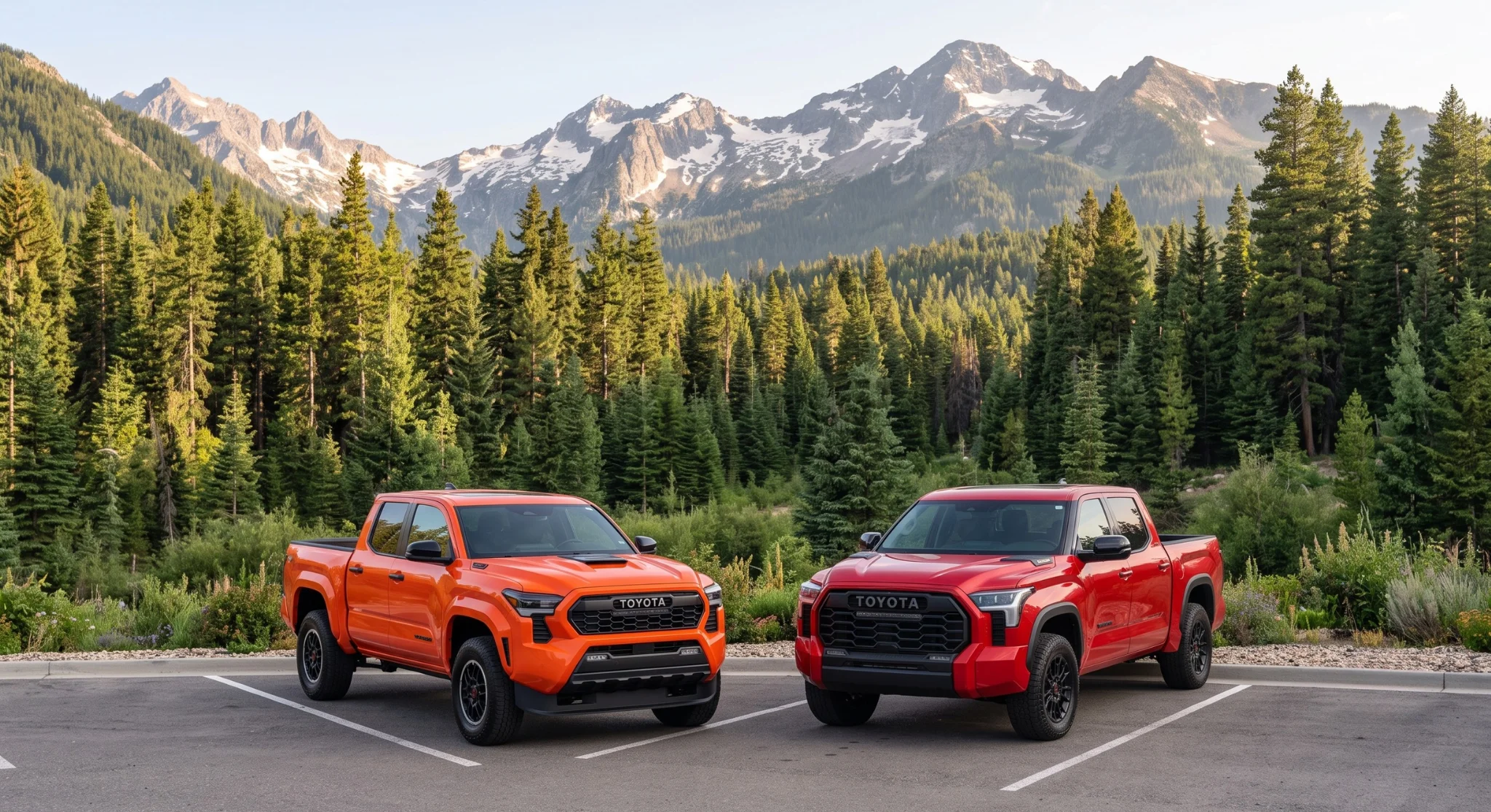
Size and Everyday Usability
The clearest difference between these two trucks is footprint. A Tacoma Double Cab measures 213.0 inches long on a 131.9-inch wheelbase. A Tundra on the 145.7-inch wheelbase — either the Double Cab with the 6.5-foot bed or the CrewMax with the 5.5-foot bed — measures 233.6 inches, and longer bed and cab combinations stretch to 245.6 or 252.5 inches. That 20-inch minimum difference in overall length is what you feel in a standard garage, a parking structure, or a tight drive-through, and it is the single most practical reason midsize buyers stay midsize.
Both trucks seat five in crew-cab form. The Tacoma is also offered as an XtraCab, which seats two and swaps the rear bench for a fold-flat passenger seat and lockable storage; Double Cab models get 60/40 folding rear seats with under-seat and behind-seat storage. Both trucks use a Sheet-Molded Compound bed surface rather than steel, which resists dents and corrosion. For drivers across Temecula, Murrieta, Menifee, and Fallbrook, the question is usually whether the Tundra’s extra cab and bed volume earns the extra length in daily parking.
Trim Lineups and Pricing
The Tacoma spans eight trims and the Tundra spans seven. Tacoma pricing runs from roughly $34,000 to roughly $66,000 with destination included, per Cars.com. Call us for the confirmed TSRP on any Tacoma configuration.
2026 Toyota Tacoma Lineup
| Trim | Standard Drivetrain | i-FORCE MAX Hybrid |
|---|---|---|
| SR | Rear-wheel drive (4WD available) | Not offered |
| SR5 | Rear-wheel drive (4WD available) | Not offered |
| TRD PreRunner | Rear-wheel drive only | Not offered |
| TRD Sport | Rear-wheel drive (4WD available) | Available |
| TRD Off-Road | Four-wheel drive | Available |
| Limited | Four-wheel drive | Available |
| Trailhunter | Four-wheel drive | Standard |
| TRD Pro | Four-wheel drive | Standard |
Tacoma drivetrain and powertrain availability per U.S. News and Edmunds. Four-wheel drive adds $3,200 where available.
2026 Toyota Tundra Starting TSRP by Trim
| Trim | Starting TSRP | Standard Drivetrain |
|---|---|---|
| SR | $43,355 | Rear-wheel drive |
| SR5 | $48,605 | Rear-wheel drive |
| Limited | $56,955 | Rear-wheel drive |
| Platinum | $65,790 | Rear-wheel drive |
| 1794 Edition | $66,475 | Rear-wheel drive |
| TRD Pro | $74,660 | Four-wheel drive |
| Capstone | $82,895 | Four-wheel drive |
Tundra trim pricing per Cars.com’s 2026 Tundra pricing breakdown. Four-wheel drive adds $3,000 where available.
Two things stand out. First, the Tacoma opens roughly $9,000 below the Tundra, which matters if you are buying at the entry end of either lineup. Second — and this is where a lot of truck shopping goes sideways — a Tundra SR starts well below a Tacoma Limited. If your budget lands in the mid-$50,000s, you are genuinely choosing between a loaded midsize truck and a work-spec full-size truck, not between a cheap truck and an expensive one.
For the full grade-by-grade breakdown, see our 2026 Tacoma trim guide and our 2026 Tundra trim and pricing guide.
Total Suggested Retail Price (TSRP) for new vehicles includes manufacturer and distributor options and delivery, processing, and handling fees, which are subject to change at any time. TSRP excludes taxes, title, license, dealer-installed options, accessories, fees and charges. TSRP is not the dealer advertised price. Dealer price will vary. The dealer sets the final price.
Powertrains and Capability
Every 2026 Tacoma uses a 2.4-liter turbocharged i-FORCE four-cylinder. The SR makes 228 horsepower and 243 lb-ft of torque; SR5 and above step up to 278 horsepower and 317 lb-ft. Trims offered with the six-speed manual read 270 horsepower and 310 lb-ft. The available i-FORCE MAX hybrid combines that engine with an electric motor for 326 horsepower and 465 lb-ft, which is the highest output in the Tacoma lineup, per Toyota.
The Tundra runs a 3.4-liter twin-turbo i-FORCE V6 producing 389 horsepower and 479 lb-ft on SR5 and above, with a detuned version of the same engine in the base SR. Its i-FORCE MAX hybrid pairs that V6 with an electric motor for 437 horsepower and 583 lb-ft, drawing on a 1.87 kWh nickel-metal hydride battery pack. The hybrid is available on Limited, Platinum, and 1794 Edition, and standard on TRD Pro and Capstone. New for 2026, every Tundra gets a 32.2-gallon fuel tank and a tow hitch with a seven-pin/four-pin connector as standard equipment, per Toyota.
Head-to-Head Capability
| Specification | 2026 Toyota Tacoma | 2026 Toyota Tundra |
|---|---|---|
| Engine | 2.4L turbocharged i-FORCE inline-4 | 3.4L twin-turbo i-FORCE V6 |
| Horsepower, gas | 228 hp (SR); 278 hp (SR5 and above) | 389 hp (SR5 and above) |
| Torque, gas | 243 lb-ft (SR); 317 lb-ft (SR5 and above) | 479 lb-ft (SR5 and above) |
| Hybrid output | 326 hp / 465 lb-ft | 437 hp / 583 lb-ft |
| Transmission | 8-speed automatic or 6-speed manual | 10-speed automatic |
| Max towing, gas | Up to 6,500 lbs (SR5, TRD PreRunner) | Up to 12,000 lbs (SR5) |
| Max towing, hybrid | Up to 6,000 lbs | Up to 11,450 lbs |
| Max payload | Up to 1,705 lbs | Up to 1,850 lbs |
| Crew-cab seating | 5 | 5 |
| Overall length | 213.0 in (Double Cab) | 233.6 in and up, by cab and bed |
Towing and payload figures reflect properly equipped configurations. Tundra maximum towing and payload per Toyota.
The capability gap is real and it is large. The Tundra tows nearly twice what the Tacoma does, which decides the question outright for anyone pulling a large travel trailer, a car hauler, or a heavier boat. Below roughly 6,000 pounds — teardrop and small travel trailers, utility trailers, personal watercraft, ATVs — the Tacoma has the capacity and is the easier truck to live with the other 350 days of the year.
Suspension is closer than the class divide suggests, and not in the direction most shoppers assume. Every 2026 Tundra uses an independent multi-link rear suspension with coil springs, which replaced leaf springs when this generation launched. The Tacoma runs leaf springs on the SR, SR5 XtraCab, and TRD PreRunner and switches to a multilink coil-spring rear on the SR5 Double Cab and from the TRD Sport up. The Tacoma Limited also gained Adaptive Variable Suspension as standard equipment for 2026, having previously been a paid option, and comes with four-wheel drive, an eight-speed automatic, and the 278-horsepower engine as standard.
Maximum towing and payload capacity figures are based on properly equipped vehicles and vary by configuration. Do not exceed any weight rating. See your owner’s manual and the vehicle’s door-jamb label for specific capacities.
EPA-Estimated Fuel Economy
Fuel economy is where the midsize truck makes its clearest ongoing-cost argument.
| Model and Configuration | EPA-Estimated City / Highway / Combined |
|---|---|
| Tacoma SR, rear-wheel drive, automatic | 20 / 26 / 23 MPG |
| Tacoma SR5, rear-wheel drive, automatic | 21 / 26 / 23 MPG |
| Tacoma Limited, four-wheel drive, automatic | 20 / 23 / 21 MPG |
| Tundra SR, rear-wheel drive | 18 / 24 / 20 MPG |
| Tundra SR5, Limited, Platinum, 1794 Edition, rear-wheel drive | 18 / 23 / 20 MPG |
| Tundra Limited, Platinum, 1794 Edition hybrid, rear-wheel drive | 20 / 24 / 22 MPG |
| Tundra Limited, Platinum, 1794 Edition hybrid, four-wheel drive; Capstone | 19 / 22 / 20 MPG |
At the top of each lineup the gap narrows to roughly one to three EPA-Estimated combined MPG, so if you are shopping loaded trims, fuel economy is a smaller factor than it looks. At the entry end it is a much bigger one: a rear-drive Tacoma SR5 returns an EPA-Estimated 23 MPG combined against 20 for a comparable Tundra. Full ratings for every configuration are published at fueleconomy.gov.
EPA-estimated fuel economy figures are for comparison purposes only. Your actual mileage will vary depending on driving conditions, how you drive and maintain your vehicle, battery age/condition, and other factors.
Cabin, Comfort, and Technology
The Tacoma Limited is the midsize lineup’s comfort trim, and its standard equipment list is stronger than most shoppers expect: a 14-inch touchscreen, a 10-speaker JBL premium audio system with subwoofer, leatherette upholstery, eight-way power front seats with heating and ventilation on both sides, a heated steering wheel, wireless charging, and a digital rearview mirror — all standard, not optional. Full feature detail is on our 2026 Toyota Tacoma research page.
The Tundra scales further up. The Limited pairs a standard 14-inch touchscreen with 20-inch wheels, dual-zone automatic climate control, leather-trimmed seating, and power heated and ventilated front seats. The Platinum adds heated and ventilated front and rear seats, a panoramic glass roof, and a head-up display. The 1794 Edition takes the Platinum’s feature set and wraps it in American walnut wood-grain trim, Saddle Tan leather, chrome accents, and 1794 tailgate badging. The Capstone tops the range with dark-gray American walnut wood-grain interior trim, a backlit “CAPSTONE” instrument panel badge, 22-inch wheels, power-operated running boards, and new-for-2026 Shale Premium Textured leather. Grade-by-grade equipment is listed on our 2026 Tundra trim lineup page.
Safety: Two Different Stories
Safety is the one category where these trucks split in opposite directions, and it is worth understanding before you decide.
Active safety favors the Tacoma. Toyota Safety Sense 3.0 is standard on every 2026 Tacoma trim, including the SR. The 2026 Tundra carries Toyota Safety Sense 2.5 as standard across its lineup. Both suites include a pre-collision system with pedestrian detection, lane departure alert with steering assist, and full-speed-range dynamic radar cruise control; TSS 3.0 is the newer generation of the system. The Tacoma Limited also adds standard Blind Spot Monitor with Rear Cross-Traffic Alert, front and rear parking sensors, emergency braking assist, and front, side, and rear camera views. On the Tundra, blind spot monitoring with rear cross-traffic alert is available from the SR5 up, and higher trims add a surround-view camera and Toyota’s Trailer Backup Guide.
Crash-test results favor the Tundra. The 2026 Tundra crew cab is an Insurance Institute for Highway Safety Top Safety Pick, earning Good ratings in the small overlap front, moderate overlap front, and side tests, with an Acceptable rating for standard pedestrian front crash prevention. The 2026 Tacoma crew cab did not earn an IIHS award for 2026: it rated Good across most evaluations but Marginal in the updated moderate overlap front test, where the Institute found the rear-passenger belt rode above the pelvis. If crash-test performance is at the top of your list, that difference matters more than the driver-assist generation.
Current ratings for both trucks are published at IIHS.org.
Safety ratings apply to specific vehicle configurations and are based on testing conducted by the IIHS. Always drive safely and obey all traffic laws. For complete rating details, visit IIHS.org.
Warranty and Maintenance Coverage
Both trucks carry identical factory coverage: a 3-year/36,000-mile basic warranty, a 5-year/60,000-mile powertrain warranty, 5-year/unlimited-mileage corrosion coverage, and 2-year/unlimited-mileage roadside assistance. Every new Toyota also includes ToyotaCare, which covers factory-scheduled maintenance for 2 years or 25,000 miles, whichever comes first. Hybrid models add extended coverage on hybrid-specific components — 8 years/100,000 miles, with certain components covered to 10 years/150,000 miles.
This information is provided for general educational purposes only and does not constitute legal advice. Warranty coverage depends on the specific terms of your vehicle’s warranty agreement. Consult your owner’s manual or a qualified legal professional for guidance on your individual situation.
Which 2026 Toyota Truck Should You Choose?
Choose the 2026 Tundra if
You tow more than 6,500 pounds, need maximum payload, regularly carry four or five adults in a full-size crew cab, or want the upper-trim luxury features the midsize class does not offer. IIHS crash-test results also favor the Tundra crew cab. And the Tundra makes sense at the entry end — an SR or SR5 delivers full-size capability for less than a loaded Tacoma.
Choose the 2026 Tacoma if
Your towing needs sit under 6,000 pounds, you want the best fuel economy in Toyota’s truck lineup, you park in tight spaces daily, or you want Toyota Safety Sense 3.0 and the option of a six-speed manual. The Tacoma also offers dedicated off-road grades — TRD Off-Road, Trailhunter, and TRD Pro — where the Tundra’s off-road hardware comes either as a TRD Off-Road Package on SR5 and above or as the flagship TRD Pro.
If you are still deciding, the fastest way to settle it is behind the wheel of both. Our team can have a Tacoma and a Tundra ready side by side. Call (951) 319-7911 or stop by our Ynez Road showroom in Temecula.
Frequently Asked Questions
Is the 2026 Toyota Tacoma easier to drive daily than the Tundra?
For most drivers, yes. A Tacoma Double Cab is 213.0 inches long on a 131.9-inch wheelbase, while the shortest Tundra configurations measure 233.6 inches on a 145.7-inch wheelbase and longer cab and bed combinations reach 252.5 inches. That difference shows up every time you park in a garage, a structure, or a compact space.
Which 2026 Toyota truck tows more?
The Tundra, by a wide margin. It is rated to tow up to 12,000 pounds on the SR5 when properly equipped, or up to 11,450 pounds with the i-FORCE MAX hybrid. The Tacoma tows up to 6,500 pounds with the gas engine and up to 6,000 pounds as a hybrid.
How does EPA-Estimated fuel economy compare between the Tacoma and Tundra?
The Tacoma is more efficient across comparable configurations. A rear-drive Tacoma SR5 is EPA-estimated at 21 city / 26 highway / 23 combined MPG and a four-wheel-drive Tacoma Limited at 20 / 23 / 21 MPG. A rear-drive Tundra SR5, Limited, Platinum, or 1794 Edition is EPA-estimated at 18 / 23 / 20 MPG, and the rear-drive Tundra hybrid reaches 20 / 24 / 22 MPG.
Which 2026 Toyota truck is safer?
It depends which measure you use. The Tacoma has the newer active-safety suite, with Toyota Safety Sense 3.0 standard on every trim against Toyota Safety Sense 2.5 on the Tundra. The Tundra crew cab has the stronger crash-test record: it is a 2026 IIHS Top Safety Pick, while the 2026 Tacoma crew cab rated Marginal in the updated moderate overlap front test and did not earn an award.
Is the Tacoma the better value?
It depends entirely on where your budget lands. The Tacoma opens roughly $9,000 lower and is more efficient, which makes it the stronger value at the entry end of the market. But a Tundra SR starts below a loaded Tacoma Limited, so if you are spending mid-$50,000s or more, the Tundra gives you far more capability for the same money. The better value is the truck matched to your actual towing and passenger needs.