

2026 Toyota Sequoia vs 2026 Chevy Tahoe: Full-Size SUV Comparison
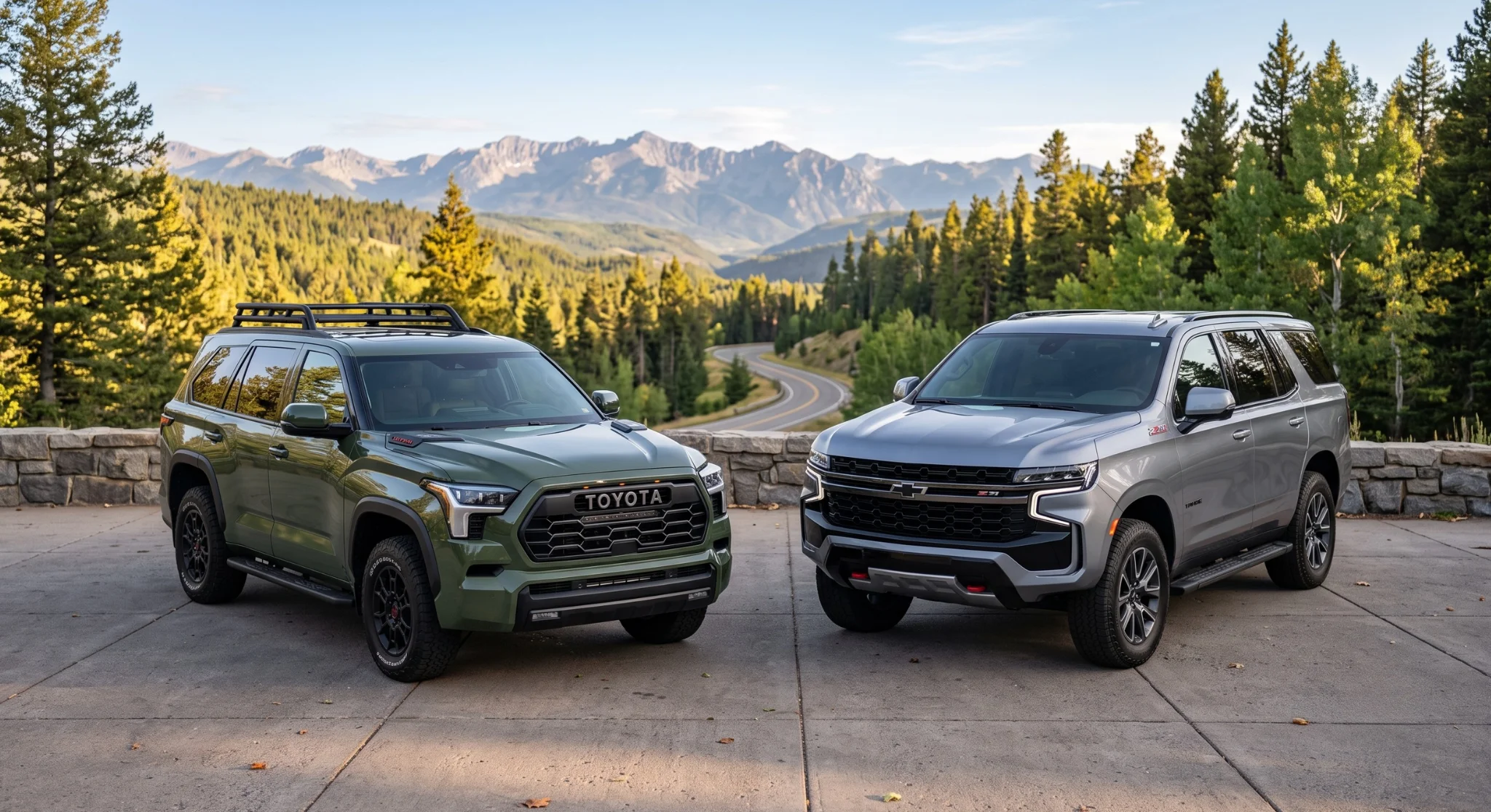
Choosing between the 2026 Toyota Sequoia and the 2026 Chevrolet Tahoe means weighing two different answers to the same question. Both are body-on-frame, three-row, full-size SUVs. From there they diverge: the Sequoia is sold only as a hybrid, while the Tahoe offers three conventional engines including a turbo-diesel. This comparison puts verified figures from both manufacturers side by side — including the categories where the Tahoe wins.
Why Temecula Valley Families Compare These Two Full-Size SUVs
Full-size three-row SUVs get asked to do two jobs at once: school runs and commutes during the week, trailer or gear duty on the weekend. In communities like Murrieta — rolling hills and suburban neighborhoods just a few miles north of Temecula — that dual demand is the norm.
The Sequoia answers it with a single powertrain. Every 2026 Sequoia, from SR5 to Capstone, uses the i-FORCE MAX twin-turbo V6 hybrid. There is no gas-only Sequoia. The Tahoe answers it with choice: a standard 5.3-liter V8, an available 6.2-liter V8, and an available 3.0-liter Duramax turbo-diesel inline-six offered on every trim except the base LS. Neither approach is automatically better. Our Toyota research library goes deeper on the Sequoia.
2026 Sequoia vs 2026 Tahoe: Specs at a Glance
| Specification | 2026 Toyota Sequoia | 2026 Chevrolet Tahoe |
|---|---|---|
| Standard engine | 3.4L i-FORCE MAX twin-turbo V6 hybrid | 5.3L V8 |
| Additional engines | None — hybrid standard on every trim | 6.2L V8; 3.0L Duramax turbo-diesel inline-six |
| Maximum horsepower | 437 hp | 420 hp (6.2L V8) |
| Maximum torque | 583 lb-ft | 495 lb-ft (3.0L Duramax) |
| Transmission | 10-speed automatic | 10-speed automatic |
| Maximum towing capacity | Up to 9,500 lbs | Up to 8,400 lbs |
| EPA-Estimated MPG, rear-wheel drive, standard engine | 21 city / 24 highway / 22 combined | 15 city / 20 highway / 17 combined |
| Cargo volume behind third row | 11.5–22.3 cu ft (sliding third row) | 25.5 cu ft |
| Maximum cargo volume | 86.9 cu ft | 122.7 cu ft |
| Seating capacity | 7 or 8 passengers | 7 to 9 passengers |
| Standard touchscreen | 8 in. on SR5; 14 in. on Limited and above | 17.7 in. |
| Hands-free driving system | Not available | Super Cruise available |
| Starting price | $68,120 TSRP (SR5) | $63,495 MSRP (LS) |
| Number of trims | 6 | 6 |
Specifications sourced from Toyota’s official 2026 Sequoia page and Chevrolet’s official 2026 Tahoe page.
Powertrain Compared: One Hybrid Against Three Engines
The Sequoia’s i-FORCE MAX 3.4-liter twin-turbo V6 hybrid produces 437 horsepower and 583 lb-ft of torque through a 10-speed automatic transmission. A 48-horsepower electric motor sits between the engine and the transmission, drawing from a 1.87-kWh sealed nickel-metal hydride battery that recharges from the engine and regenerative braking. The payoff is immediate low-end response with no plug and no engine decision to make — it is standard equipment on all six trims. Our 2026 Sequoia hybrid overview breaks the system down further.
The Tahoe divides the job three ways. The standard 5.3-liter V8 makes 355 horsepower and 383 lb-ft. The available 6.2-liter V8 steps up to 420 horsepower and 460 lb-ft, and it is standard on High Country. The available 3.0-liter Duramax turbo-diesel delivers 305 horsepower and 495 lb-ft — the strongest torque figure in the Tahoe lineup, and the engine most Tahoe shoppers who tow gravitate toward. All three use a 10-speed automatic.
Category Verdict: Toyota, on output
The Sequoia’s single powertrain beats all three Tahoe engines on both horsepower and torque, and it does so without asking the buyer to option up. The Tahoe’s counter-argument is flexibility: three distinct characters at three price points.
Towing Capacity Compared
Properly equipped, the Sequoia tows up to 9,500 lbs. The rear-drive Limited is rated at 9,300 lbs, and the heavier, fully loaded Capstone comes in at 8,980 lbs — equipment weight, not engine capability, accounts for the spread across trims.
The Tahoe’s ceiling is 8,400 lbs, and reaching it requires one specific configuration: the 5.3-liter V8 with rear-wheel drive and the Max Trailering Package. Both the 6.2-liter V8 and the Duramax diesel are rated at 8,200 lbs.
| Configuration | Maximum Towing Capacity |
|---|---|
| Toyota Sequoia, properly equipped | Up to 9,500 lbs |
| Toyota Sequoia Limited, rear-wheel drive | 9,300 lbs |
| Toyota Sequoia Capstone, four-wheel drive | 8,980 lbs |
| Chevrolet Tahoe, 5.3L V8 rear-wheel drive with Max Trailering Package | 8,400 lbs |
| Chevrolet Tahoe, 6.2L V8 | 8,200 lbs |
| Chevrolet Tahoe, 3.0L Duramax turbo-diesel | 8,200 lbs |
For trailer-by-trailer figures, see our 2026 Sequoia towing capacity guide. Buyers who tow near the limit can also add the available Load-Leveling Rear Height Control Air Suspension, which adjusts ride height to keep the vehicle level under load.
Category Verdict: Toyota, outright
Roughly 1,100 lbs of additional capability at the top of each lineup — and the Sequoia’s lowest-rated trim still out-tows the Tahoe’s highest.
Maximum towing and payload capacity figures are based on properly equipped vehicles and vary by configuration. Do not exceed any weight rating. See your owner’s manual and the vehicle’s door-jamb label for specific capacities.
EPA-Estimated Fuel Economy Compared
Fuel economy is where the Sequoia’s standard hybrid earns its keep.
| Configuration | EPA-Estimated MPG |
|---|---|
| Toyota Sequoia, rear-wheel drive | 21 city / 24 highway / 22 combined |
| Toyota Sequoia, four-wheel drive | 19 city / 22 highway / 20 combined |
| Chevrolet Tahoe, 5.3L V8, rear-wheel drive | 15 city / 20 highway / 17 combined |
| Chevrolet Tahoe, 3.0L Duramax diesel, rear-wheel drive | 24 combined |
The gas Tahoe is not close. Against the engines most Tahoe buyers actually purchase, the Sequoia’s hybrid advantage is a full 5 MPG combined.
There is an honest caveat. The Duramax diesel beats every Sequoia on combined economy. The trade-off is a diesel engine premium, diesel fuel pricing, and diesel exhaust fluid to maintain. Comparing gas SUVs, the Sequoia is meaningfully more efficient. For a high-mileage highway driver who will pay for a diesel, the Tahoe has a real answer.
EPA-estimated fuel economy figures are for comparison purposes only. Your actual mileage will vary depending on driving conditions, how you drive and maintain your vehicle, battery age/condition, and other factors.
Cargo and Passenger Space Compared
This is the category where the Tahoe wins, and it is not close on paper.
2026 Chevrolet Tahoe
The Tahoe offers 25.5 cu ft behind the third row, 72.5 cu ft with the third row folded, and 122.7 cu ft maximum with both rear rows down. Its second and third rows fold flat. Seating runs from seven to nine depending on configuration — eight is standard on most trims, a nine-passenger layout is optional on the LS, and captain’s chairs drop it to seven.
2026 Toyota Sequoia
The Sequoia offers 11.5 to 22.3 cu ft behind the third row, 49 cu ft with the third row folded, and 86.9 cu ft maximum. It seats seven or eight: SR5 and Limited use a 60/40 split second-row bench for eight, while the upper trims move to captain’s chairs for seven. The hybrid battery and solid rear axle account for the shortfall.
The Sequoia’s counter is flexibility rather than volume. Its third row slides roughly six inches fore and aft, which is what produces that 11.5-to-22.3 range — legroom or cargo depth, adjustable on the fly. Power-folding third-row seats are now standard across every 2026 trim, and a multi-level adjustable cargo shelf helps organize the space that is there. The Tahoe’s rows fold; they do not slide. Our 2026 Sequoia interior and safety features guide covers the seating configurations in detail.
Category Verdict: Chevrolet on raw space, Toyota on adjustability
If you regularly carry eight or nine people and a full load of luggage, that is a real argument for the Tahoe.
Technology Compared
Every 2026 Sequoia includes a 12.3-inch digital gauge cluster and wireless Apple CarPlay and Android Auto. The SR5 pairs those with an 8-inch touchscreen; Limited and above move to a 14-inch Toyota Audio Multimedia display. A 14-speaker JBL premium audio system is standard from the Platinum up, and the Capstone adds a 10-inch color head-up display projecting speed, navigation, and hybrid system information onto the windshield.
The Tahoe leads on screen size and driver assistance. A 17.7-inch touchscreen and an 11-inch digital instrument cluster are standard, with wireless Apple CarPlay, Android Auto, and Google built-in. More significantly, Super Cruise hands-free driving is available on the LT, RST, Z71, Premier, and High Country. The Sequoia has no hands-free driving system at any price.
Category Verdict: Chevrolet
If hands-free highway driving matters to you, the Tahoe is the only one of the two that offers it.
Safety Compared: IIHS Crash Test Results
Toyota Safety Sense 2.5 is standard on all six Sequoia trims. It bundles a pre-collision system with pedestrian detection, adaptive cruise control, and lane departure alert. Blind spot monitoring with rear cross-traffic alert is included. So is Front and Rear Parking Assist with Automatic Braking. On the Tahoe, Chevrolet Safety Assist is standard across the lineup.
Standard equipment lists look similar. Independent crash testing separates them. The Insurance Institute for Highway Safety publishes 2026 ratings for both. In the two evaluations where they differ, the Sequoia rates a full tier higher.
| IIHS Evaluation, 2026 Model Year | Toyota Sequoia | Chevrolet Tahoe |
|---|---|---|
| Small overlap front | Good | Acceptable |
| Moderate overlap front, updated test | Marginal | Poor |
| Side, updated test | Good | Good |
| LATCH child seat anchor ease of use | Good | Good+ |
| 2026 Top Safety Pick award | None | None |
Neither vehicle earned a 2026 IIHS Top Safety Pick or Top Safety Pick+ award. Large body-on-frame SUVs have struggled with the updated moderate overlap test as a class. That test added a second-row dummy to measure rear-passenger protection.
IIHS publishes two more Sequoia results with no 2026 Tahoe counterpart. The Sequoia earns Good for pedestrian front crash prevention. It earns Marginal for vehicle-to-vehicle front crash prevention. Its headlight rating splits by trim. Ratings are Good on the 1794 Edition, Platinum, TRD Pro, and Capstone. The Limited also rates Good with the Premium Auto-Leveling LED Headlights package. The SR5 and the base Limited rate Poor. If nighttime visibility matters, the LED package is worth specifying.
Full results are published by IIHS for the 2026 Toyota Sequoia and the 2026 Chevrolet Tahoe. Ratings for both carry forward from earlier tests within the current generation. The Sequoia’s updated moderate overlap result comes from a 2026 Limited.
Insurance Institute for Highway Safety ratings are current as of the date of publication and are subject to change. Ratings may not apply to all trim levels or equipment configurations. Driver-assistance and crash-avoidance systems are supplemental aids and are not substitutes for safe and attentive driving. See iihs.org for complete and current ratings.
2026 Toyota Sequoia Trims and Pricing
The Sequoia lineup spans six trims. Pricing below reflects Total Suggested Retail Price.
| Trim | TSRP | Drivetrain | EPA-Estimated MPG (City / Highway / Combined) |
|---|---|---|---|
| SR5 | $68,120 | Rear-wheel drive standard, 4WD available | 21 / 24 / 22 (rear-wheel drive) |
| Limited | $73,890 | Rear-wheel drive standard, 4WD available | 21 / 24 / 22 (rear-wheel drive) |
| Platinum | $84,130 | Four-wheel drive standard | 19 / 22 / 20 |
| TRD Pro | $84,860 | Four-wheel drive only | 19 / 22 / 20 |
| 1794 Edition | $84,945 | Four-wheel drive standard | 19 / 22 / 20 |
| Capstone | $88,530 | Four-wheel drive standard | 19 / 22 / 20 |
The SR5 competes most directly on price. Limited adds the 14-inch touchscreen and heated and ventilated leather-trimmed front seats. Platinum brings JBL audio and a panoramic roof. The 1794 Edition goes its own direction with Saddle Tan leather, open-pore American walnut trim, and massaging front seats. TRD Pro trades luxury for FOX off-road suspension and BBS wheels. Capstone tops the range with Shale premium textured leather, 22-inch dark chrome wheels, power-extending running boards, and the head-up display. Full detail is in our 2026 Sequoia trims and pricing breakdown.
For context, the 2026 Tahoe LS starts at a Manufacturer’s Suggested Retail Price of $63,495. The Tahoe undercuts the Sequoia at the entry point by roughly $4,600.
Total Suggested Retail Price (TSRP) for new vehicles includes manufacturer and distributor options and delivery, processing, and handling fees, which are subject to change at any time. TSRP excludes taxes, title, license, dealer-installed options, accessories, fees and charges. TSRP is not the dealer advertised price. Dealer price will vary. The dealer sets the final price.
Manufacturer’s Suggested Retail Price (MSRP) for new vehicles includes manufacturer and distributor options and delivery, process and handling fees, which may be subject to change at any time. MSRP excludes taxes, title, license and dealer installed options, accessories, fees and charges. MSRP is not the dealer advertised price. Dealer price will vary. The dealer sets the final price.
Value and Resale
Where the Sequoia recovers ground is what happens after the purchase. Kelley Blue Book named the Toyota Sequoia its 2026 Best Resale Value winner in the Full-Size SUV category. J.D. Power also recognized the Sequoia with a 2026 U.S. ALG Residual Value Award, one of six model-level wins for Toyota — more than any other brand. Every new Sequoia also includes ToyotaCare, covering normal factory-scheduled maintenance for two years or 25,000 miles.
A lower purchase price and a lower resale value are not the same as a lower cost of ownership. Buyers planning to keep the vehicle three to five years should weigh both ends.
The Verdict: Which Full-Size SUV Fits Your Household?
Choose the 2026 Toyota Sequoia if
Towing capability is a priority — it out-tows every Tahoe configuration by roughly 1,100 lbs. Or if you want strong fuel economy without a diesel, since the Sequoia’s hybrid beats the gas Tahoe by 5 MPG combined. Or if resale value factors into your decision, where the Sequoia holds both major 2026 industry awards in this segment. It also rates a tier higher than the Tahoe in both IIHS crashworthiness tests where the two differ.
Choose the 2026 Chevrolet Tahoe if
Maximum cargo volume or nine-passenger seating is non-negotiable, if you want hands-free highway driving, or if a lower entry price is the deciding factor.
For most Temecula Valley households towing a boat or trailer a few times a season and driving the rest of the year, the Sequoia’s combination of standard hybrid efficiency, class-leading towing in this matchup, and award-winning resale is the stronger long-term case. If your weekends involve nine people and a mountain of gear rather than a trailer, the Tahoe earns the look.
Frequently Asked Questions: 2026 Toyota Sequoia vs 2026 Chevy Tahoe
Is the 2026 Toyota Sequoia worth more than the Chevy Tahoe?
The Sequoia costs more to start — the Tahoe LS opens roughly $4,600 below the Sequoia SR5 — but it includes the i-FORCE MAX hybrid powertrain on every trim, along with 437 horsepower and 583 lb-ft of torque that exceed all three Tahoe engines. It also holds both of 2026’s major resale honors in this segment: Kelley Blue Book’s Best Resale Value award for Full-Size SUVs and a J.D. Power U.S. ALG Residual Value Award. Whether that is worth the premium depends on how long you plan to keep it.
Which SUV gets better fuel economy?
It depends on the engine. Against the gas Tahoe, the Sequoia wins clearly: an EPA-estimated 22 MPG combined in rear-wheel drive versus 17 MPG combined for the 5.3-liter V8 Tahoe. However, the Duramax turbo-diesel Tahoe is rated at an EPA-estimated 24 MPG combined with rear-wheel drive, which is better than any Sequoia. The Sequoia is the more efficient gas-powered choice; the diesel Tahoe is the more efficient option overall, with the added cost and maintenance a diesel brings.
Can the 2026 Toyota Sequoia tow more than the Tahoe?
Yes. The Sequoia tows up to 9,500 lbs properly equipped, while the Tahoe’s maximum is 8,400 lbs with the 5.3-liter V8, rear-wheel drive, and the Max Trailering Package. The Tahoe’s 6.2-liter V8 and Duramax diesel are both rated at 8,200 lbs. Even the Sequoia Capstone, the heaviest and lowest-rated trim at 8,980 lbs, out-tows every Tahoe configuration.
How many people can each SUV seat?
The Sequoia seats seven or eight — a 60/40 split second-row bench on SR5 and Limited seats eight, while captain’s chairs on the upper trims reduce capacity to seven. The Tahoe seats seven to nine, with eight standard on most trims and a nine-passenger configuration available on the LS. If maximum seating capacity is the priority, the Tahoe holds the advantage.
Visit Temecula Valley Toyota
26631 Ynez Road, Temecula, CA 92591
Sales: (951) 319-7911
Stop by the showroom or call our sales team to set up a test drive.