

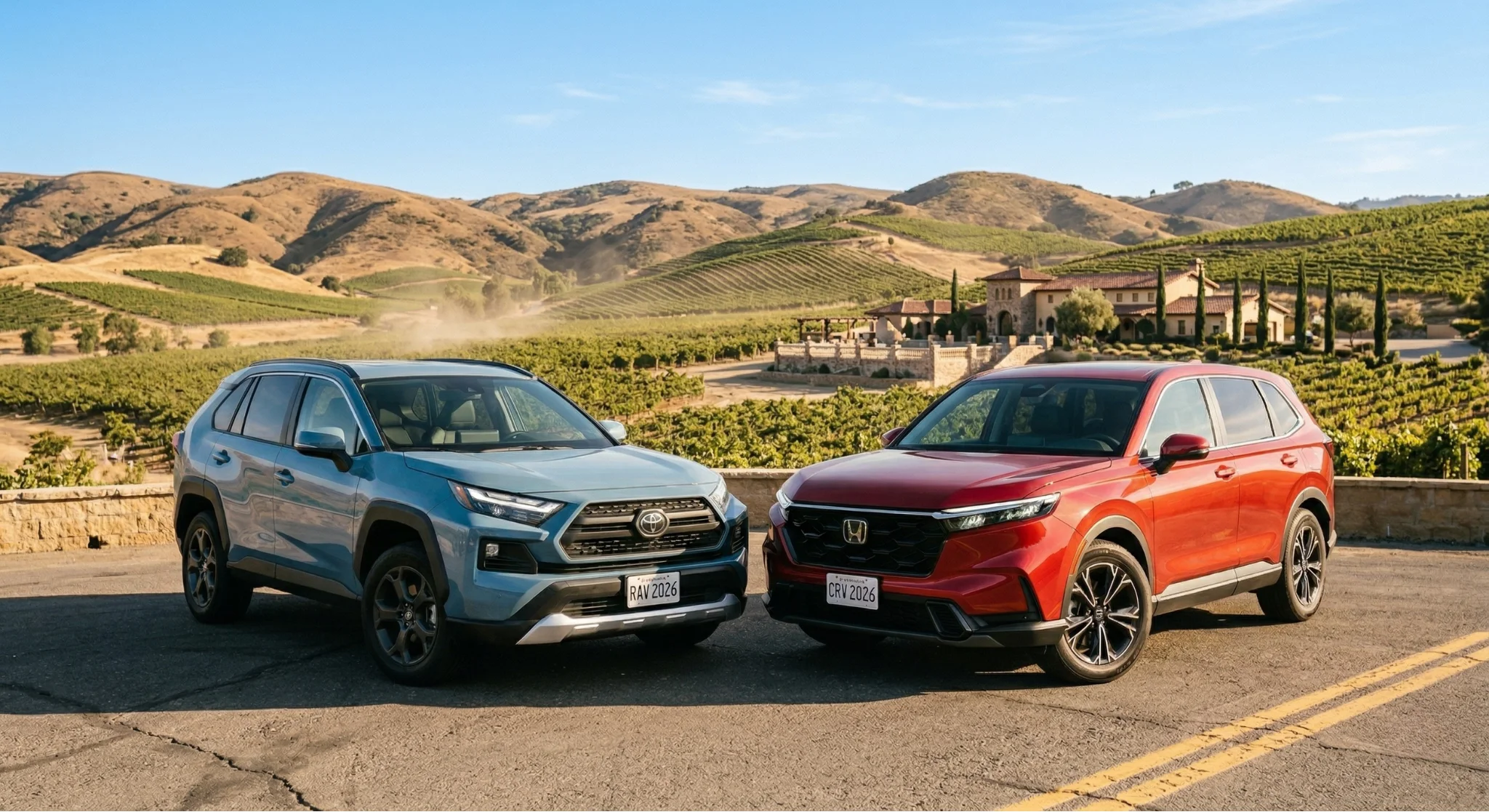
2026 Toyota RAV4 vs. Honda CR-V: Which Compact SUV Wins for Temecula Drivers?
Choosing between two of America’s most popular compact SUVs comes down to what matters most for your daily life. For families and commuters across Temecula, Murrieta, and the surrounding communities, the 2026 Toyota RAV4 and 2026 Honda CR-V each bring strong credentials — but the RAV4’s all-hybrid lineup delivers a combination of efficiency, power, and capability that the CR-V’s gas-powered base trims struggle to match.
The biggest headline for 2026: every RAV4 now comes standard with a hybrid powertrain. Shoppers comparing the base RAV4 Hybrid LE at $31,900 against the CR-V LX at $30,920 are weighing a hybrid against a traditional gas engine — a distinction that shapes nearly every category in this comparison.
Performance and Powertrain
| Specification | 2026 Toyota RAV4 | 2026 Honda CR-V |
|---|---|---|
| Engine | 2.5L 4-Cylinder Hybrid | 1.5L Turbocharged 4-Cylinder |
| Horsepower | 226 hp (FWD) / 236 hp (AWD) | 190 hp |
| Torque | 163 lb-ft (engine) | 179 lb-ft |
| Transmission | eCVT | CVT |
| Drivetrain | FWD standard; AWD available | FWD standard; AWD available |
The RAV4’s 2.5-liter hybrid system produces 226 net combined horsepower in front-wheel-drive trims and 236 horsepower with all-wheel drive — comfortably ahead of the CR-V’s 190 horsepower from its turbocharged gas engine. The RAV4 pairs this output with an electronically controlled CVT that delivers smooth, responsive acceleration suited to Temecula Valley’s mix of suburban streets and rolling terrain near Murrieta and Fallbrook.
Both vehicles offer available all-wheel drive. The RAV4’s electronic on-demand AWD features multiple drive modes — Sport, Eco, Normal, and EV — for tailoring the driving experience. The CR-V’s Real Time AWD is competent but offers fewer driver-selectable modes.
For shoppers seeking even more capability, the RAV4 Plug-in Hybrid pushes output to 324 net combined horsepower with up to 52 miles of electric-only range — a level of performance and efficiency the CR-V lineup does not offer.
Fuel Economy
| Specification | 2026 Toyota RAV4 Hybrid LE | 2026 Honda CR-V LX |
|---|---|---|
| City MPG | 47 mpg | 28 mpg |
| Highway MPG | 40 mpg | 33 mpg |
| Combined MPG | 43 mpg | 30 mpg |
| Fuel Type | Regular Unleaded | Regular Unleaded |
This is the RAV4’s most decisive advantage. At 43 mpg combined versus the CR-V’s 30 mpg, the RAV4 Hybrid LE delivers over 40% better fuel efficiency. For Temecula families commuting between Murrieta, Menifee, and Lake Elsinore, that translates to meaningful savings at the pump over the life of the vehicle.
The all-wheel-drive RAV4 LE still achieves 42 mpg combined — far ahead of the CR-V LX AWD’s 29 mpg. Honda does offer CR-V Hybrid trims starting at $35,630 with improved efficiency of up to 40 mpg combined, but the RAV4 makes hybrid power standard from the entry level at $31,900 — no upcharge required.
Dimensions, Cargo, and Comfort
| Specification | 2026 Toyota RAV4 | 2026 Honda CR-V |
|---|---|---|
| Seating Capacity | 5 | 5 |
| Cargo Volume (seats up) | 37.8 cu ft | 39.3 cu ft |
| Cargo Volume (seats down) | 70.4 cu ft | 76.5 cu ft |
| Rear Legroom | 37.8 in | 41.0 in |
| Overall Length | 181.1 in | 184.8 in |
| Overall Width | 73.0 in | 73.5 in |
Credit where it is due: the CR-V wins on raw interior space. Its 39.3 cubic feet of cargo behind the rear seats edges out the RAV4’s 37.8, and 76.5 cubic feet with seats folded tops the RAV4’s 70.4. The CR-V also offers a class-leading 41 inches of rear legroom compared to the RAV4’s 37.8 — a noticeable advantage for rear passengers on longer drives.
Where the RAV4 closes the gap is in comfort features and practical touches. Available SofTex-trimmed seats with heating and ventilation, dual-zone climate control, and a 120V/1500W AC power outlet in the cargo area add utility for families heading to Santa Rosa Plateau or Temecula’s vineyards. The RAV4’s 60/40 split fold-flat rear seats provide flexible cargo configurations, and the overall cabin emphasizes durable, easy-to-maintain materials suited to active households. Explore the full interior layout in our 2026 RAV4 interior breakdown.
Towing Capability
The RAV4 holds a clear towing advantage, though the capacity depends on configuration. Front-wheel-drive models and the LE AWD are rated at 1,750 pounds, while the SE AWD and above support up to 3,500 pounds — enough for small boats, utility trailers, or compact campers for trips to nearby lakes and the coast. The CR-V gas trims max out at 1,500 pounds, limiting heavier hauling needs.
For families in Temecula Valley who tow occasionally, stepping up to a mid-range RAV4 AWD trim unlocks towing capability the CR-V simply cannot match.
Technology and Connectivity
The RAV4 leads in display technology with a standard 10.5-inch touchscreen across all trims and an available 12.9-inch multimedia display on upper trims. The CR-V counters with a standard 9-inch touchscreen — capable, but smaller. Both offer wireless Apple CarPlay and Android Auto as standard.
Behind the steering wheel, the RAV4 comes standard with a 12.3-inch digital gauge cluster on every trim. The CR-V offers a 7-inch instrument cluster on LX and EX trims, with a 10.2-inch fully digital display reserved for EX-L and above.
Audio enthusiasts will appreciate the RAV4 Limited’s 9-speaker JBL Premium system, while the CR-V reserves its Bose system for the top-tier Sport Touring Hybrid. The RAV4’s infotainment runs on Toyota’s Arene software platform, supporting over-the-air updates that keep the system current without dealer visits — a forward-looking advantage over the CR-V’s more conventional update approach.
Safety
The 2026 RAV4 debuts Toyota Safety Sense 4.0 as standard equipment across all trims — Toyota’s most advanced suite to date. It includes Pre-Collision System with Pedestrian Detection, Lane Tracing Assist, Full-Speed Dynamic Radar Cruise Control, Blind Spot Monitor with Rear Cross-Traffic Alert, and Front and Rear Parking Assist with Automatic Braking. Higher trims add a Panoramic View Monitor with 360-degree overhead perspective.
The CR-V counters with Honda Sensing as standard, including Collision Mitigation Braking, Adaptive Cruise Control, and Lane Keeping Assist. Both vehicles offer strong safety foundations. Note that official 2026 NHTSA and IIHS crash test ratings for the redesigned RAV4 were not yet published at the time of writing; the CR-V carries forward strong ratings from its current generation.
Where the RAV4 edges ahead is in the depth of its standard safety features. TSS 4.0 includes Lane Change Assist and Front Cross-Traffic Alert with Braking — technologies that are not available across all CR-V trims — providing peace of mind for navigating Temecula’s family neighborhoods and busy school zones.
Trim Levels and Value
The RAV4 Hybrid LE FWD starts at $31,900, with the LE AWD at $33,300, the SE FWD at $34,700, and the SE AWD at $36,100. The lineup continues through XLE Premium, Woodland, XSE, and Limited trims with increasingly premium features. See the complete 2026 RAV4 trim comparison for the full breakdown.
The CR-V LX FWD begins at $30,920, the LX AWD at $32,420, and the EX FWD at $33,150. While the CR-V’s entry price is $980 lower, it comes with a gas engine producing 30 mpg combined. The RAV4’s modest premium buys a hybrid powertrain with 36 more horsepower and 13 more miles per gallon — an investment that pays for itself at the fuel pump.
| Warranty Coverage | 2026 Toyota RAV4 | 2026 Honda CR-V |
|---|---|---|
| Basic Warranty | 3 years / 36,000 miles | 3 years / 36,000 miles |
| Powertrain Warranty | 5 years / 60,000 miles | 5 years / 60,000 miles |
| Corrosion Warranty | 5 years / unlimited miles | 5 years / unlimited miles |
| Roadside Assistance | 2 years / unlimited miles | 3 years / 36,000 miles |
Both manufacturers offer identical basic and powertrain coverage. Toyota provides 2 years of roadside assistance with unlimited mileage, while Honda offers 3 years capped at 36,000 miles. The better fit depends on your driving habits — high-mileage drivers may prefer Toyota’s unlimited-mile approach.
Frequently Asked Questions
Is the 2026 Toyota RAV4 worth the price difference over the Honda CR-V?
The RAV4 Hybrid LE starts at $31,900 — just $980 more than the CR-V LX at $30,920. That modest premium delivers a hybrid powertrain with 226 horsepower and 43 mpg combined versus the CR-V’s 190 hp and 30 mpg. For Temecula drivers, the fuel savings alone can offset the price gap within the first year of typical commuting.
Which SUV offers better fuel economy for daily commuting?
The RAV4 Hybrid LE achieves 43 mpg combined, significantly outperforming the CR-V LX’s 30 mpg. Commuters traveling between Temecula, Murrieta, and Menifee will notice fewer fuel stops and lower monthly costs.
How does cargo and passenger space compare?
The CR-V offers 39.3 cubic feet of cargo with seats up and 41 inches of rear legroom — edging the RAV4’s 37.8 cubic feet and 37.8 inches of rear legroom. For families prioritizing maximum rear passenger space, the CR-V has a slight edge. The RAV4 compensates with available comfort features like heated and ventilated seats and a cargo-area power outlet.
What about towing?
The RAV4 supports up to 3,500 pounds of towing on SE AWD and above trims, with FWD models rated at 1,750 pounds. The CR-V gas trims max out at 1,500 pounds. For families who tow boats or trailers, the RAV4 offers significantly more capable options.
The Verdict
The 2026 Toyota RAV4 earns its recommendation for Temecula Valley shoppers through one defining advantage: hybrid efficiency comes standard, not as an upgrade. For less than $1,000 more than the CR-V’s base price, you get substantially better fuel economy, more horsepower, and access to towing capability the CR-V cannot match. The CR-V is a strong competitor with segment-leading rear legroom and cargo space, but the RAV4’s value proposition is hard to beat for cost-conscious families who want efficiency without compromise.
Ready to experience the difference firsthand? Call our sales team at (951) 319-7911 or visit Temecula Valley Toyota at 26631 Ynez Road in Temecula.