

2026 Toyota Corolla Hybrid MPG: Fuel Economy and Commuter Value
Choosing an efficient vehicle for the daily drive is one of the most direct ways to lower monthly costs. The 2026 Toyota Corolla Hybrid is built for exactly that job. It is a compact sedan that keeps fuel spending low without asking you to change how you drive. Toyota offers it in LE, SE, and XLE grades, with Electronic On-Demand All-Wheel Drive available on the LE and SE.
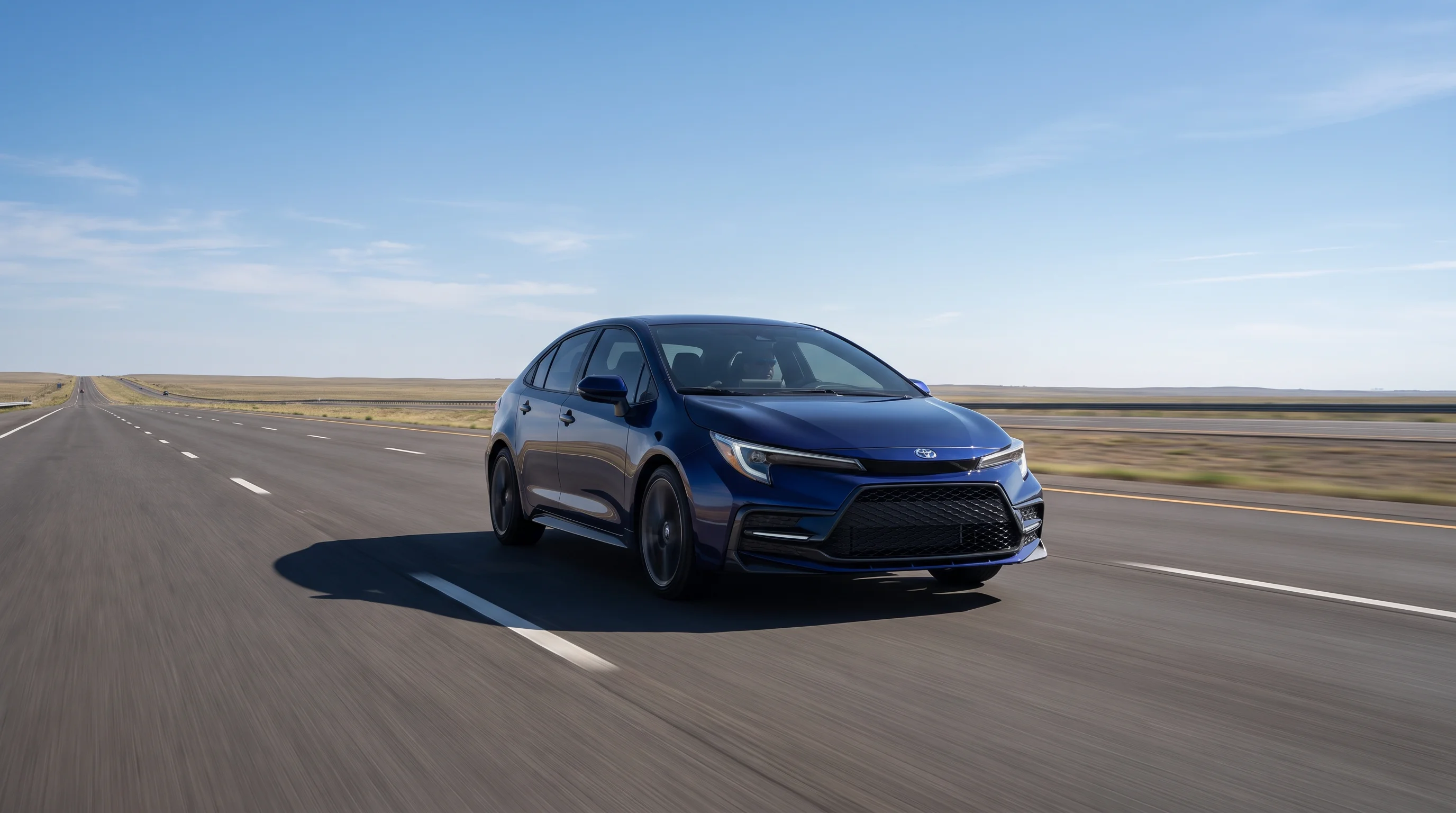
Front-wheel-drive LE and XLE models carry an EPA-Estimated 53 mpg city, 46 mpg highway, and 50 mpg combined rating. With an 11.3-gallon fuel tank, that works out to an estimated 599 miles of city driving between fill-ups. That matters for a commuter heading out of Murrieta toward employment centers along the I-15. A single tank can stretch across most of a work week instead of a stop at the pump every few days.
Interior space holds up its end as well. The Corolla Hybrid offers 88.6 cubic feet of passenger volume and 13.1 cubic feet of trunk space. Passengers and daily gear both fit without negotiation.
EPA-Estimated Fuel Economy by Grade and Drivetrain
Fuel economy shifts with both grade and drivetrain. The spread is worth knowing before you choose a configuration. The LE and XLE deliver the highest ratings in front-wheel drive. Stepping into the SE trades a few mpg for sportier tuning and larger wheels. Adding all-wheel drive costs a few more.
| Grade | Drivetrain | EPA-Estimated City | EPA-Estimated Highway | EPA-Estimated Combined |
|---|---|---|---|---|
| LE | Front-Wheel Drive | 53 mpg | 46 mpg | 50 mpg |
| LE | All-Wheel Drive | 51 mpg | 44 mpg | 48 mpg |
| SE | Front-Wheel Drive | 50 mpg | 43 mpg | 47 mpg |
| SE | All-Wheel Drive | 47 mpg | 41 mpg | 44 mpg |
| XLE | Front-Wheel Drive | 53 mpg | 46 mpg | 50 mpg |
Even the least efficient configuration in the lineup, the SE with all-wheel drive, returns an EPA-Estimated 44 mpg combined. Every rating above is published by the EPA at fueleconomy.gov.
EPA-estimated fuel economy figures are for comparison purposes only. Your actual mileage will vary depending on driving conditions, how you drive and maintain your vehicle, battery age/condition, and other factors.
Under the Hood: Engine, Power, and the eCVT
Powertrain Specifications
| Specification | 2026 Toyota Corolla Hybrid |
|---|---|
| Engine | 1.8-liter four-cylinder |
| Hybrid system | Fifth-generation Toyota Hybrid System |
| Combined output | 138 net combined horsepower |
| Torque | 105 lb-ft |
| Transmission | Electronically controlled CVT (eCVT) |
| Drivetrain | Front-wheel drive; Electronic On-Demand AWD available on LE and SE |
| Recommended fuel | Regular unleaded |
| Fuel tank capacity | 11.3 gallons |
| Seating capacity | 5 |
Engine, hybrid system, output, and drivetrain details are published by Toyota in the 2026 Corolla Hybrid press release.
How the eCVT Works
How the Corolla Hybrid makes its power explains why it does so well in stop-and-go traffic. Rather than a conventional automatic with fixed gears, Toyota routes power through an electronically controlled continuously variable transmission. The system continuously seeks the most efficient operating point rather than stepping through preset ratios. Because the electric motor delivers its torque immediately, the car feels responsive pulling away from a light, which is where a commuter spends much of the day.
Why City MPG Beats Highway MPG
Highway driving works the engine harder. At a sustained 70 mph the gasoline engine does most of the work. The electric motor contributes less. That is why the highway figure sits below the city figure on every configuration in the table above, and why a hybrid pays off most for drivers who spend their miles in traffic rather than on open freeway.
For a full breakdown of how each grade is equipped, see our 2026 Toyota Corolla trims, features, and pricing guide.
Available All-Wheel Drive on the LE and SE
How the System Works
Available all-wheel drive on a 50-mpg compact sedan is uncommon. It is one of the Corolla Hybrid’s real differentiators. Toyota’s Electronic On-Demand All-Wheel Drive is offered on the LE and SE grades. The XLE is front-wheel drive only.
The system uses a separate rear-mounted electric motor to drive the rear wheels when they are needed. There is no driveshaft running the length of the car, and no mechanical connection between the front and rear axles. According to Toyota, the system preemptively distributes driving force to the rear wheels to help suppress front-wheel slip during off-the-line starts. It also engages the rear motor in response to slip at the front wheels, and improves cornering agility by helping reduce understeer.
What All-Wheel Drive Costs in Fuel Economy
The efficiency cost is modest. An LE with all-wheel drive still returns an EPA-Estimated 48 mpg combined, only two mpg below the front-wheel-drive version. An SE with all-wheel drive returns an EPA-Estimated 44 mpg combined.
EPA-estimated fuel economy figures are for comparison purposes only. Your actual mileage will vary depending on driving conditions, how you drive and maintain your vehicle, battery age/condition, and other factors.
Is the Hybrid Worth the Premium Over the Gas Corolla?
The hybrid carries a modest price increase over the comparable gasoline Corolla, and on the top grade that gap narrows considerably. Against that, the efficiency advantage is substantial. The gas Corolla LE is rated at an EPA-Estimated 35 mpg combined, while the Corolla Hybrid LE reaches an EPA-Estimated 50 mpg combined. Third-party analysis from Cars.com puts the resulting fuel savings at several hundred dollars per year for a typical driver. On most grades that recovers the upfront difference in roughly five years. On the XLE it takes about a year.
Do You Need to Plug It In?
This question comes up constantly on the showroom floor, and the answer is no. The Corolla Hybrid is a conventional hybrid with no charging port. The battery replenishes itself through regenerative braking and surplus output from the gasoline engine. You fuel it at any gas station, exactly like a gas-only car.
Warranty Coverage and Long-Term Ownership
Toyota has spent decades refining this hybrid system, and the coverage reflects that confidence.
Coverage at a Glance
| Coverage | Term |
|---|---|
| Hybrid battery (2020 model year and newer) | 10 years or 150,000 miles, whichever comes first |
| ToyotaCare factory-scheduled maintenance (2026 model year) | 2 years or 25,000 miles, whichever comes first |
| 24-hour roadside assistance | 2 years, unlimited mileage |
| Basic warranty | 3 years or 36,000 miles |
| Powertrain warranty | 5 years or 60,000 miles |
Hybrid battery coverage begins on the date of first use and transfers to subsequent owners. Full warranty terms are published at toyota.com, and ToyotaCare plan details are at toyota.com/maintenance-plans. Note that the 2-year, 25,000-mile ToyotaCare term applies to 2026 and earlier model years.
Lower Brake Wear and Standard Safety Technology
Hybrids also tend to be easier on their brakes. The regenerative braking system uses the electric motors to slow the car. It recovers energy that would otherwise be lost as heat, and it reduces wear on the pads and rotors. Toyota Safety Sense 3.0 is standard on every grade, adding driver-assist technology including Lane Departure Assist and Proactive Driving Assist.
This information is provided for general educational purposes only and does not constitute legal advice. Warranty coverage depends on the specific terms of your vehicle’s warranty agreement. Consult your owner’s manual or a qualified legal professional for guidance on your individual situation.
Common Questions About the 2026 Toyota Corolla Hybrid
Does the 2026 Toyota Corolla Hybrid require premium gasoline?
No. The Corolla Hybrid is rated for regular unleaded gasoline. That keeps running costs down compared with efficient vehicles that require premium fuel to hit their published numbers.
Does the hybrid battery reduce trunk space compared with the gas-only Corolla?
No. The 2026 Corolla Hybrid and the gas-powered 2026 Corolla both offer 13.1 cubic feet of trunk space. The hybrid battery does not cost you any cargo capacity, and the rear seats fold down on both.
Does a 2026 Toyota Corolla Hybrid qualify for a federal clean vehicle tax credit?
No. The federal clean vehicle credit applied only to plug-in electric and fuel cell vehicles, so a conventional hybrid like the Corolla Hybrid was never within its scope. The credit was also repealed for vehicles acquired after September 30, 2025, so it is no longer available on any vehicle.
Current guidance on the repealed credit is published by the IRS.
Start Your Fuel-Efficient Commute in a 2026 Corolla Hybrid
Daily efficiency, proven hybrid engineering, and long-term warranty coverage add up to a straightforward answer. The 2026 Corolla Hybrid suits drivers who want their fuel budget to shrink without rearranging their routine. Our team is here whenever you want to look one over at your own pace.