Open Today Sales: 9 AM-7 PM
Open Today Service: 6 AM-5 PMOpen Today Express Service Center: 6 AM-5 PM
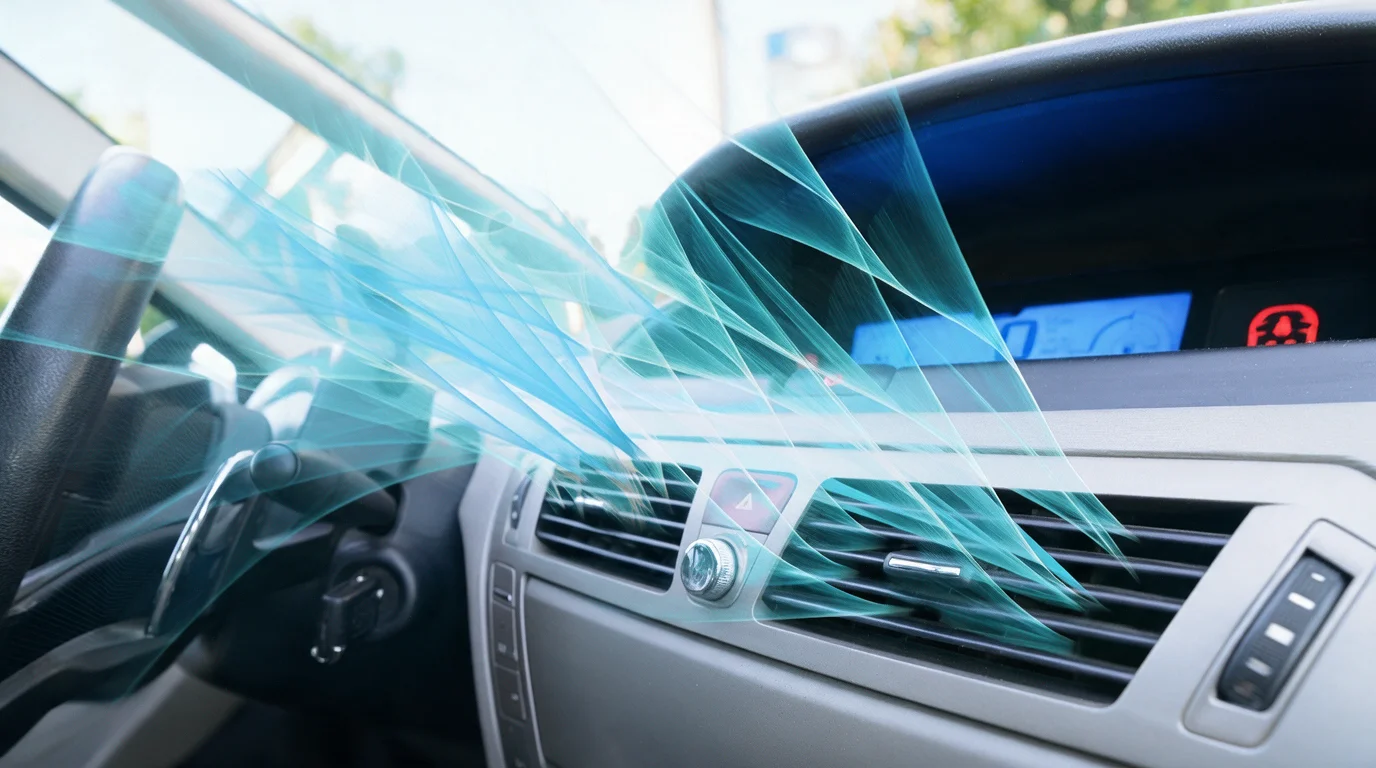
Your car’s AC blows hot air when something in the refrigeration loop or the climate control system stops doing its job. The most common causes are low refrigerant from a leak, an AC compressor clutch that no longer engages, a stuck blend door actuator letting heater core warmth into the vents, a blocked condenser, or a blown fuse or relay. Each one produces a slightly different symptom, and the pattern tells you a lot before a technician ever opens the hood.
The compressor is the heart of the system, pumping pressurized refrigerant through the condenser and evaporator. When the clutch wears out or current never reaches the electromagnetic coil, the pump sits still and nothing but ambient air moves through the cabin vents.
Match what your system is actually doing against the most likely cause. This narrows the diagnosis before you book the appointment.◊
| What you’re noticing | Most likely cause | What it means |
|---|---|---|
| Air is warm all the time, no cold at all | Low refrigerant from a leak, or a compressor that won’t engage | Refrigerant sits in a closed loop — if it’s low, it escaped somewhere |
| Compressor clicks on and off every few seconds | Low refrigerant tripping the low-pressure cut-off switch | A protective shutdown, not a random fault |
| Cold while driving, warm at idle or a red light | Condenser airflow problem — failed cooling fan or blocked fins | At speed, air flows through the grille; at idle, the fan is the only airflow |
| Squealing the moment the AC switches on | Slipping clutch plate | Worn friction surface or an air gap that’s grown too wide |
| Grinding or growling even with the AC off | Failing clutch pulley bearing | The pulley spins whenever the engine runs — fix before it shreds the belt |
| Weak airflow, vents barely moving air | Clogged cabin air filter, possibly a frozen evaporator | Full cooling power can’t reach you if air can’t get through |
| One side cold, the other side warm | Failed blend door actuator on the warm side | Each zone has its own blend door motor |
| Cold at first, then gradually warm | Evaporator icing, or moisture frozen at the expansion valve | Airflow drops with icing; it doesn’t with a moisture blockage |
◊ The information in this article is general guidance and does not constitute a specific diagnostic or repair recommendation for any individual vehicle. Repair and maintenance decisions should be made in consultation with a certified technician based on the specific condition of your vehicle.
Your air conditioning system doesn’t create cold air. It moves heat out of the cabin, and that takes a chain of components working together. When one link in that chain breaks, warm air is the result.
| Component | What it does | What you notice when it fails |
|---|---|---|
| AC compressor | Pumps pressurized refrigerant through the system | No cold air at all |
| Compressor clutch | Connects and disconnects the compressor from the serpentine belt | Squeal when the AC switches on, or rapid clicking |
| Condenser | Releases absorbed cabin heat into the outside air | Weak cooling that gets worse in slow traffic |
| Cooling fan | Pulls air across the condenser when the vehicle isn’t moving | Cold while driving, warm at idle |
| Evaporator | Absorbs heat and moisture out of the cabin air | Airflow weakens as ice builds on the fins |
| Expansion valve or orifice tube | Meters refrigerant flow into the evaporator | Cold at first, then warm |
| Blend door actuator | Positions the flaps that route air past the evaporator or the heater core | Warm air despite normal pressures, or one side warm |
| Cabin air filter | Filters dust, pollen, and road debris out of incoming air | Weak airflow on every fan setting |
| Low-pressure cut-off switch | Cuts power to the clutch when pressure drops too low | Compressor cycles on and off every few seconds |
| High-pressure switch | Shuts the clutch off when pressure climbs too high | No AC at all, often right after an overcharge |
A car AC compressor clicks rapidly on and off when low refrigerant drops system pressure below the threshold of the low-pressure cut-off switch. That switch interrupts current to the electromagnetic clutch coil to protect the compressor from running without lubrication, so the clutch plate engages and disengages in short cycles.
The compressor needs refrigerant mixed with specialized oil to lubricate its internal pistons and seals — the refrigerant is what carries that oil through the circuit. When a leak develops, total fluid volume in the sealed aluminum lines drops. As the compressor engages, it pulls low-side pressure down fast. Once pressure falls past the cut-off point — commonly around 25 psi, though the exact threshold varies by vehicle — the switch opens and voltage to the clutch coil stops. Pressure in the lines then equalizes slightly, the switch closes, and the clutch re-engages. The loop repeats every few seconds.
Rapid cycling stops cold air production and wears the clutch plate and drive belt. You get short bursts of semi-cool air followed by cabin heat. In Temecula and Murrieta, where July highs average in the mid-to-upper 80s and roughly 95 days a year climb above 90°F, that cycling makes an afternoon drive genuinely uncomfortable. Running the system this way also starves the compressor of oil circulation, which is how a refrigerant problem turns into a compressor problem.
Screeching, grinding, and burning rubber odors are the classic signs of a failing AC compressor clutch — but which noise you hear, and when, points at different parts.
The clutch assembly has three pieces: an electromagnetic coil, a drive pulley turned by the serpentine belt, and a clutch plate attached to the compressor shaft. Energize the coil and magnetic force pulls the plate against the spinning pulley, driving the compressor.
Timing separates the two most common failures. A squeal that starts the moment you switch the AC on usually means the clutch plate is slipping against the pulley — a worn friction surface or an air gap that’s grown too wide. A grinding or growling noise that’s present even with the AC off points instead at the clutch pulley bearing, because that pulley spins whenever the engine runs. The distinction matters: a failing bearing is the more urgent of the two.
Slippage generates friction heat that glazes the metal contact surfaces and can scorch the drive belt, producing an acrid smell under the hood. In the worst case, a seized compressor or seized bearing locks the pulley entirely and the serpentine belt drags across a stationary wheel until it shreds — taking the alternator, power steering, and water pump with it. That’s the point where an AC inconvenience becomes a no-drive situation.
Bad blend door actuators, clogged cabin air filters, and electrical faults stop cabin cooling by misrouting airflow, choking air volume, or cutting power to the compressor clutch. Even a fully charged refrigeration loop can’t cool you if one of these support systems fails.
The HVAC plenum under the dash uses small electric motors — blend door actuators — to position internal flaps. Those flaps route air either across the cold evaporator core or across the hot heater core, depending on your temperature setting. When an actuator’s gears strip or its motor fails, the door can stick in the heat-mix position. Cold air coming off the evaporator gets immediately reheated by engine coolant in the adjacent heater core, and warm air arrives at the vents despite perfectly normal system pressures. In dual-zone systems each side has its own blend door motor, which is why one vent can run cold while the other runs warm.
Cabin air filters protect the passenger compartment from dust, pollen, and road debris. A severely clogged filter restricts airflow across the evaporator and makes the AC feel ineffective even when the system is producing full cooling power. Restricted airflow also cuts heat exchange efficiency, and condensation on the evaporator fins can freeze into a solid block of ice that blocks the ductwork entirely until it melts. Replacing a genuine Toyota cabin air filter is the cheapest fix on this entire page, and it’s worth ruling out first.
Electrical faults cut cooling abruptly. Blown fuses, failed relays, damaged wiring, and faulty sensors all prevent the compressor clutch from receiving activation voltage. If the clutch never engages and refrigerant pressure reads normal, the fault is almost always electrical rather than mechanical.
Modern automotive AC systems use either the older R-134a or the newer R-1234yf refrigerant, and the two require different equipment, different fittings, and different handling procedures. This is the main reason a modern AC service isn’t a driveway job.
| Property | R-134a | R-1234yf |
|---|---|---|
| Chemical family | HFC (hydrofluorocarbon) | HFO (hydrofluoroolefin) |
| Ozone depletion potential | 0 | 0 |
| Global warming potential | 1,430 | 4 |
| ASHRAE safety classification | A1 — low toxicity, non-flammable | A2L — low toxicity, mildly flammable |
| Service equipment standard | SAE J2788 recovery, recycling, and recharging | SAE J2843 recovery, recycling, and recharging, built for flammable refrigerants |
| Service fittings | Unique quick-couplers for R-134a | Unique quick-couplers, sized differently from R-134a |
| Status in newly built light-duty vehicles | Phased out — EPA listed it unacceptable for new light-duty systems from Model Year 2021 | The current standard for new vehicles |
| Servicing vehicles already on the road | Still fully serviceable — EPA rules do not restrict servicing existing systems | Still fully serviceable |
Refrigerant classifications, global warming potential values, and listing status above are published by the EPA in its SNAP list of acceptable substitutes for motor vehicle air conditioning.
Check the under-hood A/C label. Vehicles built during the industry’s transition years can go either way within the same model year, and sometimes within the same nameplate, so the label is far more reliable than a model-year rule of thumb. That label is standardized under SAE J639 and lists both the refrigerant type and the exact charge amount your system takes.
Under the Clean Air Act, anyone servicing a vehicle air conditioning system for payment must be certified under EPA Section 609 and must use EPA-certified refrigerant handling equipment — and that requirement applies no matter which refrigerant is in the system. Recovered refrigerant has to be recycled or reclaimed before it can go back in, even when it is returning to the same vehicle it came out of. The EPA also requires every approved refrigerant to use its own unique set of service fittings so different refrigerants cannot be accidentally mixed, and adapters may not be used to convert one fitting into another. The full rules are published in the EPA’s regulatory requirements for MVAC system servicing.‖
‖ This information is provided for general educational purposes only and does not constitute legal advice. Warranty coverage depends on the specific terms of your vehicle’s warranty agreement. Consult your owner’s manual or a qualified legal professional for guidance on your individual situation.
Your vehicle’s under-hood A/C label lists the refrigerant type and the exact charge amount, and the factory repair manual specifies it in grams and ounces. Toyota’s own service procedures state the specification as a narrow range and carry an explicit instruction not to overcharge.
The gauge on the can reads low-side pressure only — it can’t see high-side pressure, and low-side pressure on its own moves with ambient temperature, humidity, engine speed, and blower setting. Add too much refrigerant and there isn’t room for it to condense and expand properly, so high-side pressure climbs, the compressor works harder, and cooling performance gets worse, not better. Push further and liquid refrigerant reaches the compressor — a condition called liquid slugging, where a pump designed for vapor is asked to compress a liquid. Push further still and the high-pressure safety switch stops engaging the clutch at all, leaving you with no AC whatsoever.
Fixing an overcharged system isn’t a matter of letting some out. It takes certified recovery equipment to evacuate the lines and recharge to the exact specified weight.
For the life of the vehicle. Refrigerant operates in a sealed closed loop — nothing burns it off or consumes it during normal operation. If your system needs refrigerant, it lost refrigerant, which means a physical leak exists somewhere in the seals, hoses, condenser, or evaporator. A technician needs to find and repair that leak before recharging, or you’ll be back in a few months.
Two causes produce this pattern. Evaporator icing happens when a low charge lets the evaporator run too cold and humidity freezes on the fins until ice blocks airflow. Alternatively, moisture trapped in the sealed lines can freeze at the expansion valve or orifice tube and clog refrigerant flow. There’s a useful tell between them: with evaporator icing you’ll notice airflow weakening and a puddle of water under the car after shutdown. With a moisture blockage at the valve, airflow stays normal right up until the cold stops.
Yes. The condenser sits in front of the radiator behind the grille and needs air moving across it to shed the heat it pulled out of your cabin. At highway speed, airflow through the grille does that work. At a standstill, the electric fan is the only airflow you have. If that fan fails, high-side pressure climbs fast, the safety switch disengages the clutch, and the air goes warm — then goes cold again once you’re moving.
In a dual-zone system, separate blend door motors control air distribution for each side of the cabin. When one motor fails, its vent locks onto whatever position the door was in — commonly the warm one. A temperature split between driver and passenger sides is a blend door symptom, not a refrigerant symptom.
No. The refrigerant carries the oil that lubricates the compressor’s internal pistons, bearings, and seals. Running the system under low pressure starves those components, generating friction and metallic wear that can seize the pump. The low-pressure switch exists to prevent exactly this, but continued operation on a low charge accelerates failure and raises the eventual repair bill.‖
‖ This information is provided for general educational purposes only and does not constitute legal advice. Warranty coverage depends on the specific terms of your vehicle’s warranty agreement. Consult your owner’s manual or a qualified legal professional for guidance on your individual situation.
Compressor replacement is one of the more involved repairs in a vehicle’s climate system, and the final number depends on your specific vehicle.‖
‖ This information is provided for general educational purposes only and does not constitute legal advice. Warranty coverage depends on the specific terms of your vehicle’s warranty agreement. Consult your owner’s manual or a qualified legal professional for guidance on your individual situation.
How much has to come apart to reach it.
When a compressor fails internally, metallic debris disperses through the sealed lines and has to be cleared, or it destroys the replacement pump.
Replaced as part of a proper job, not optional.
Frequently replaced alongside the compressor.
R-1234yf costs more to service than R-134a.
A seized compressor can take the belt and condenser with it.
Our technicians run a full diagnostic before recommending any major AC repair, because the most expensive mistake in this category is replacing a compressor that wasn’t the failed part. Pressure readings on both the high and low side, clutch engagement, fan operation, blend door function, and leak detection all get checked first. Catching a refrigerant leak or clutch wear early routinely prevents the larger repair.
For repairs that need to fit a budget, ask about Service Now, Pay-Over-Time, and check current service and parts specials before you book. If you’re heading into summer and want to catch problems before they strand you, our Toyota Summer Service Checklist covers seasonal AC preparation, and you’ll find more service tips from our team across the service and parts library.
‖ WARRANTY: This information is provided for general educational purposes only and does not constitute legal advice. Warranty coverage depends on the specific terms of your vehicle’s warranty agreement. Consult your owner’s manual or a qualified legal professional for guidance on your individual situation.
◊ SERVICE: The information in this article is general guidance and does not constitute a specific diagnostic or repair recommendation for any individual vehicle. Repair and maintenance decisions should be made in consultation with a certified technician based on the specific condition of your vehicle.
The 2026 Toyota bZ Woodland comes standard with dual-motor electronic all-wheel drive, an X-MODE® terrain management system with Grip Control¶, 8.4 inches of ground clearance, ladder-style roof rails, 18-inch aluminum wheels, protective body cladding, and a tow hitch receiver rated for up to 3,500 pounds§ when properly equipped. All-terrain tires are available on both grades….
Temecula Valley Toyota, located at 26631 Ynez Road just off Interstate 15, serves drivers and military families across southwest Riverside County with new and pre-owned vehicle sales, factory-certified service, and genuine parts. Our showroom is built around making the visit comfortable: guest lounges, complimentary Wi-Fi, bottled water, coffee, fresh popcorn and morning donuts, and a…
Toyota Tacoma 2026 alcanza una capacidad máxima de remolque de 6,500 libras en los modelos a gasolina con carrocería XtraCab de dos puertas y el equipamiento adecuado. Las configuraciones de cuatro puertas con cabina Double Cab están clasificadas para arrastrar hasta 6,400 libras, mientras que las versiones con el tren motriz híbrido i-FORCE MAX alcanzan…